Table of Contents
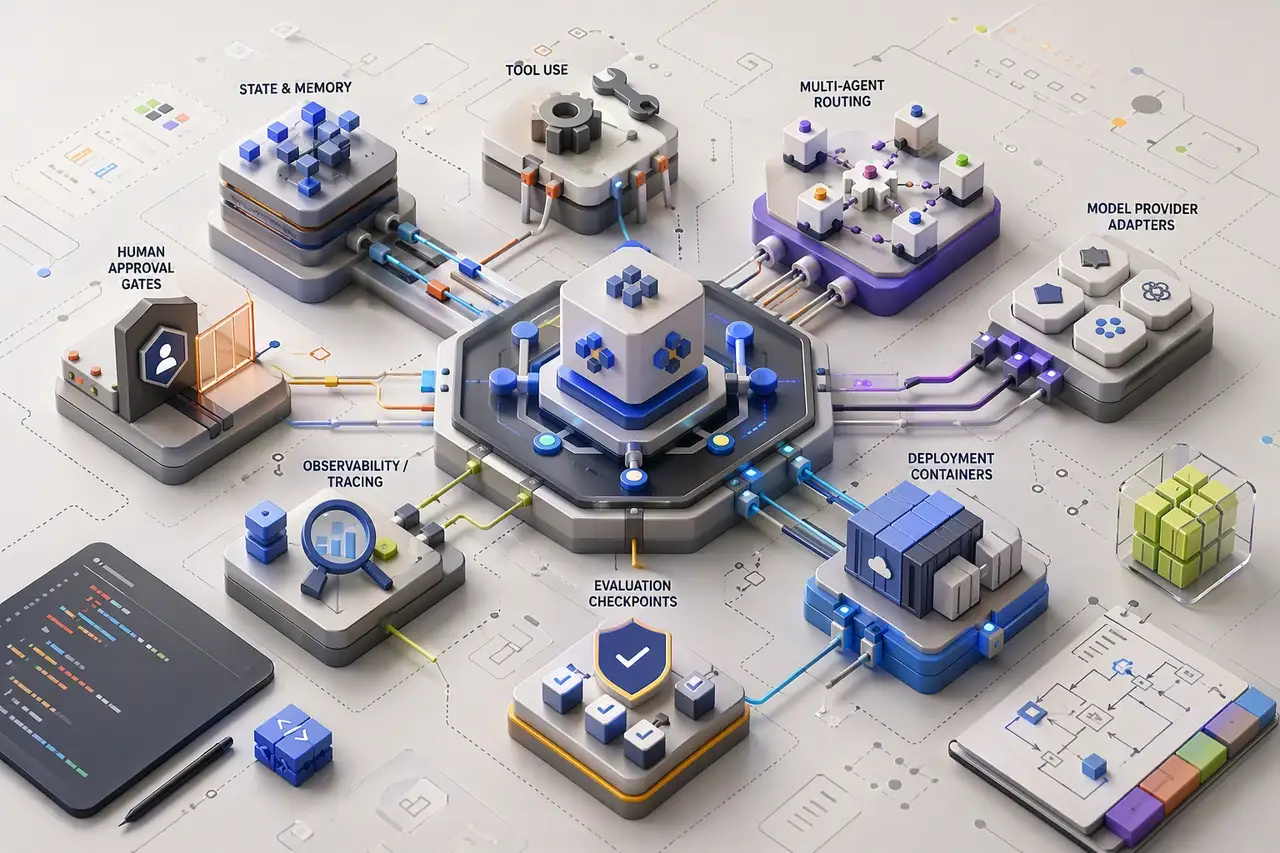
Choosing the best AI agent frameworks is no longer just about finding a library that can call an LLM and a few tools. Developers now need to evaluate orchestration, state management, memory, human approval, observability, evaluation, deployment, model portability, and long-term maintainability.
This guide focuses on code-first AI agent development frameworks and SDKs, not no-code agent builders. It compares leading options for developers building agentic workflows, multi-agent systems, tool-using assistants, RAG agents, coding agents, and production AI applications.
Last reviewed: July 2026. AI agent frameworks evolve quickly, so framework status, language support, licensing, documentation, and production features should be rechecked before implementation.
Key Takeaways
- The best AI agent framework depends on whether the project needs graph orchestration, multi-agent collaboration, provider-native agents, typed Python workflows, or RAG-heavy agentic applications.
- LangGraph is often a strong fit for stateful, long-running, controlled workflows, while CrewAI is commonly evaluated for role-based multi-agent collaboration.
- Provider-native SDKs such as OpenAI Agents SDK, Google ADK, Claude Agent SDK, and Microsoft Agent Framework may be useful when teams are already committed to those ecosystems.
- Production-readiness depends on more than tool calling. Teams should evaluate observability, evaluation, human approval, security controls, deployment options, and maintenance maturity.
- AI agent frameworks change quickly, so teams should verify documentation, licensing, version status, and community activity before choosing one.
How We Compared the Best AI Agent Frameworks
To identify the best AI agent frameworks, we evaluated each option across critical technical dimensions. Our comparison focuses on orchestration models, state management, tool integration, and multi-agent support. We also analyzed production-level capabilities like human-in-the-loop approval, observability, and deployment flexibility. Finally, we assessed developer experience by examining language support, licensing, documentation quality, and community maturity.
We also considered model portability, evaluation support, deployment maturity, documentation quality, licensing, and community activity. These criteria matter because a framework that works well in a prototype may still require additional engineering for production monitoring, testing, security, and long-term maintenance.
Quick Comparison of Code-First AI Agent Frameworks
Selecting the right framework depends on your team’s model stack and orchestration needs. This comparison table serves as a starting point, not a final recommendation, to help you evaluate core technical trade-offs.
| Framework | Best For | Key Strength | Main Trade-Off |
|---|---|---|---|
| LangGraph | Stateful, long-running, controlled agent workflows | Graph-based orchestration, persistence, human-in-the-loop, memory, and fault-tolerance | More architectural design effort than simpler agent SDKs |
| CrewAI | Role-based multi-agent workflows | Agent crews, tasks, collaboration patterns, and approachable multi-agent setup | May require extra engineering for strict production controls |
| Microsoft Agent Framework | Microsoft/Azure-oriented agent systems | Agents, tools, workflows, memory/persistence, providers, and hosting guidance | Best fit depends on Microsoft ecosystem alignment and current framework maturity |
| OpenAI Agents SDK | OpenAI-native agent apps | Agents, tools, handoffs, guardrails, sessions, and tracing | Less provider-neutral if the team wants broad model portability |
| Google ADK | Google/Gemini and enterprise cloud deployment | Tools, evaluation, deployment paths, and Google Cloud alignment | Strongest fit for Google Cloud/Gemini-oriented teams |
| Claude Agent SDK | Claude-oriented developer workflows | Built-in tools, permissions, hooks, sessions, and developer workflow support | More specialized toward Claude developer workflows |
| LlamaIndex Workflows | RAG-heavy and event-driven agentic workflows | Strong fit for data, retrieval, event-based workflows, and the LlamaIndex ecosystem | Less general-purpose than graph-first or multi-agent-first frameworks |
| PydanticAI | Typed Python agent application | Strong typing, Pydantic validation, structured outputs, and Python developer experience | Less focused on broad multi-agent orchestration out of the box |
LangGraph
LangGraph is often a strong fit for developers requiring graph-based orchestration with cyclical flows. It provides state checkpoints, persistence, and memory, which makes it useful for controlled workflows that need explicit steps and branching logic. Its flexibility can add complexity when teams are designing debugging and retry behavior. Best fit: stateful, long-running workflows and multi-step agent systems that need careful orchestration.
CrewAI
CrewAI is often a strong fit for role-based multi-agent workflows. Developers can define crews, agents, tasks, and tools, which is useful when work naturally splits into specialized responsibilities. Teams should still test how task handoffs behave under failure conditions. Best fit: collaborative agent systems with distinct roles and shared goals.
Microsoft Agent Framework
Microsoft Agent Framework is relevant for teams already working in Microsoft, Azure, Python, C#, or enterprise Microsoft environments. Current documentation should be reviewed carefully because Microsoft’s agent tooling has been evolving quickly, and teams migrating from AutoGen or Semantic Kernel should verify the official migration guidance before adopting it. Best fit: enterprise teams that want Microsoft-aligned agent tooling and deployment patterns.
OpenAI Agents SDK
OpenAI Agents SDK is often a strong fit for developers building OpenAI-native agent apps. It provides tools, handoffs, tracing, and session-oriented workflows for teams centered on OpenAI models and services. Provider alignment can simplify development, but it also narrows model portability. Best fit: teams building OpenAI-oriented assistants and workflows.
Google ADK
Google ADK is often a strong fit for teams deploying Gemini-based agents within Google Cloud. It supports multi-agent systems, evaluation, and multi-language development across Python, TypeScript, Go, and Java. Its strongest value tends to appear when the deployment stack is already tied to Google infrastructure. Best fit: Gemini-oriented teams that want cloud-native agent deployment patterns.
Claude Agent SDK
Claude Agent SDK is often a strong fit for developers building Claude-oriented developer workflows, including coding, repository, file, and command-based automation. Supporting Python and TypeScript, it includes built-in tools, permissions, hooks, sessions, and developer workflow support. Teams should be careful about granting broad file or command execution access. Best fit: controlled developer automation and file-based agent tasks.
LlamaIndex Workflows
LlamaIndex Workflows is often a strong fit for RAG-heavy and event-driven agentic workflows. By using events and steps, developers can construct retrieval pipelines and structured application flows around document and data sources. It is less focused on broad multi-agent orchestration out of the box. Best fit: retrieval-centered systems that need workflow control and data connectivity.
PydanticAI
PydanticAI is often a strong fit for developers building typed Python agent applications. It leverages Pydantic validation and type hints to enforce structured outputs, which is helpful when application logic depends on predictable schemas. Teams should still plan for testing and observability outside the framework itself. Best fit: Python-first applications that need structured outputs and validation.
Use-Case Decision Matrix: Which AI Agent Development Framework Should You Choose?
Selecting the right AI agent development framework depends on your team’s model stack and orchestration requirements. The following matrix maps specific technical use cases to strong framework candidates, helping you evaluate options based on your architectural needs.
| Use Case | Strong Candidates | Key Reasoning |
|---|---|---|
| Stateful business workflows | LangGraph | Graph-based orchestration is a strong fit for complex, cyclical flows. |
| Multi-agent collaboration | CrewAI | Role-based coordination may be better when managing structured agent teams. |
| OpenAI-native | OpenAI Agents SDK | Direct integration should be evaluated when building on OpenAI models. |
| Google Cloud | Google ADK | Native Gemini support is often a strong fit for GCP environments. |
| Claude coding | Claude Agent SDK | Built-in tools are suitable for autonomous file and code tasks. |
| RAG-heavy | LlamaIndex Workflows | Event-driven steps are ideal for complex data retrieval pipelines. |
| Typed Python | PydanticAI | Strict data validation is a strong fit for type-safe applications. |
| Enterprise production | Microsoft Agent Framework | Session persistence is suitable when requiring additional production controls. |
Note: Production readiness depends on architecture, monitoring, evaluation, and deployment practices. Verify current documentation before adoption.
Production Caveats Developers Should Consider
Deploying agents requires addressing failure modes that do not disappear just because the framework is well designed. Hallucinated tool calls, prompt injection, unsafe actions, and over-permissioned tools can create real operational and security risk. A framework can help organize agent behavior, but it does not make an AI agent safe, reliable, or production-ready by default.
Teams also need to account for poor state management, weak evaluation, lack of observability, cost and latency growth, multi-agent coordination failures, and model or version drift. Human approval is important for sensitive actions, especially when agents can access files, databases, browsers, or code execution environments. When budgeting for these safeguards, evaluating the overall AI agent development cost is a practical step.
Production systems should be designed with permissions, logging, rollback paths, and testing in mind before agents are allowed to make external changes.
Scopic Case Study: How Framework Selection Applies in a Real AI System
Spearphish is a relevant demonstration of the type of AI-powered customer interaction system where framework selection matters. Scopic developed an AI Conversation Solution for Spearphish using conversational AI and natural language processing to handle customer queries, automate conversations, support scalable conversation management, and integrate with business workflows. Our custom software development services team can help design similar systems around the right architecture.
This does not mean Spearphish was built with LangGraph, CrewAI, OpenAI Agents SDK, Google ADK, or any specific AI agent framework. Instead, it shows the kind of product context where agent architecture decisions become important.
For a Spearphish-like system, the framework decision would depend on whether the product needs long-running conversation state, tool access to CRM or campaign systems, human escalation, workflow approvals, multi-tenant permissions, response evaluation, and observability across customer interactions. A graph-first framework may be useful when conversation flows need strict control. A provider-native SDK may work when the model ecosystem is fixed. A RAG or workflow-centered framework may be useful when customer answers depend heavily on internal knowledge sources.
How to Evaluate an AI Agent Framework Before Building
Before committing to a framework, teams should run a proof of concept using the real workflow, not a toy example. The goal is to confirm whether the framework can represent the workflow cleanly, pause for human approval, persist and resume state, and restrict tool permissions without creating brittle logic.
Teams should also verify support for the target model providers, the target infrastructure, and the required deployment path. A practical evaluation should include observability, testing, and evaluation support, plus documentation that is detailed enough for real debugging. Licensing compatibility for commercial use matters just as much as technical features, and long-term adoption depends on whether the community is active enough to support maintenance, fixes, and ecosystem updates.
Best AI Agent Framework: Practical Recommendation
There is no single best AI agent framework for every development team. LangGraph is often a strong fit for stateful and controlled workflows. CrewAI can be useful for role-based multi-agent collaboration. OpenAI Agents SDK, Google ADK, Claude Agent SDK, and Microsoft Agent Framework are stronger when teams are aligned with those ecosystems. LlamaIndex Workflows is useful for RAG-heavy workflows, while PydanticAI is strong for typed Python applications.
Scopic can help teams evaluate AI agent architecture, select the right AI agent development framework, design tool and memory layers, integrate models and business systems, and build production-ready AI applications with the right controls for security, observability, and scalability. Learn more about AI development services.
Need help choosing the right AI agent framework?
Scopic can help evaluate your AI agent use case, architecture, model stack, integrations, deployment needs, and production requirements to determine the right framework and implementation approach.
Conclusion
The best AI agent frameworks are not interchangeable. Some are designed for graph-based orchestration, some for multi-agent collaboration, some for provider-native development, and others for typed Python applications or RAG-heavy workflows. The right choice depends on the agent’s task complexity, state requirements, tool access, human approval needs, deployment environment, model strategy, and long-term maintenance expectations.
Before choosing a framework, developers should test the real workflow, evaluate failure modes, verify observability and evaluation support, and confirm that the framework can scale beyond a prototype. For production systems, framework selection should be part of a broader architecture decision that includes security, monitoring, model governance, integration design, and user experience.
If your team is planning an AI agent project, Scopic can help assess the right framework, architecture, and development approach based on your product goals, technical stack, and production requirements. Discuss Your AI Agent Project.
FAQ
What is the best AI agent framework for developers?
The best AI agent framework depends on the workflow, language stack, and production requirements. LangGraph is often a strong fit for controlled workflows, CrewAI for role-based collaboration, and PydanticAI for typed Python applications. Teams should compare the framework against the real use case before deciding.
What is an AI agent development framework?
An AI agent development framework is a code-first library or SDK that helps developers build agents that can reason, use tools, manage state, and follow workflow logic. It is meant for application development, not just prompt experimentation.
What is the difference between an AI agent framework and a chatbot framework?
A chatbot framework usually focuses on conversational flows. An AI agent framework is broader and can manage tool use, state, approvals, branching logic, and multi-step workflows.
Which AI agent framework is best for production?
There is no universal production winner. The best choice depends on architecture, observability, evaluation, deployment, security, and human approval needs. Teams should validate production behavior with a real proof of concept.
Which AI agent framework is best for multi-agent systems?
CrewAI and LangGraph are common starting points for multi-agent systems. The better choice depends on whether the workflow is role-based, graph-based, or tightly controlled.
Which AI agent framework is best for RAG workflows?
LlamaIndex Workflows is a strong option for RAG-heavy applications. LangGraph can also work well when retrieval needs to be part of a larger controlled workflow.
Should developers choose a provider-native SDK or a model-agnostic framework?
It depends on how much portability the team needs. Provider-native SDKs can be a good fit when the organization is already committed to one ecosystem. Model-agnostic frameworks can be better when teams want more flexibility across providers.
How often should AI agent framework comparisons be updated?
Frequently. This space changes quickly, so teams should recheck documentation, version status, licensing, and community activity before making a final choice.
This guide was written by Scopic Team
Scopic provides quality and informative content, powered by our deep-rooted expertise in software development. Our team of content writers and experts have great knowledge in the latest software technologies, allowing them to break down even the most complex topics in the field. They also know how to tackle topics from a wide range of industries, capture their essence, and deliver valuable content across all digital platforms.