Table of Contents
Listen to article
Most businesses have added AI somewhere in their stack. A chatbot here, a recommendation engine there, maybe a summarization tool that saves the team an hour a week. That is useful. But it is not agentic.
The real shift happening right now is not about AI that responds. It is about AI that acts. Systems that can take a goal, break it into steps, make decisions along the way, use tools, recover from errors, and deliver an outcome, without a human guiding each move. That is what agentic AI architecture makes possible.
According to Gartner, nearly 33% of enterprise software applications will include agentic AI capabilities by 2028, up from less than 1% in 2024 (Gartner, 2025). The global agentic AI market is projected to grow from $5.25 billion in 2024 to $199 billion by 2034, a compound annual growth rate of 43.84% (Precedence Research, 2026). The window to get the architecture right, before it becomes urgent, is narrow.
This guide is written for technical leads, product owners, and business decision-makers who are evaluating what it actually takes to build autonomous AI systems. Businesses already investing in AI development services will find this a practical reference for making smarter architectural decisions early.
What Is Agentic AI Architecture?
Agentic AI architecture is the structural framework that allows AI agents to operate independently toward a defined goal. Rather than waiting for a human to issue each instruction, an agentic system perceives its environment, reasons through a problem, plans a sequence of actions, and executes them, adjusting course based on what happens along the way.
Think of it as the difference between a calculator and a project manager. A calculator does exactly what you tell it, every time. A project manager understands the goal, figures out the steps, delegates tasks, handles blockers, and reports back when something is done or wrong.
That capacity for goal-directed, self-correcting behavior is what makes an AI system agentic. The architecture is the engineering blueprint that makes that behavior reliable, scalable, and safe.
Agentic AI vs. Traditional AI Systems
The distinction between agentic and traditional AI is not just about capability. It is about how the system is designed to operate.
| Feature | Traditional Generative AI | Agentic AI |
| Instruction model | Rule-based or prompt-response | Goal-directed and self-directed |
| Adaptability | Fixed | Dynamic |
| Human involvement | Required at every step | At defined checkpoints only |
| Task scope | Narrow and single-step | Multi-step and cross-system |
| Error handling | Predefined fallback paths, exceptions, or manual review | Dynamic retries, rerouting, tool switching, or escalation based on context |
Traditional AI systems are built around a specific input producing a specific output. They are excellent at narrow, well-defined tasks. Agentic systems are built around objectives. They decide how to achieve those objectives based on context, available tools, and feedback from the environment.
If you want to understand how agentic AI sits in the broader AI landscape, our breakdown of agentic AI vs. generative AI covers the key distinctions in depth.
Why Agentic AI Architecture Matters for Businesses Right Now
The competitive pressure to move on this is real, but the more important reason to get serious about architecture now is compounding. Systems that are designed well from the start can be extended, improved, and scaled. Systems that are bolted together reactively become expensive to maintain and nearly impossible to scale without rebuilding.
Already, 79% of organizations report some level of agentic AI adoption, and 96% of IT leaders plan to expand their implementations in 2025 (Arcade, 2025). The businesses that move with a solid architectural foundation today will have a structural advantage over those that scramble to retrofit in two years.
Core Components of Agentic AI Architecture
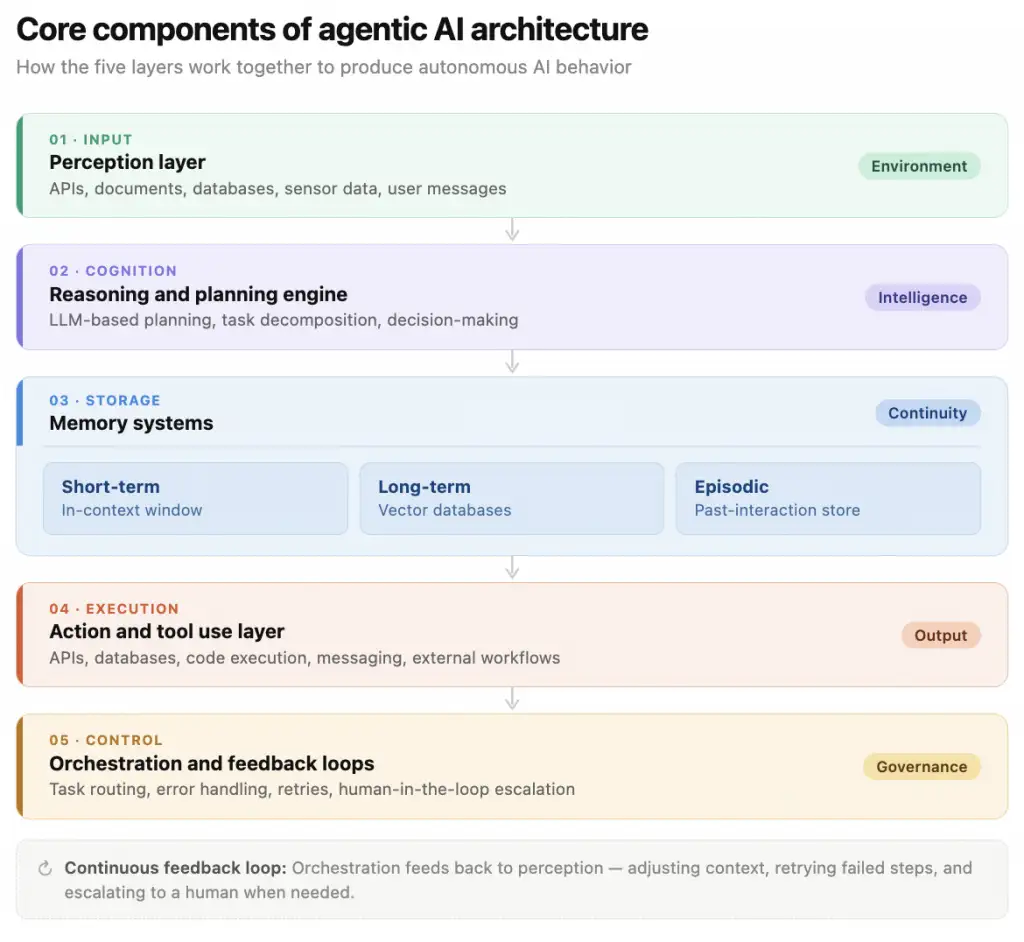
Most agentic AI systems, regardless of its complexity or the industry it operates in, are built on the same foundational layers. Understanding each one, and the role it plays, is essential for anyone making decisions about how these systems are designed and built.
This is what practitioners mean when they talk about AI agent architecture: a set of interconnected components that work together to produce autonomous behavior.
The Perception Layer
The perception layer is how an agent takes information about the world it is operating in. For a human, that means senses. For an AI agent, it means inputs: API responses, document contents, database records, user messages, sensor data, or any other structured or unstructured information the system needs to understand its current situation.
What makes the perception layer so critical is that everything downstream, the reasoning, the planning, the actions, depends on the quality of what the agent perceives. Garbage in, garbage out applies here more than anywhere else in the system.
When designing this layer, the key questions are: what data sources does the agent need access to, how reliably can it retrieve them, and what happens when a data source is unavailable or returns unexpected results?
The Reasoning and Planning Engine
Once an agent has perceived its environment, it needs to figure out what to do about it. That is the job of the reasoning and planning engine.
Modern agentic systems most commonly use LLM-based planning and reasoning patterns, where the model breaks a problem into steps, evaluates possible actions, and chooses a path forward before acting. This allows the agent to break complex goals into manageable sub-tasks, evaluate different approaches, and choose a path forward based on context rather than rigid rules.
Symbolic reasoning, which is more rule-based and deterministic, is still used in specific domains where precision matters more than flexibility. Many production systems combine both approaches depending on the type of decision being made.
This layer is also where most fragile systems break down. A poorly designed reasoning engine will make confident-looking decisions based on flawed logic. Building in validation, self-checking, and fallback behaviors at this layer pays dividends across the entire system.
Memory Systems
Memory is what separates a capable agent from a useful one. Without well-designed memory, an agent loses context between sessions, cannot learn from past interactions, and has to start from scratch every time.
There are three types of memory that matter in agentic AI system architecture:
- Short-term memory is the in-context window, what the agent can actively hold in mind during a single session or task. It is fast and directly accessible but limited in size.
- Long-term memory is typically implemented using vector databases and retrieval systems. The agent can store and retrieve information that does not fit in the context window, making it possible to handle knowledge-intensive tasks across sessions.
- Episodic memory allows agents to learn from what has happened before (Atlan, 2026). When a task fails or succeeds in a particular way, that experience can be stored and referenced in future runs, gradually improving performance over time.
For enterprise deployments, long-term memory design is often the most underestimated architectural decision. Getting it wrong means either bloated retrieval costs or agents that cannot access the information they need.
The Action and Tool Use Layer
This is where the agent stops thinking and starts doing. The action layer is how an agent interacts with systems outside itself: calling APIs, writing to databases, executing code, browsing the web, sending messages, or triggering workflows in other platforms.
In terms of architecture of intelligent agents in AI, this layer defines the agent’s real-world footprint. An agent that can only respond with text is limited. An agent that can call your CRM, update a ticket, send a notification, and log the outcome has tangible business value.
Security scoping is the most important design consideration here. Every tool the agent can use represents a potential attack surface or a source of unintended consequences. The principle of least privilege, giving the agent access only to what it needs for the specific task at hand, should be applied at this layer with discipline.
Orchestration and Feedback Loops
The orchestration layer is the connective tissue of the whole system. It manages how the other components interact: routing tasks to the right agents, managing the sequence of operations, handling errors, retrying failed steps, and validating outputs before they are acted on.
Think of it as the nervous system of the agentic architecture. Without it, you have capable components that do not know how to work together. With it, you have a system that can pursue a goal through a series of steps, recover from setbacks, and know when to escalate to a human.
Agentic-native frameworks such as LangGraph, LangChain, Google ADK, and AutoGen are commonly used at this layer for production deployments where reliability and observability matter.
Types of Agentic AI Architecture
Not every business problem needs the same type of agentic system. One of the most common and costly mistakes in early agentic AI projects is picking an architecture based on what sounds impressive rather than what fits the actual problem. Here is a breakdown of the main patterns and where each one genuinely makes sense.

Single-Agent Architecture
A single agent handles the entire task from start to finish. It perceives, reasons, acts, and reports back.
- Best for: Well-scoped, self-contained tasks with a clear start and end point. Document summarization, data extraction, single-workflow automation.
- Trade-off: Does not handle tasks that require parallelism, multiple specialized capabilities, or cross-system coordination well.

Multi-Agent Architecture
An orchestrator agent breaks the goal into sub-tasks and delegates them to specialized sub-agents. Each sub-agent handles its domain and reports results back to the orchestrator.
- Best for: Complex enterprise workflows where different parts of the task require different expertise. A customer onboarding system, for example, might have separate agents for identity verification, CRM updates, and welcome communications.
- Trade-off: Coordination overhead adds complexity. Failures in one sub-agent can cascade if the system is not designed to handle them gracefully.
It is worth noting that multi-agent designs are already the dominant pattern in production: 66.4% of current agentic AI implementations use multi-agent system designs, reflecting a market that has moved past single-agent experimentation (Landbase, 2026).

Hierarchical Agent Architecture
A layered structure with manager agents overseeing worker agents, and optionally reviewer agents checking outputs before they are passed up or acted on.
- Best for: Large-scale automation that needs human-like delegation, approval chains, or quality control at multiple stages.
- Trade-off: More complex to design and maintain. Requires clear role definitions at each layer or the system becomes hard to debug.

ReAct Architecture (Reason and Act)
ReAct agents operate through a step-by-step loop of Thought, Action, and Observation. Rather than generating an upfront plan, the agent reasons about what to do next, takes a single action, observes the result, and then reasons again before taking the next step. This continues until the goal is reached or an escalation condition is triggered.
- Best for: Dynamic, unpredictable environments where the agent needs to adapt its approach based on what is happening rather than following a fixed plan.
- Trade-off: Without well-designed iteration caps and timeout policies, ReAct systems can loop indefinitely on hard problems.
Which Architecture Fits Your Business? A Decision Framework
When choosing between these patterns, start with three questions: How complex is the task? How much does it span different systems or domains? And how much can your team realistically maintain in production?
Single-agent for simple, focused tasks. Multi-agent when complexity demands specialization. Hierarchical when scale and oversight both matter. ReAct when the environment is unpredictable. RAG-augmented whenever the task is knowledge-heavy.
Right-sizing the architecture to the problem is more valuable than picking the most sophisticated option available.
How to Evaluate and Choose the Right Agentic AI Architecture for Your Business
Choosing an agentic AI architecture is not a purely technical decision. The right choice depends on the specific problem, the state of your data and systems, and the capability of the team that will build and maintain it.
Start With the Workflow, Not the Technology
Before any architecture decision is made, map the workflow the agent will own. Define the starting trigger, the steps involved, the decision points, the tools needed, and the conditions under which a human should be brought in. If you cannot describe the workflow clearly without mentioning AI, the workflow is not ready to be automated.
The architecture should be chosen to fit the workflow, not the other way around.
Assess Your Data and Integration Readiness
An agentic AI system is only as capable as the data and systems it can access. Before committing to an architecture, audit: are your data sources clean and consistently structured? Are your APIs reliable and well-documented? Do your legacy systems expose the right interfaces for an agent to interact with?
If the answer to any of these is uncertain, that needs to be addressed before or alongside the agentic system build, not after. AI business integration planning is often where this groundwork gets laid, and getting it right before architecture decisions are finalized saves considerable rework later.
Match Architecture Complexity to Team Capability
A multi-agent hierarchical system running in production requires a team that can monitor it, debug it, and evolve it. If that capability does not exist internally, the architecture needs to be scoped accordingly, or external expertise needs to be brought in from the start.
Building a system that nobody can maintain is not a competitive advantage.
Plan for Scale from Day One
Pilots regularly work beautifully and then fall apart when volume increases. The architecture decisions that seem low-stakes in proof of concept, how memory is managed, how tool calls are queued, how errors are handled, and become high-stakes at production scale. Design with the eventual load in mind, even if you are not building to that scale yet. Understanding the full AI development life cycle before committing to an architecture helps teams anticipate these pressure points rather than discover them in production.
Agentic AI Architecture in Practice: Business Applications
Understanding agentic AI architecture conceptually is one thing. Seeing what it enables in real business contexts is where the value becomes concrete. By 2028, 68% of customer service interactions are projected to be handled by agentic AI systems (7T, 2025), and 71% of organizations currently deploying agents are doing so primarily for process automation (Arcade, 2025).
Customer Support and Service Automation
An agentic support system does not just retrieve FAQ answers. It reads the customer’s message, checks their account history, determines the issue type, and resolves or escalates based on confidence and context. A well-designed architecture handles:
- Triage and intent classification
- Account and order lookup via API
- Resolution drafting and sending
- Escalation to a human agent when confidence is low or the issue is high-stakes
Finance, Compliance, and Risk Monitoring
Agents in financial operations can monitor transaction streams for anomalies, cross-reference flagged activity against compliance rules, and generate audit-ready documentation, all without waiting for a human to initiate the process. The value is speed and consistency at a scale no human team can match.
Software Development and QA Workflows
Development teams are using agentic systems for:
- Automated code review and regression detection
- Test generation and execution
- Documentation drafting from code comments and commit history
- Dependency monitoring and vulnerability alerting
A well-architected agent can flag a regression, trace it to a recent commit, and open a ticket with supporting context before a developer has had their morning coffee. Beyond individual tasks, agentic systems are increasingly being designed to mirror the full engineering workflow: understanding a codebase, breaking down a feature request, writing and testing code, and iterating based on feedback, much like a developer would.
Healthcare Operations
In healthcare, agentic AI is reducing administrative burden in scheduling, prior authorization processing, and clinical documentation without touching clinical decision-making. The architecture here requires especially careful design around data access, compliance, and human oversight given the regulatory environment.
Supply Chain and Logistics
Agents monitoring supply chains can detect inventory shortfalls, identify alternative suppliers, trigger reorder workflows, and update logistics systems, all in response to conditions that would otherwise require hours of manual coordination.
Key Design Principles for a Strong Agentic AI System
The difference between an agentic system that works in a demo and one that works reliably in production comes down to how carefully it was designed. These principles separate well-built systems from fragile ones.
Modularity: Build Agents as Composable Units
Each agent or component in the system should be designed, so it can be modified, replaced, or scaled without requiring the rest of the system to be rebuilt. This is not just good engineering hygiene. It is what makes the system evolvable as requirements change.
Observability: Log Everything, Expose Nothing Sensitive
Every action an agent takes should be logged in a way that allows engineers to trace what happened, why it happened, and what the agent had access to at the time. At the same time, logs must be designed to keep PII and sensitive data out of plain sight. The goal is fully operational visibility without creating a compliance liability.
Human-in-the-Loop Checkpoints
Autonomy does not mean no oversight. Every agentic system should have clearly defined points where a human reviews or approves before the system proceeds, especially for high-stakes actions. These checkpoints should be triggered by context, not just time intervals.
Security and Access Scoping
This is one of the most frequently underdesigned aspects of agent architecture in AI projects. Every tool the agent can call, every database it can read from or write to, every API it can hit, should be scoped to the minimum access required for that specific task. Access that is not needed should not exist.
Error Handling and Graceful Degradation
When something goes wrong, the system needs a defined behavior for every failure mode. Does it retry? Does it try a different approach? Does it escalate to a human? Does it fail silently or loudly? Defining failure states with the same rigor as success states is a mark of a mature architecture.
Task Execution Guardrails
The agent’s interactions with external tools need to be constrained at the architectural level, not just at the prompt level. Rate limits, output validation, sandboxed execution environments, and strict data access controls all reduce the risk of unintended consequences from agent actions.
Common Challenges in Implementing Agentic AI Architecture
Even well-designed systems run into predictable problems. Knowing what to expect, and how to mitigate it, is part of building production-ready agentic systems. The failure rate is sobering: an analysis of enterprise AI agent deployments found that fewer than 1 in 8 agent initiatives successfully reach production, with scope creep and data quality issues accounting for 61% of all failures (Digital Applied, 2026). Gartner also warns that 40% of agentic AI projects will fail by 2027 due to cost overruns and poor risk controls (Introl, 2026). Understanding these failure patterns in advance is the most practical thing a team can do before starting.
Hallucination and Reasoning Errors
LLMs can produce confident-sounding outputs that are factually wrong or logically broken. In agentic systems, where one step feeds the next, a single reasoning error can cascade. Mitigation strategies include:
- Grounding the agent in verified, structured data sources
- Building output validation layers before actions are executed
- Defining human review triggers for high-stakes or low-confidence decisions
Runaway Agent Loops
Without proper controls, a ReAct-style agent can loop indefinitely on a problem it cannot solve. The fixes are straightforward but need to be built in from the start: timeout policies, maximum iteration counts, and escalation triggers that hand off to a human when the agent exceeds its defined boundaries.
Integration Complexity with Legacy Systems
Most enterprises do not have clean, modern APIs across all their systems. Agentic AI projects frequently hit friction at the integration layer. The practical approach is to use middleware adapters and to stage the rollout, starting with systems that are already well-exposed before tackling harder integrations.
Data Privacy and Regulatory Compliance
Agents that have broad data access create real compliance risk if that access is not carefully managed. Key requirements:
- Audit trails built in from day one, not retrofitted
- Data retention policies applied to agent memory the same as any other system
- In regulated industries, compliance requirements treated as a primary design constraint, not an afterthought
Is Your Business Ready for Agentic AI?
Before committing to a build, it is worth honestly answering a few questions that separate businesses that are ready from those that are not quite there yet. If you want a more structured way to work through this, our AI readiness guide covers the full assessment process.
- Do you have clearly defined, repeatable workflows an AI agent could own end-to-end? If a process is inconsistent or poorly documented even for human workers, it is not ready to be automated.
- Is your data infrastructure clean, accessible, and consistently structured? Agents need reliable data. If the data is messy, fixing that is a prerequisite, not a parallel track.
- Do you have observability tooling in place? You cannot manage what you cannot see. Monitoring autonomous actions in production is non-negotiable.
- Is there an internal alignment on acceptable automation risk? Someone in the organization needs to own the answer to “what happens when the agent makes a mistake.”
- Do you have the engineering capability to build, maintain, and evolve an agentic system? If not, that is not a reason to wait. It is a reason to find the right partner. McKinsey’s 2025 State of AI report found that fewer than 20% of AI pilots scale to production within 18 months (McKinsey, 2025). Businesses that work with experienced teams on AI development services avoid the expensive mistakes that come from building these systems without prior production experience.
Expertise in Agentic AI Architecture: What Good Looks Like in Practice
Understanding architecture principles is one thing. Applying them across real projects, with real constraints, is where the learning curve gets steep.
As an experienced custom AI development company, we build agentic systems designed to hold up in production, not just in demos. That means working through the messy reality of legacy integrations, scoping data access correctly from day one, and building the observability layer that lets teams trust what their agents are doing. Our AI consulting services guide clients through every stage, from architecture planning and feasibility through to deployment and iteration.
The experience that matters most in agentic AI work tends to be invisible in proposals. It shows up in decisions like:
- How error states are defined before the first line of code is written
- How data access is scoped at the tool level rather than the agent level
- How human-in-the-loop checkpoints are built into the workflow from the start, not patched in later
- How memory systems are designed to stay coherent across hundreds of sessions
- How the system is structured so it can be maintained and extended by the team that inherits it
For teams evaluating external partners for complex autonomous AI builds, our roundup of agentic AI development companies is a useful starting point for comparison. And if you are earlier in the process and thinking through budget and feasibility, our guide to AI development costs covers what to realistically plan for.
Below are a few examples of our AI development work:
- Akillion: We developed an AI virtual assistant that increases data management efficiency for a complex operational environment. Learn more
- OrthoSelect: We built AI-powered 3D modeling software that improves accuracy in orthodontic treatment planning. Learn more
- Codeaid: We developed an advanced AI coding test platform that streamlines technical recruitment processes. Learn more
Conclusion
Agentic AI architecture is not a trend to monitor. It is a foundational decision that will shape how competitive your AI capabilities are for years to come. Businesses that invest in getting the architecture right early, with modular components, proper observability, tight security scoping, and well-defined human oversight, will build systems that compound in value. Those that rush to ship something without structural rigor will find themselves rebuilding sooner than expected.
The ROI data supports the investment: companies report an average 171% return on agentic AI deployments, with 62% expecting returns above 100% (Landbase, 2026). But those returns depend almost entirely on the quality of the decisions made before the first line of code is written. The components are understood. The architecture patterns are well-established. What separates successful deployments from failed ones is execution discipline from the start.
If you are ready to design and build your first agentic system, or to bring structure to one that has grown without it, working with a team that has shipped these systems in production makes the path significantly shorter. Explore our AI agent development services to see how we approach agentic architecture from strategy through deployment.
Frequently Asked Questions
What is the difference between agentic AI and generative AI?
Generative AI produces outputs, text, images, code, in response to a prompt. It is reactive and stateless. Agentic AI takes that a step further: it uses generative models as a reasoning engine but wraps them in a system that can plan, take actions, use tools, and pursue a goal across multiple steps without waiting for a human to guide each one. Generative AI answers. Agentic AI acts.
Do you need an LLM to build an agentic AI system?
Not necessarily, but in practice most modern agentic systems use an LLM as the reasoning core. The LLM handles natural language understanding, task decomposition, and decision-making. Other components, the memory layer, tool integrations, orchestration logic, can be built independently of any specific model. The architecture is what holds the system together; the LLM is one component within it.
What is the hardest part of building an agentic AI system?
Most teams underestimate the integration layer. Connecting an agent to real business systems, CRMs, databases, legacy APIs, and ensuring it can act reliably on live data is where most projects stall. The reasoning and planning pieces are relatively well-supported by existing frameworks. The hard work is in making those capabilities useful within the specific constraints of your existing infrastructure.
How is agentic AI architecture different from traditional software architecture?
Traditional software follows deterministic paths: if X happens, do Y. Agentic architecture is goal-directed and adaptive. The system decides how to reach an objective based on context, not a fixed script. This means the design must account for uncertainty, failure modes, and dynamic decision-making in ways that traditional software engineering does not require.
Can small or mid-size businesses benefit from agentic AI, or is it only for large enterprises?
The architecture patterns scale down as well as up. A single-agent system handling a well-defined workflow, say, automating client onboarding or processing incoming requests, is well within reach for smaller teams. The key is scoping the first use case tightly, proving the value, and expanding from there. Starting with a multi-agent hierarchical system as a first project is where smaller businesses get into trouble.
How long does it typically take to build and deploy an agentic AI system?
A focused single-agent system with a clean integration layer can be built and deployed in six to twelve weeks. Multi-agent systems with complex orchestration, memory design, and multiple tool integrations typically take three to six months to reach a stable production state. The timeline is heavily dependent on the state of the underlying data and systems the agent needs to interact with.
What frameworks are commonly used to build agentic AI systems?
LangGraph, AutoGen, and CrewAI are among the most widely adopted frameworks for building multi-agent systems. LangChain remains popular for single-agent and RAG-augmented patterns. The framework choice should follow the architecture type, not the other way around. No framework compensates for a poorly designed underlying system.

About Agentic AI Architecture
This guide was authored by Meri Tiratsyan and reviewed by Viet-Anh Nguyen, Machine Learning Lead
at Scopic.
Scopic provides quality and informative content, powered by our deep-rooted expertise in software development. Our team of content writers and experts have great knowledge in the latest software technologies, allowing them to break down even the most complex topics in the field. They also know how to tackle topics from a wide range of industries, capture their essence, and deliver valuable content across all digital platforms.