
Table of Contents
Choosing between Angular, Vue, and React is not just a framework popularity contest. The right choice affects how your frontend team structures components, manages state, handles scaling, and maintains the application over time. For teams comparing Angular vs Vue as part of a broader React decision, the real question is which framework best fits your architecture, team skill set, and delivery model.
According to the Stack Overflow Developer Survey 2025, React is used by 46.9% of professional developers, followed by Angular at 19.8% and Vue.js at 18.4%. Those numbers show React’s hiring and ecosystem advantage, but they do not make React the automatic answer. Angular and Vue remain strong choices when their structure, learning curve, or maintainability model fits the product better.
Key Takeaways
- React for Ecosystem: Choose React for its larger talent pool, flexibility, reusable components, and custom frontend architecture.
- Angular for Structure: Opt for Angular when building large-scale enterprise applications that require the strongest built-in structure and built-in TypeScript support.
- Vue for Productivity: Select Vue to achieve balanced simplicity and rapid developer onboarding without sacrificing performance or scalability.
- Implementation Over Hype: Recognize that real-world performance depends on implementation quality rather than framework benchmarks.
- Context is King: Prioritize your team’s existing expertise and hiring pool over industry trends when evaluating Angular vs Vue or React.
React: The UI Library Approach
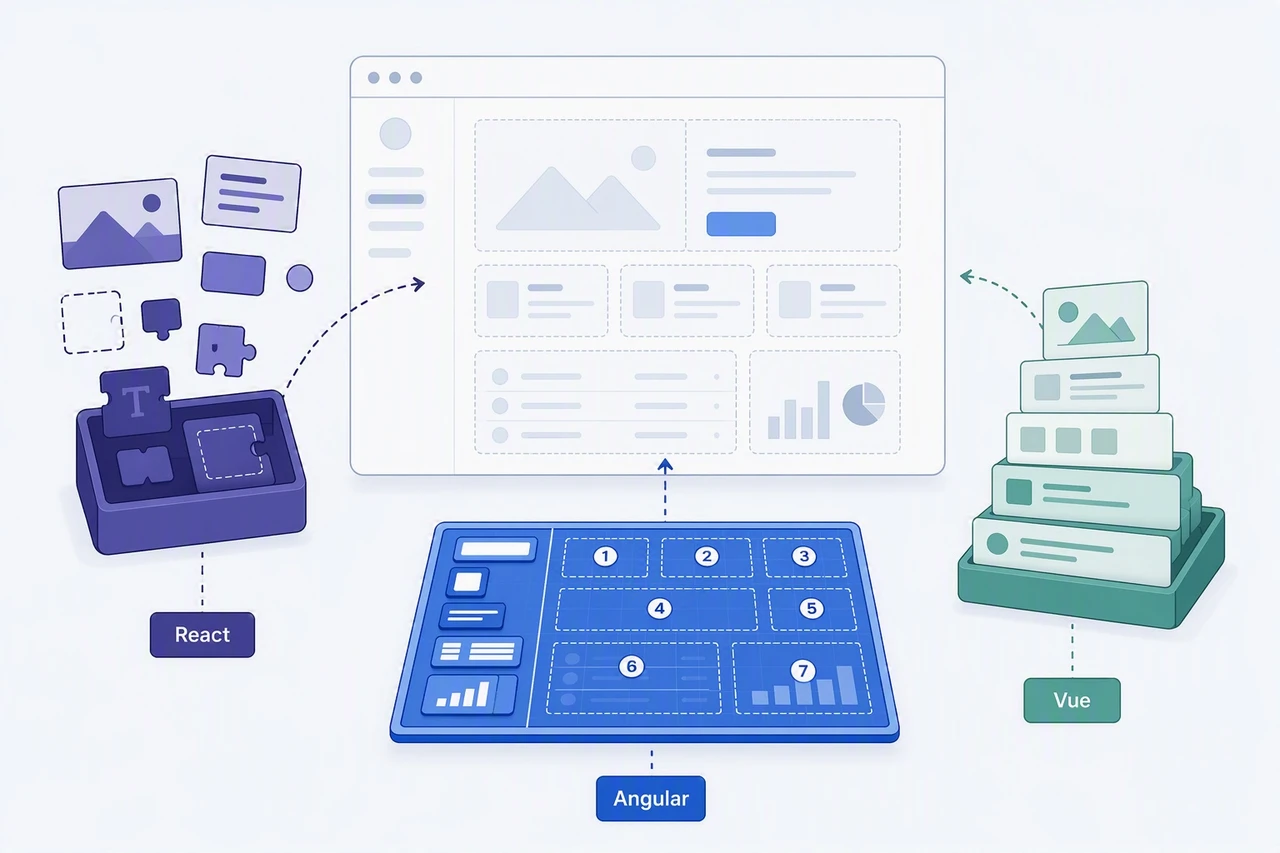
Unlike its competitors, React is fundamentally a UI library focused on components and rendering, not a complete framework. This composability grants engineering leads immense flexibility, but it requires teams to independently select and maintain tools for routing, state management, and data fetching. While this demands stronger project conventions to avoid architectural drift, it also unlocks a massive ecosystem.
- Works well for: Product teams that need ecosystem flexibility, reusable components, broad hiring options, and custom frontend architecture.
- Not ideal for: Teams without strong frontend governance, because routing, state management, data fetching, and project structure require separate decisions.
Angular: The Full Framework Approach
Unlike library-based alternatives, Angular provides the strongest built-in structure, with an opinionated, TypeScript-first environment. It provides built-in routing, form validation, an HTTP client, dependency injection, and a standardized CLI. This comprehensive architecture ensures strict consistency across large engineering teams, drastically reducing architectural decision fatigue. However, this robust structure demands a steeper onboarding curve and introduces more initial boilerplate.
- Works well for: Large teams, enterprise dashboards, regulated products, complex forms, and long-lived applications that benefit from strict conventions.
- Not ideal for: Small teams that need very fast prototyping and do not want to manage Angular’s initial learning curve.
Vue: The Progressive Framework
Vue.js bridges the gap between React’s flexibility and Angular’s rigid structure. As a progressive framework, it allows engineering leads to adopt features gradually, starting with a simple script tag or scaling up to a fully structured codebase. Its approachable HTML-based syntax and single-file components simplify developer onboarding while maintaining architectural consistency.
For many teams, the choice between them is less about popularity and more about whether they want Angular’s stricter conventions or Vue’s lighter progressive model.
- Works well for: Teams that want fast onboarding, approachable syntax, structured components, dashboards, admin tools, and gradual modernization.
- Not ideal for: Teams whose hiring strategy depends heavily on the largest possible frontend talent pool.
Architecture Philosophy: Flexibility vs Convention
When evaluating Angular vs Vue or React, the core decision centers on architectural control. React operates as a UI library, granting maximum flexibility but requiring teams to establish their own patterns for routing and state management. This freedom demands strict governance to prevent project fragmentation, particularly as codebases grow and team composition shifts over time.
Conversely, Angular enforces a highly structured, convention-driven environment. Its built-in patterns ensure consistency across large engineering teams, though the framework can feel constraining for rapid prototyping or experimental feature development.
Performance Comparison
When evaluating Vue.js vs Angular alongside React, performance depends heavily on implementation choices rather than framework selection alone. According to the JS Framework Benchmark (2025), absolute performance metrics vary significantly by version, application structure, and optimization strategies employed by development teams.
| Performance Factor | React | Angular | Vue | Practical Takeaway |
|---|---|---|---|---|
| Initial load | Lightweight core, but app size depends on added libraries | Larger framework baseline, reduced with tree-shaking and lazy loading | Lightweight core and progressive adoption | Vue and React often start lighter, while Angular needs careful bundle planning. |
| Rendering efficiency | Strong with memoization and component discipline | Strong with optimized change detection and OnPush patterns | Strong reactive updates with less manual tuning | All three can perform well when implemented correctly. |
| Optimization flexibility | High, but developer-controlled | High, but framework-pattern-driven | High, with simpler defaults | React offers the most manual control, Angular the most structure, Vue the easiest defaults. |
| Large-app scalability | Strong with architecture rules | Strong because conventions are built in | Strong with governance and official libraries | Angular reduces drift by default, while React and Vue need internal standards. |
| Complex interfaces | Strong for custom UI systems | Strong for complex enterprise workflows | Strong for dashboards and admin interfaces | Choose based on team skill and interface complexity, not benchmark scores alone. |
Rather than declaring an absolute winner, teams must focus on developer-controlled tuning, including code splitting, lazy loading, and component-level optimization, to improve performance for complex UI behavior. In practice, a well-architected Angular application can outperform a poorly structured React codebase, and vice versa. The framework choice establishes baseline capabilities, but execution quality determines real-world user experience.
Ecosystem, Tooling, and Community
The choice between React vs Vue vs Angular often hinges on ecosystem maturity and tooling integration. React offers the largest package ecosystem, with thousands of community-maintained libraries covering everything from animation to form validation. However, this abundance requires developers to independently assemble and maintain their build pipelines, introducing potential version conflicts and upgrade complexity.
Conversely, Angular provides a highly integrated, batteries-included tooling suite with robust CLI standards, ensuring consistency across large engineering teams. The Angular CLI handles scaffolding, testing, building, and deployment with minimal configuration, reducing setup time and standardizing project structure.
Vue strikes a balance, offering an approachable, progressive ecosystem with excellent developer experience and official companion libraries. The Vue CLI and Vite build tool provide modern development workflows without the overwhelming choice paralysis that can accompany React’s ecosystem. Choosing among them requires balancing React’s vast library options against Angular’s structured tooling or Vue’s streamlined developer experience.
Learning Curve and Developer Experience
Evaluating Angular vs Vue requires analyzing how quickly a team can achieve productive velocity. Vue offers an accessible entry point, allowing developers familiar with standard HTML, CSS, and JavaScript to build features with minimal framework-specific knowledge. Its single-file component structure keeps templates, logic, and styles co-located, reducing cognitive overhead during feature development.
React introduces a moderate learning curve, requiring developers to master JSX syntax and make critical ecosystem decisions for state management and routing early in the project lifecycle.
Conversely, Angular presents the steepest initial hurdle. Its TypeScript-first architecture demands immediate mastery of dependency injection, decorators, and RxJS patterns for reactive programming. However, this upfront investment establishes strict framework conventions that streamline long-term maintenance across large engineering teams.
Enterprise vs Startup Fit
Choosing between Vue.js vs Angular or React depends heavily on your organizational structure and product goals. Angular is often a strong fit for large-scale enterprise environments with complex domain models and regulated systems, where its strict, convention-driven architecture ensures long-term consistency across massive teams spanning multiple geographies and business units.
Conversely, React is highly suited for fast-growing startups and scale-ups that prioritize ecosystem flexibility and require a broad hiring pool to scale operations quickly. Its component-based architecture supports rapid experimentation and feature iteration, making it ideal for organizations validating product-market fit or pivoting based on user feedback.
For teams focusing on rapid iteration, internal dashboards, and admin tools, Vue offers a strong developer experience. It streamlines custom web application development by reducing onboarding friction and maintaining simplicity without sacrificing architectural cleanliness.
Migration and Long-Term Maintainability
Evaluating React vs Vue vs Angular for long-term maintainability requires balancing architectural freedom against technical debt accumulation. React offers immense flexibility, but without strict internal governance and code review standards, projects risk becoming highly inconsistent over time as different developers introduce competing patterns for state management, component structure, and data fetching.
Conversely, Angular’s rigid conventions ensure long-term stability and easier developer transitions, though teams must accept deep framework lock-in and commit to regular, structured version upgrades. Angular’s opinionated nature means that refactoring efforts typically follow well-documented migration paths, reducing uncertainty during major version transitions.
Vue provides a balanced, progressive path, allowing teams to introduce it gradually into legacy systems through incremental adoption. This makes Vue particularly attractive for organizations modernizing monolithic applications or transitioning from jQuery-based frontends. However, like React, Vue still demands strong architectural rules and coding standards to prevent fragmentation as the application scales. Ultimately, the choice depends on whether your team prefers enforcing custom standards through code review and documentation, or adopting built-in framework constraints that limit architectural flexibility but guarantee consistency.
Decision Matrix: Angular vs Vue vs React
Choosing between Angular, Vue, and React requires balancing immediate delivery speed with long-term architectural stability. To guide your selection, this practical decision matrix maps common project scenarios to the most suitable frontend technology based on organizational context and technical requirements.
| Project Requirement | Choose React When | Choose Angular When | Choose Vue When | Best Fit |
|---|---|---|---|---|
| Startup MVP | You need fast hiring, reusable components, and ecosystem flexibility | Your team already knows Angular and needs strict structure from day one | You need fast onboarding and simple iteration | React or Vue |
| Enterprise dashboard | You have strong frontend architects and need custom UI flexibility | You need strict conventions, forms, routing, and long-term consistency | You need a lighter dashboard architecture with good developer experience | Angular |
| Regulated system | You can enforce standards through internal governance | Compliance, auditability, and consistency across teams matter most | The app is smaller but still needs maintainable structure | Angular |
| Design-heavy interface | You need highly customized component behavior | You need consistency across large feature teams | You need fast UI iteration with approachable syntax | React or Vue |
| Large team | You have strong internal architecture standards | You want the framework to enforce conventions | You have a mid-sized team with clear governance | Angular |
| Legacy migration | You want to introduce UI components gradually | You are ready for a more structured rewrite | You need progressive adoption with lower friction | Vue or React |
| Complex forms | You can assemble form tooling intentionally | Built-in form patterns are a major requirement | Forms are important but not the whole architecture | Angular |
| Hiring flexibility | Talent availability is the main constraint | You already have Angular specialists | You prioritize smaller, productive teams | React |
| Long-term maintainability | You can maintain conventions through reviews and documentation | You want framework-enforced consistency | You want balance between structure and simplicity | Context-dependent |
While these recommendations serve as a reliable baseline, your team’s existing expertise and specific product requirements should ultimately guide the final architectural decision. Organizations with strong React experience may achieve better outcomes with React even for enterprise applications, while teams with Angular expertise can successfully build rapid prototypes despite the framework’s reputation for complexity.
FAQ: Angular vs Vue vs React
Is Angular better than Vue?
Angular is not universally better than Vue, but it suits different organizational needs. Angular provides a highly structured, TypeScript-first environment with built-in routing and state management, making it ideal for large enterprise teams managing complex domain models. Conversely, Vue offers a progressive, flexible architecture that simplifies developer onboarding and accelerates rapid prototyping, making it effective for organizations prioritizing developer velocity and maintainable code without extensive boilerplate.
Is Vue easier than Angular?
Yes, Vue is generally easier to learn than Angular. While Angular requires mastering TypeScript, RxJS, and strict architectural patterns upfront, Vue uses a gentle learning curve with standard HTML, CSS, and JavaScript. According to the Stack Overflow Developer Survey 2025, Vue was used by 14.1% of those learning to code compared to Angular’s 9.5%, reflecting Vue’s lower barrier to entry and more intuitive component model.
Is React better than Angular and Vue?
React is not inherently better, but it offers the largest ecosystem and hiring pool. Because React is a UI library rather than a full framework, developers must choose their own routing and state management tools, which appeals to teams wanting custom architectures. Conversely, Angular and Vue provide more out-of-the-box structure, reducing decision fatigue but limiting architectural flexibility for teams with specific technical requirements.
Which is better for enterprise apps, Angular, React, or Vue?
Angular is often preferred for large-scale enterprise applications due to its strict conventions and built-in features, which ensure consistency across massive teams and facilitate compliance in regulated industries. However, React is highly effective for enterprises that value a vast ecosystem and need to scale hiring rapidly, while Vue is excellent for organizations seeking maintainable, structured applications without steep training overhead or extensive onboarding programs.
Should startups choose React, Vue, or Angular?
Startups prioritizing rapid MVP delivery and easy hiring typically choose React or Vue. React offers a large talent pool and extensive third-party libraries, while Vue allows small teams to build and iterate quickly without complex setup or architectural decisions. Angular is rarely chosen for early-stage startups unless the team already possesses deep Angular expertise or requires its rigid architecture from day one to support anticipated rapid scaling.
Conclusion
Selecting the right framework depends on your team’s skill set, architectural needs, product complexity, and long-term maintainability goals. Rather than seeking a universal winner, evaluate how each option aligns with your engineering velocity, hiring constraints, and product roadmap. React excels when ecosystem flexibility and hiring speed are paramount. Angular provides the strongest built-in structure for large teams managing complex, regulated systems. Vue offers a strong developer experience that balances simplicity with architectural consistency.
Scopic case study: WorldClinic Website redesign
Scopic’s WorldClinic Website redesign shows how frontend decisions affect usability, information architecture, and web performance in practice. The project required a clearer digital experience for communicating healthcare membership options, navigation paths, and service information. This makes it a relevant example of why frontend framework decisions should not be made in isolation. The right framework needs to support the user experience, content structure, long-term maintainability, and the team responsible for extending the product.
Scopic’s frontend development team works across modern web application architectures and can help you evaluate React, Angular, and Vue in the context of your product, team, and migration goals. If you are choosing a framework for a new product or planning a frontend migration, contact us to discuss the right path for your requirements.
This guide was written by Scopic Team
Scopic provides quality and informative content, powered by our deep-rooted expertise in software development. Our team of content writers and experts have great knowledge in the latest software technologies, allowing them to break down even the most complex topics in the field. They also know how to tackle topics from a wide range of industries, capture their essence, and deliver valuable content across all digital platforms.