



Select Page

MLOps in Medical Imaging

A MedCAD Case Study

This real-world MLOps use case for medical imaging demonstrates how Scopic transformed MedCAD's machine learning workflow with end-to-end MLOps infrastructure, enabling faster model iterations and complete traceability for healthcare compliance.

The Results at a Glance

MLOps Impact 

50-60% Faster Delivery

with automated retraining and validation workflows

Minutes to Onboard

new engineers with reproducible environments 

Complete Traceability

linking every model to its exact dataset, code, and configuration 

Regulatory Ready

with full audit trails for healthcare QA and compliance

Services Performed

MLOps
Infrastructure Development

Machine Learning and Pipeline Automation

Cloud Architecture (AWS)

The Context

Scaling AI in Healthcare

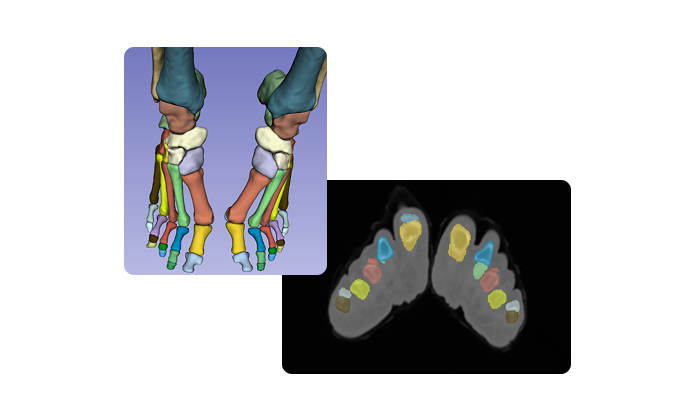
MedCAD provides medical imaging solutions that automatically segment 3D bone structures from DICOM scans. The system uses multiple machine learning models working together to extract high quality bone surfaces from complex medical data, enabling faster and more reliable orthopedic modeling.

The challenge was clear: as new datasets arrived in phases and labeling rules evolved over time, maintaining consistency, quality, and reproducibility across model versions became increasingly difficult. This created critical pain points that threatened the project’s scalability. 

Version Control Issues

Version Control Issues

No systematic way to track which dataset or model produced which result, making debugging and auditing nearly impossible.

Long Iteration Cycles

Long Iteration Cycles

Manual retraining after each client data update involved repetitive steps, significantly increasing delivery time and reducing team productivity.

Limited Traceability

Limited Traceability

Auditing model performance or data lineage for regulatory purposes was extremely difficult, creating potential compliance risks.

Frequent Data Updates

Frequent Data Updates

New CT scans and updated annotations required constant model retraining without clear
version management.
MedCAD needed a systematic approach that could handle evolving datasets, maintain complete traceability, and accelerate the development cycle while meeting healthcare industry standards, making this an ideal MLOps case study
for medical imaging. 

The Solution

End-to-End MLOps Framework

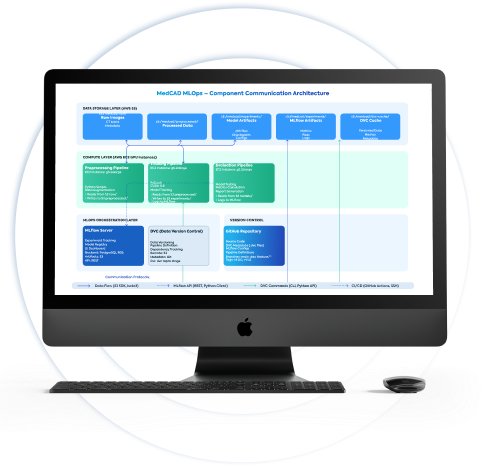
Scopic designed and implemented a comprehensive MLOps system that streamlines the entire machine learning model lifecycle, from data ingestion to deployment and monitoring. This framework brought engineering discipline to the data science workflow. 

Here’s how it works: 

Reproducible Environment Management
Using the uv package manager, we standardized all development and training environments to create lightweight, reproducible setups. This ensures every engineer and training node uses identical dependency versions, a critical factor for consistent results across the team. 
Data Version Control
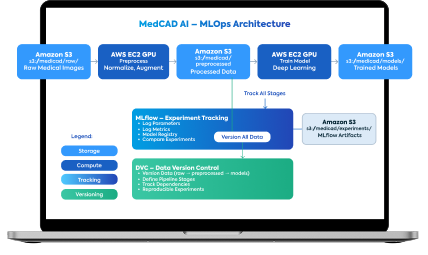
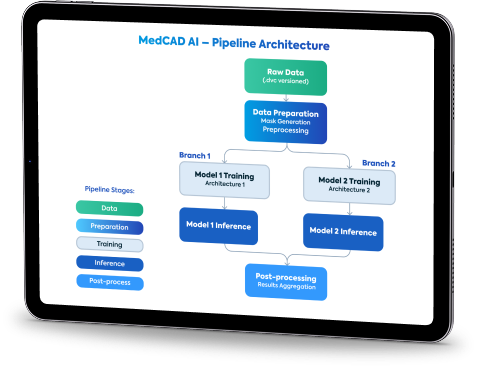
We integrated DVC (Data Version Control) to make data and model management work like Git workflows. Each model is linked to the exact dataset, code, and configuration used during training. Historical experiments can be re-run using DVC's version tracking, and multi-model pipelines were consolidated under a unified workflow.
Automated Experiment Tracking
We established centralized experiment tracking where all training runs automatically log parameters (learning rates, data augmentations), Git commit IDs, dataset versions, and evaluation metrics. Each run generates an automated report comparing new model performance against previous baselines.
Cloud Infrastructure Training
Training runs locally during experimentation and scales to AWS EC2 GPU instances for full model training, with all data and models stored on S3 with Git remotes for centralized access.
Standardized Workflow
We codified the entire workflow into six repeatable steps: ingest new DICOM datasets and apply preprocessing, version the data and update DVC records, recreate training environments via locked configurations, train models with GPU acceleration, evaluate automatically using standardized metrics, and promote only the best performing models to production.

Technology Stack

The system leverages modern MLOps tools and infrastructure:

Environment Management
uv package manager for reproducible dependencies
Data Versioning
Data Version Control for data and model tracking

Experiment
Tracking

MLFlow with DVC logs for metadata and metrics
Cloud Infrastructure
AWS EC2 GPU instances
for scalable training
Storage
Remotes for centralized artifacts
Pipeline Orchestration
pipelines for end-to-end workflow automation 

Why It Worked

MLOps Success Factors

The solution’s success can be attributed to three key factors:
check.svg
Automation First​

Eliminated manual steps throughout the training and evaluation process.​

check.svg
Reproducibility by Design​

Every result can be recreated from version controlled components.​

check.svg
Practical Scalability​

Balanced automation and transparency without complexity.​

A Workflow Transformed

Before and After MLOps

Before

Manual retraining after each data update
No clear version control for datasets or models

Difficult to reproduce past results

Limited visibility into model lineage

After

Automated retraining and validation workflows
Complete traceability for every model
and dataset

One command reproduction of any
historical experiment

Clear audit trail for regulatory compliance

The Future of MLOps in Healthcare

MedCAD's success demonstrates the critical importance of MLOps infrastructure for healthcare AI projects. By bringing engineering discipline to machine learning workflows, development teams can focus on model improvement rather than manual coordination.  

Now It's Your Turn:

Implement MLOps for Your AI Project 

his MLOps case study for medical imaging demonstrates how Scopic can transform your machine learning workflow with tailored MLOps infrastructure. If you’re ready to explore what’s possible for your company, schedule a free consultation today.

Frequently Asked Questions 

What is MLOps?
MLOps (Machine Learning Operations) applies DevOps principles to machine learning, creating systematic workflows for training, versioning, deploying, and monitoring ML models at scale. 
Why is MLOps important for healthcare AI?
Healthcare requires complete traceability and reproducibility for regulatory compliance. MLOps provides the audit trails and version control necessary to meet these standards while accelerating development.
How long does MLOps implementation take?
Implementation timeline varies based on project complexity, but teams typically see benefits within weeks as automated workflows begin reducing manual overhead.