Table of Contents
Listen to article
There are over 1.13 billion websites online, but most of them do not receive substantial traffic. The reason, surprisingly, is no bad code, but things like vague requirements, the wrong partner model, misaligned expectations, or scope creep.
That’s where web development consulting comes in. A good web development consultant doesn’t just tell you what to build — they help you figure out whether to build it, how to structure it, and who should build it.
In this blog, we’ll cover the services, the partner types, the pricing structures, the right questions to ask, and the red flags that experienced buyers learn to spot — sometimes too late.
What is Web Development Consulting?
Web development consulting is a professional service in which experienced website development experts help organizations plan, evaluate, and optimize their web presence and digital infrastructure. Rather than building directly, a web development consultancy focuses on the strategic and technical advisory layer:
Typically, website development consultants cover various critical areas such as:
- Strategy creation: Consultants analyze your current website and develop a tailored plan to enhance its design, functionality, and overall user experience.
- UX design consultation: They provide guidance on how to create intuitive, user-centric interfaces that improve engagement, conversion rates, and customer satisfaction.
- Navigational paths and engagement: By analyzing how users interact with your site, consultants refine navigation paths to ensure visitors can easily find what they’re looking for.
- Prototyping and planning: Web development consultants assist with creating wireframes to map out your website’s structure before development, ensuring all stakeholders are aligned on the vision.
- Website audits and performance evaluation: They conduct thorough audits to identify areas for improvement in website speed, security, and UX.
- Technology stack recommendations: Based on your business goals and budget, consultants recommend the best technologies to support your website’s development and scalability. They also identify opportunities to reduce costs by recommending more efficient or cost-effective solutions, ensuring you’re not overpaying for unnecessary tools.
- Scaling for future growth: As your business grows, so must your website. Consultants ensure your website can handle increased traffic and additional features without compromising performance.
- Website monitoring: Consultants integrate powerful monitoring tools like Google Analytics and Pendo to track user behavior, performance, and engagement in real-time. This allows them to identify key trends and suggest site improvements.
Web Developer vs. Web Development Consultant: What’s the Difference?
A web developer executes — they write code, build features, and implement designs according to a defined specification. A web design or web development consultant operates upstream of that work.
Here’s a more detailed breakdown of the two:
|
|
Web Developer |
Web Development Consultant |
|
Primary focus |
Building and coding |
Strategy, planning, and guidance |
|
Engagement start |
Once requirements are defined |
Before requirements are defined |
|
Output |
Working software |
Roadmaps, audits, recommendations, architecture plans |
|
Best suited for |
Execution |
Decision-making and de-risking |
|
Can overlap? |
Yes — many consultants also build |
Yes — many developers also advise |
In practice, many engagements combine both. A web development consultation might begin with strategy and architecture, then transition into hands-on implementation with the same partner.
Do You Need Consulting or Full Development?
This is the question most buyers skip — and it costs them later. Before engaging any website development consultants, it’s worth being honest about where you actually are in the process.
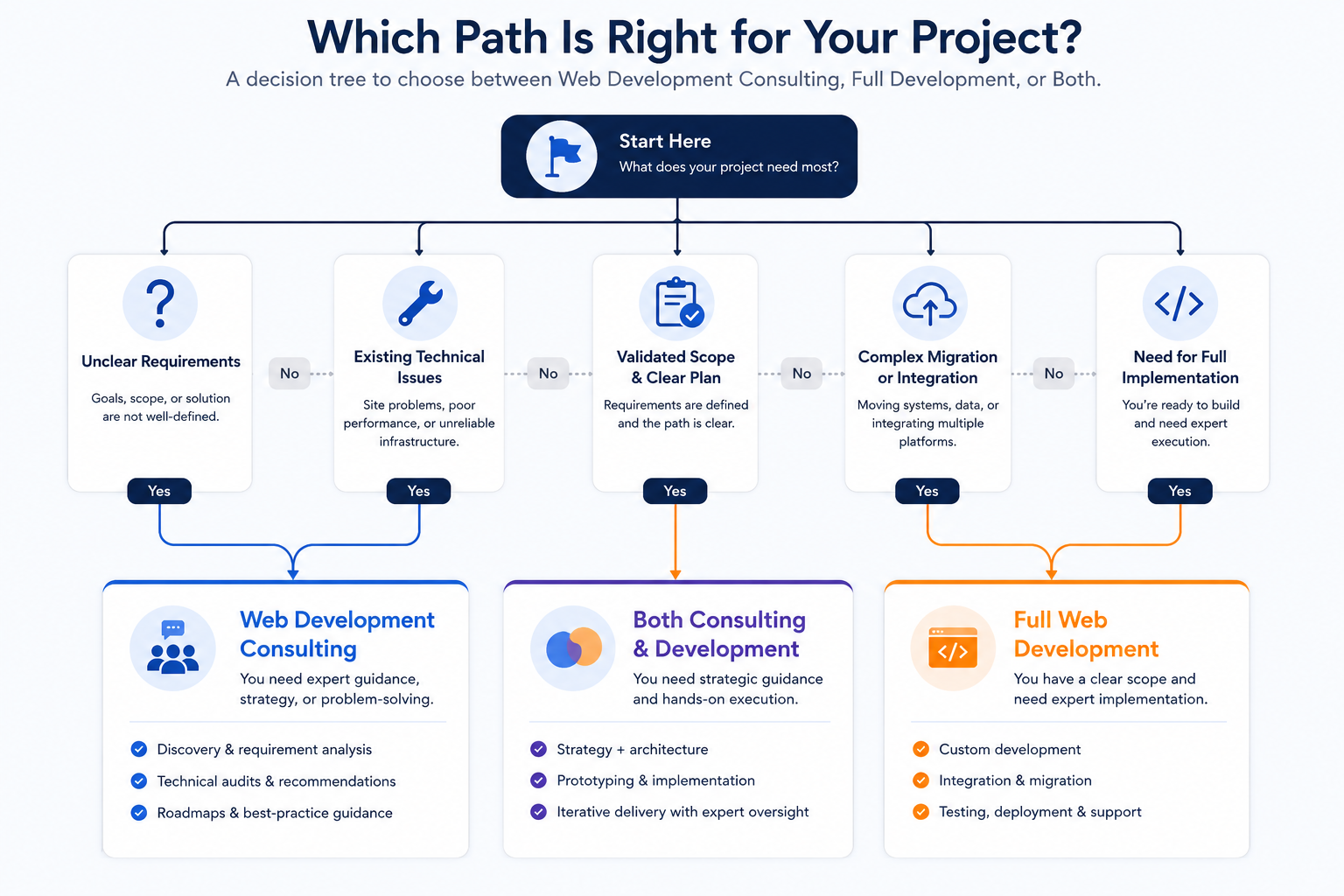
You likely need consulting if:
- You have a business problem but aren’t sure what kind of web solution addresses it
- You’re evaluating whether to rebuild, migrate, or redesign an existing site
- You’ve had a failed or over-budget development project and want an independent audit
- You’re preparing requirements to send to development vendors and want them validated first
- You need a technical roadmap before you can get budget approval internally
You likely need full development (with or without consulting) if:
- Your requirements are well-defined and validated
- You’ve done discovery and know what you want to build
- You have existing infrastructure and just need execution capacity
You likely need both if:
- You’re embarking on a large or complex project (migration, platform rebuild, e-commerce launch, digital transformation)
- You want the same partner to advise and build, which reduces handoff risk and keeps accountability in one place
At Scopic, we offer web development services that span both consulting and implementation — so clients don’t have to manage two separate vendor relationships for a single project.
8 Key Benefits of Hiring a Web Development Consultant
Choosing the right web development company can be the key to building and maintaining a high-performing, future-proof website. Let’s dive into the core benefits of working with a consultant:

Expert Guidance and Strategic Insights
A skilled web development consultant brings pattern recognition built across dozens of projects. They’ve seen what works and what doesn’t across different industries, platforms, and team structures — and can apply that experience to your specific situation without the trial-and-error cost.

Cost Efficiency and Long-Term Savings
The most expensive part of most web projects isn’t the hourly rate — it’s rework. Consulting upfront reduces rework by catching architectural problems, scope ambiguities, and technical risks before they become expensive to fix. According to IBM’s Systems Sciences Institute, bugs found in the requirements phase cost roughly 15x less to fix than those found post-launch.

Customized Solutions Tailored to Your Business
No two businesses are alike, and neither should their websites be. Consultants provide bespoke web development solutions tailored to your specific needs, industry, and audience. Whether you’re focused on e-commerce or lead generation, they design strategies that help you meet your goals more effectively.

Scalability
The top web development companies design with growth in mind. That means architecture decisions — hosting, database structure, API design, third-party integrations — that won’t need to be fully rebuilt when your user base doubles or your feature set expands.

SEO and Performance Optimization
Technical SEO is increasingly built into the development process, not bolted on afterward. A web design consultant with performance expertise can flag issues like Core Web Vitals problems, crawlability gaps, and page speed bottlenecks during planning — before they’re hard-coded into your build.

Security and Compliance
Web security is non-negotiable. For businesses operating in regulated industries — healthcare (HIPAA), finance (PCI-DSS), or markets with privacy regulation (GDPR, CCPA) — compliance requirements need to be built into the architecture from the start. This helps you avoid retrofitting security measures at significant cost later.

Unbiased, Objective Advice
Sometimes, internal teams can lose sight of the bigger picture. Web development consultants offer external, unbiased advice and a fresh perspective. This can help avoid internal roadblocks and make the decision-making process faster and more effective.

Faster Time to Market
By bringing in a web development consultant, you can expedite the development process. As consultants have the experience and tools needed to streamline your workflows, you can reduce bottlenecks and enable faster project completion.
Types of Web Development Consulting Services
Web development consulting isn’t a single service — it’s a category that covers a range of engagement types. Understanding which type you need is the first step toward finding the right partner.

Website Strategy & Development Consulting
From initial concept to launch, consultants can guide you through the entire website strategy-building process, so your site not only looks great but also performs optimally to meet business goals.
For example, they can use their deep industry knowledge to ensure your website incorporates the latest trends and best practices. Additionally, they can help you align your website’s look and feel with your brand’s identity and values.

Technical Audits and Optimization
Technical audits are one of the highest-ROI forms of website development consulting available. A web development service partner steps in to assess the site’s performance, security, SEO, code quality, and accessibility, providing a prioritized list of issues to address.
They also offer expertise in web analytics, using data to fine-tune your website to user and business needs. Such audits are useful both as standalone engagements and as precursors to larger redesign or migration projects.

Website Redesign and Migration Consulting
When it comes to a website overhaul or moving to a new platform, the process can be complex and daunting.
A web design consultant can simplify this process so you can keep your online operations running without any interruptions. They usually focus on improving site aesthetics, user flow, and functionality while minimizing downtime, all to ensure that your brand maintains its online visibility and credibility during these critical phases.

Website Marketing Consulting Services
Website marketing consulting can boost your site’s visibility through SEO services, data-driven marketing, and content marketing strategies. Consultants work towards aligning your organic and paid marketing efforts to improve performance and ROI.
Whether it’s optimizing for search engines or crafting high-quality content, these experts provide a comprehensive strategy to help your site attract and retain visitors, enhancing your digital presence.

UX/UI Design Consulting
Custom UI/UX design services ensure that your website is not only visually appealing but also functional and easy to navigate.
Consultants work closely with you to understand the needs and behaviors of your audience so they can create intuitive, conversion-oriented designs.
The end result? You provide a smoother user experience and turn more visitors into loyal customers.

Hosting and Server Management
Reliable hosting and efficient server management can significantly improve your website’s performance, uptime, and security.
Consultants provide guidance on the right hosting solution for you based on your business size, traffic needs, and growth plans. They also identify opportunities for price reduction by recommending more cost-effective cloud or non-cloud services without sacrificing quality.
From ensuring data backups to managing server configurations, they keep your site running smoothly, handling potential technical hiccups before they become serious issues.

AI Integration on Websites
AI web development consulting has grown significantly as a service category. Website development experts in this area help businesses evaluate where AI features — chatbots, personalization engines, search, recommendation systems — add genuine value versus where they add complexity without meaningful return. This includes vendor evaluation, integration architecture, and implementation oversight.
Choosing the Right Partner Type
One of the most overlooked decisions in website development consulting is the partner model itself. Not all consulting relationships are structured the same way, and the right choice depends on your project scope, internal capabilities, and risk tolerance.
Consultant vs. Agency vs. Freelancer vs. In-House Team
|
Partner Type |
Best For |
Watch Out For |
|
Independent consultant |
Focused advisory, audits, strategy |
Limited execution capacity; single point of failure |
|
Boutique agency |
Small-to-mid projects; design + consulting |
May lack depth for complex technical work |
|
Full-service agency / firm |
Large projects; consulting + implementation |
Higher cost; can be process-heavy |
|
Freelancer |
Narrow, well-defined tasks |
Availability, accountability, scalability |
|
In-house team |
Ongoing, high-volume product work |
High overhead; slow to scale |
Onshore vs. Nearshore vs. Offshore
Geography affects more than hourly rates — it affects communication quality, timezone overlap, and cultural alignment.
|
Model |
Hourly Range (2026) |
Key Consideration |
|
Onshore (US/Canada/W. Europe) |
$100–$200+/hr |
Easiest communication; highest cost |
|
Nearshore (E. Europe, Latin America) |
$40–$90/hr |
Strong quality-to-cost ratio; workable timezone overlap |
|
Offshore (South/SE Asia) |
$20–$55/hr |
Significant cost savings; timezone and communication overhead |
The best value for most mid-market web projects sits in nearshore models — particularly Eastern Europe and Latin America — where technical quality is high, time zone overlap is manageable, and rates are competitive. Scopic operates with a global remote team structured to give clients the benefits of nearshore delivery without sacrificing communication quality.
Web Development Consulting Pricing: What to Expect
Web development consulting pricing depends heavily on the type of engagement, partner location, and scope. Here’s a practical breakdown by engagement type:
|
Engagement Type |
Typical Price Range |
What’s Included |
|
One-time technical audit |
$1,000 – $10,000 |
Code, performance, SEO, or security review with report |
|
Strategy / discovery engagement |
$3,000 – $20,000 |
Requirements definition, roadmap, architecture recommendations |
|
Redesign / migration consulting |
$5,000 – $30,000+ |
Migration planning, content mapping, SEO continuity, oversight |
|
Ongoing retainer |
$2,000 – $15,000/month |
Continuous advisory, technical oversight, optimization |
|
Consulting + implementation |
Project-based; varies widely |
End-to-end: strategy through custom web application development and launch |
Key Pricing Variables
- Consultant vs. firm: Independent consultants typically charge lower day rates but have limited bandwidth and no backup capacity. Firms carry higher overhead but offer team depth and continuity.
- Scope clarity: Vague briefs lead to inflated estimates. A well-documented scope reduces padding built in for unknowns.
- Location: Onshore website development consultants command the highest rates. Nearshore and offshore firms can deliver comparable quality at significantly lower cost for many project types.
How to Choose a Web Development Consulting Firm
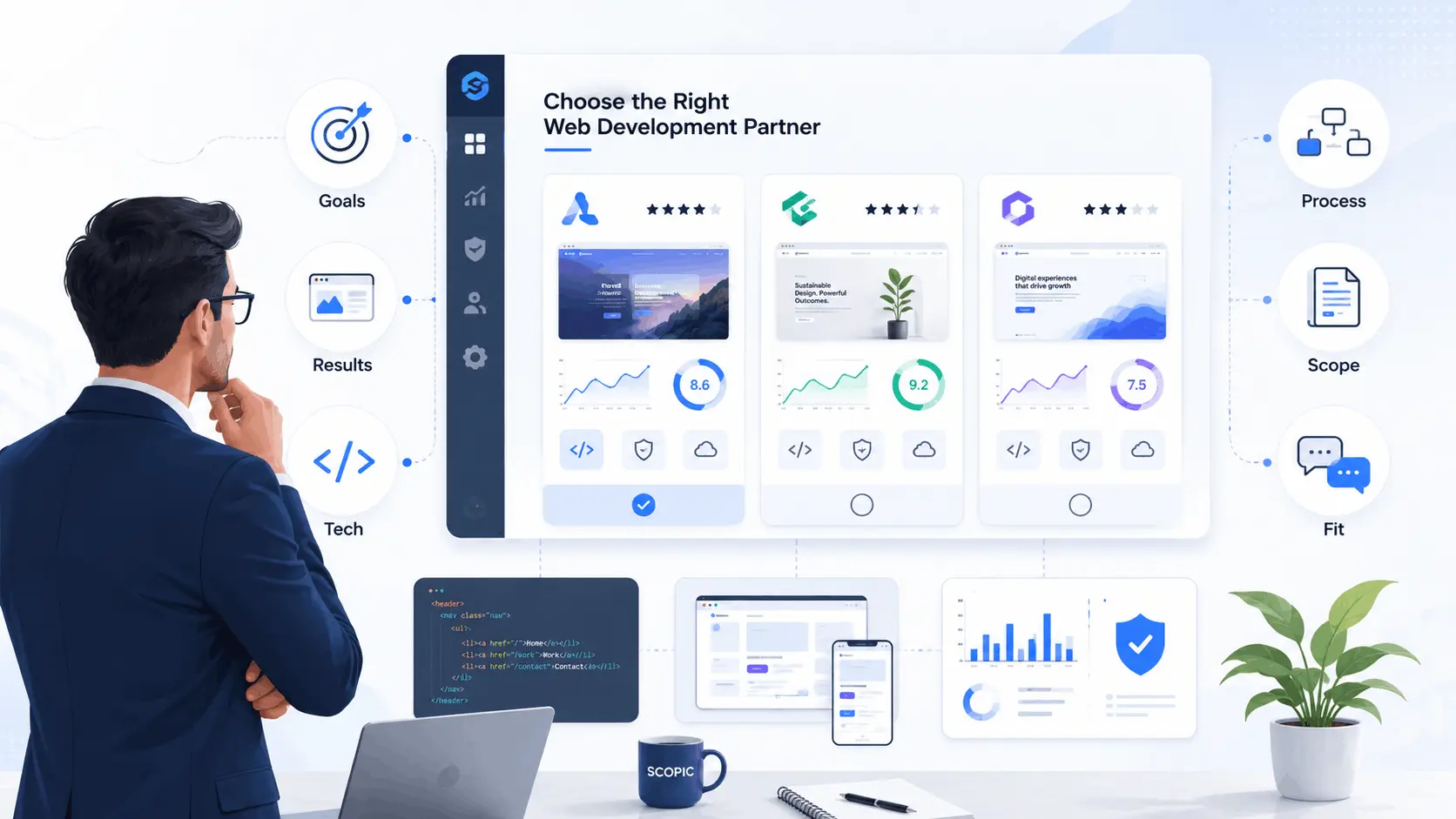
Finding the right web development consultant is critical for ensuring the success of your website project. Use the following checklist to make the right choice:
Step 1: Define Your Goals and Constraints Before You Talk to Anyone
Before engaging any website development consultants, be clear on:
- What business problem are you solving?
- What does success look like — and how will you measure it?
- What’s your realistic budget range?
- What’s your timeline, and how flexible is it?
- Do you have internal technical resources, or will the consultant need to operate independently?
Arriving at a first conversation with these answers narrows the field dramatically and makes every subsequent evaluation more meaningful.
Step 2: Evaluate Their Portfolio for Outcomes, Not Just Design
Pretty screenshots don’t tell you whether a project delivered business results. When reviewing a web development consulting firm’s portfolio, ask:
- What was the business problem they were solving?
- What metrics improved after the engagement?
- Have they worked with businesses of similar size, complexity, or industry?
- Can they provide references or case studies with concrete outcomes?
Step 3: Assess Technical Depth
A web development consultancy needs to be technically credible — not just strategically articulate. Probe their understanding of:
- Your specific technology stack or platform
- Security and compliance requirements relevant to your industry
- Performance and scalability architecture
- Integration patterns for your existing tools and systems
Step 4: Understand Their Process
How a web development consultant runs their process tells you a lot about the engagement you’ll have. Questions worth asking:
- How do you typically run discovery?
- How do you handle scope changes?
- What’s your communication cadence, and who’s my day-to-day contact?
- Do you work in sprints or milestones?
- How do you handle disagreements on technical direction?
Step 5: Compare Proposals on Scope, Not Just Price
When reviewing proposals from website development consultants, price is rarely the most important variable. Compare:
- How clearly is the scope defined?
- What are the specific deliverables and their formats?
- What’s included in the engagement vs. what triggers additional billing?
- Who owns the IP for any work produced?
- What are the exit terms if the relationship isn’t working?
Step 6: Check Cultural Fit and Communication Style
For longer engagements especially, the quality of the working relationship matters. Signs of a good fit: they ask as many questions as they answer, they push back thoughtfully rather than agreeing with everything, and they communicate in plain language rather than jargon.
For guidance on the broader partner selection process, see our related guide: How to Choose a Web Development Company.
Red Flags to Watch For
Here are the most common warning signs when evaluating web development consulting partners:
- No discovery process. A consultant who sends a proposal without understanding your business has templated their answer to a question they haven’t asked yet.
- Vague deliverables. If the proposal lists “consulting” without specifying what you’ll receive, you don’t have a scope — you have an invoice waiting to happen.
- Pressure to sign quickly. Urgency tactics in consulting sales are a signal that the partner’s interests aren’t aligned with yours.
- No relevant portfolio or references. Experience in your industry, tech stack, or project type is not optional — it’s what makes advice contextually valid.
- They agree with everything. A good web design consultant should challenge your assumptions, not validate them wholesale. If they never push back, they’re not doing their job.
- Unclear IP and ownership terms. Any deliverable — code, designs, documentation, roadmaps — should come with clear ownership terms in the contract.
- No talk of post-launch. If a consultant never raises what happens after the project ends, they’re thinking about the engagement, not your outcome.
Post-Launch Support and Long-Term Fit
One of the clearest differentiators between website development consultants who think transactionally and those who think strategically is how they talk about what comes after launch.
For most web projects, launch isn’t the finish line — it’s the beginning of a new phase. That phase typically involves:
- Performance monitoring and optimization: Tracking Core Web Vitals, conversion rates, error rates, and infrastructure costs against baselines
- Ongoing technical support: Bug fixes, security patches, dependency updates, and platform compatibility
- Iterative improvements: Using post-launch data (analytics, user feedback, heatmaps) to prioritize the next round of enhancements
- Infrastructure scaling: Adjusting hosting and cloud configuration as traffic grows
When evaluating a web development consultancy, ask explicitly: What does your post-launch engagement look like? The quality of their answer will tell you whether they’re thinking about your long-term success or just the contract in front of them.
At Scopic, our software development consulting services include ongoing advisory and support structures — because we’ve found that the most valuable client relationships start at launch, not end there.
Conclusion
Web development consulting is worth the investment when it’s matched to the right problem and delivered by the right partner.
Use this guide as a checklist. Define your goals before you talk to anyone. Compare proposals on scope and deliverables, not just price. Ask about post-launch. Look for partners who push back on your assumptions rather than validate them. And take red flags seriously — they’re rarely isolated.
If you’re ready to discuss your project with website development experts who can advise and build, contact the Scopic team for a consultation.
FAQs
How do I know if I need consulting or full development?
You likely need web development consulting if you’re still figuring out what to build, want an independent audit of an existing site, or need technical guidance before committing to a development budget.
You probably need full development if your requirements are already well-defined. Many projects benefit from both — a consulting phase that defines scope, followed by implementation with the same or a different partner.
How much does web development consulting cost?
Costs vary significantly by engagement type and partner location. A one-time technical audit typically runs $1,000–$10,000. A strategy or discovery engagement ranges from $3,000–$20,000. Ongoing advisory retainers typically cost $2,000–$15,000 per month.
Website development consultants based in Eastern Europe or Latin America often offer comparable quality at significantly lower rates than onshore firms.
What should I ask before hiring a web development consultant?
Key questions include:
- What does your discovery process look like?
- Can you share case studies with measurable outcomes?
- How do you handle scope changes?
- Who owns deliverables and IP?
- What does post-launch support look like?
- What’s your experience with my industry or technology stack?
What are the types of web development consulting services?
Web development consulting services include:
- Strategic planning and roadmap development
- Technical audits
- Website redesign and migration consulting
- UX/UI design consulting
- Performance and SEO optimization
- Hosting and infrastructure advisory
- Marketing technology consulting
- AI strategy consulting
How long does a web development consulting engagement typically take?
Scope varies widely. A focused technical audit can be completed in 1–2 weeks. A strategy and discovery engagement typically takes 2–6 weeks. Ongoing advisory retainers run monthly with no fixed end date. Consulting-plus-implementation engagements follow the project timeline of the build itself.

About Creating Web Development Consulting Guide
This guide was authored by Vesselina Lezginov, and reviewed by Alan Omarov, Solutions Architect at Scopic.
Scopic provides quality and informative content, powered by our deep-rooted expertise in software development. Our team of content writers and experts have great knowledge in the latest software technologies, allowing them to break down even the most complex topics in the field. They also know how to tackle topics from a wide range of industries, capture their essence, and deliver valuable content across all digital platforms.