Table of Contents
TL;DR: Healthcare software modernization involves upgrading existing systems to improve security, interoperability, and performance. For healthcare organizations, the challenge is making these improvements without disrupting patient care or critical workflows. A phased approach that includes system assessments, parallel testing, and careful planning helps minimize downtime, maintain compliance, and support a smooth transition.
According to the CHIME 2026 Leadership Pulse Survey, nearly 90% of healthcare leaders believe operations must modernize to manage growing clinical, regulatory, and financial demands.
The gap between what clinicians expect from software and what their systems can actually deliver is no longer a back-office inconvenience. It is a patient safety and compliance risk that grows more expensive every year it goes unaddressed.
The problem most modernization guidance ignores is the one constraint that actually governs hospital and clinic IT decisions: the system cannot go down while patients are being treated.
This guide outlines a phased approach to healthcare software modernization, one that protects uptime, data integrity, and staff adoption at every step.
What Healthcare Software Modernization Really Means
Healthcare software modernization is the process of upgrading, re-architecting, or replatforming existing software to improve security, interoperability, and scalability.
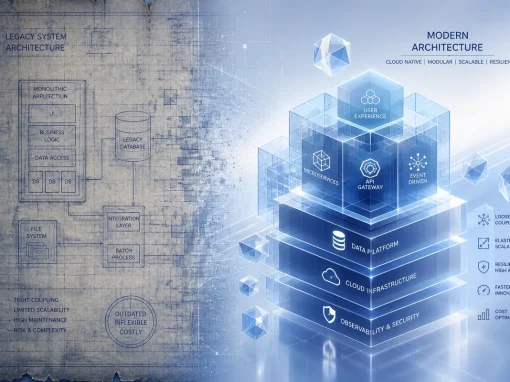
Modernization of healthcare systems is not synonymous with ripping out an EHR or practice management platform and starting from zero. In most cases, it means selectively replacing the parts of a system that can no longer meet clinical, regulatory, or performance demands while preserving the workflows and integrations that already work.
This distinction matters because healthcare leaders increasingly see legacy application modernization as unavoidable rather than optional. At the same time, the sheer number of organizations still running on legacy information systems shows how slowly that belief has translated into action.
The Hidden Cost of Staying on Legacy Systems
Maintaining legacy systems carries direct financial, clinical, and operational costs that compound the longer modernization is delayed.
Legacy systems quietly tax healthcare organizations well beyond the headline maintenance bill. The costs show up across several categories:
- Security exposure. Legacy systems were rarely built with modern security controls such as encrypted data stores, granular access logging, or automated threat detection, making them a frequent target for breaches and driving up the cost of any incident that occurs.
- Downtime losses. Every minute a core clinical system like an EHR platform is down, healthcare organizations risk losing revenue through canceled appointments, halted billing, and stalled care delivery.
- Clinical workforce burden. Manual workarounds forced by outdated software push clinicians toward administrative data entry rather than direct patient care, a burden that contributes to burnout and reduces the time available for diagnosis and treatment.
- Delayed care delivery. Unplanned outages and system slowdowns can delay lab results and other diagnostic information, directly slowing the decisions clinicians need to make.
Together, these costs make the business case for modernization difficult to ignore, even before accounting for compliance exposure.
Info box: According to a 2025 U.S. Government Accountability Office report, 11 critical federal legacy IT systems cost approximately $754 million annually to operate and maintain, highlighting the significant financial burden of outdated technology.
Types of Legacy Healthcare Systems
Legacy systems in healthcare take several recognizable forms, each presenting unique application modernization challenges:
- On-premises EHR and EMR platforms built on older client-server architectures that lack modern APIs, making integration with newer tools slow and expensive.
- Legacy practice management and billing systems, often customized over years with undocumented logic that is difficult to replicate in a new platform.
- Older laboratory information systems (LIS) that rely on proprietary or point-to-point HL7 v2 interfaces rather than standardized, reusable connections.
- Legacy PACS and imaging systems with limited cloud storage support and restrictive vendor lock-in on image formats and viewers.
- Homegrown scheduling and referral tools built internally years ago, frequently maintained by a single staff member or long-departed vendor.
- Pharmacy management systems running on outdated databases that struggle to support real-time drug interaction checks against current formularies.
- Fax- and paper-dependent referral workflows that persist alongside digital systems because no one has modernized the handoff between departments or outside providers.
Each of these systems typically touches several others, which is why modernization efforts that treat them in isolation tend to break something unexpected.
A single outdated LIS, for example, might feed data into billing, the EHR, and a public health reporting workflow simultaneously. Mapping these dependencies before planning any change is the foundation of a modernization effort that does not disrupt care.
A Phased Roadmap for Healthcare Application Modernization
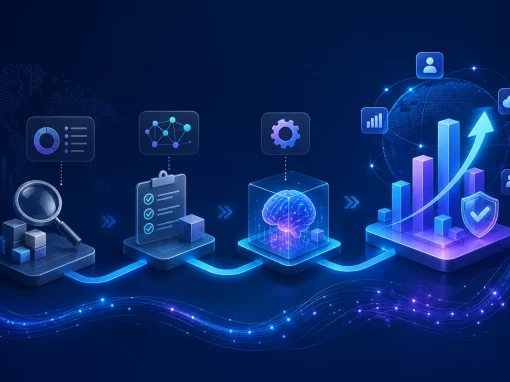
Application modernization in healthcare succeeds when it is approached as a sequence of controlled, reversible steps rather than a single cutover event. Each phase should be validated before the next begins, with the legacy system remaining available as a fallback until the new component has proven itself under real clinical load.
The three phases below (assessment, parallel run, and validated cutover) form the core of that roadmap.

Assess and Map Every System Before Touching Code
Before any migration work begins, catalog every integration point in the environment, from lab interfaces and billing systems to scheduling feeds and public health reporting connections. A modernization plan built on an incomplete system map is the most common cause of mid-project surprises.
Part of this assessment involves classifying workflows by risk. Safety-critical functions such as medication ordering and clinical alerting need the most conservative sequencing and the most rigorous testing, while lower-risk functions like reporting dashboards and appointment scheduling can tolerate a faster pace of change.
Involving clinicians and frontline staff at this stage is essential. Formal system diagrams rarely capture the manual workarounds staff have built to compensate for legacy limitations, and those undocumented processes are exactly what cause disruption if they are not accounted for in the migration plan.
Run Old and New Systems in Parallel
The Strangler Fig pattern is the standard technique for modernizing healthcare systems without downtime. Specific functions are routed to the new system while the legacy platform continues handling everything else, allowing the new component to be proven under live conditions without removing the safety net clinicians depend on.
During this transition window, data should be mirrored between the old and new systems so clinicians never lose access to records regardless of which platform they happen to be using. This also gives technical teams a live comparison point to confirm the new system is processing data correctly before it takes on more responsibility.
Rather than rolling a new component out organization-wide immediately, pilot it with a single department or clinic location first. A contained pilot surfaces integration issues, workflow friction, and training gaps while the blast radius of any problem remains small and manageable.
Validate, Train, and Cut Over
The final phase combines structured validation with a planned, reversible cutover. Functional, security, and interoperability testing should run against real, de-identified patient data, not synthetic test records, since synthetic data rarely surfaces the edge cases that actual clinical data contains.
Cutovers themselves should be scheduled during the lowest-patient-volume windows available, with the legacy system kept on standby for a defined rollback period in case unexpected issues emerge once the new system is handling live traffic at full scale.
Technical readiness alone does not guarantee a successful go-live. Pairing the cutover with mandatory staff training sessions is non-negotiable, since adoption failure on the part of clinical and administrative staff is just as damaging to patient care as a technical failure in the system itself.
Interoperability and Compliance Are Non-Negotiable
A modernization project fails if it does not account for data exchange standards and regulatory requirements from the outset. Interoperability and compliance cannot be bolted on after a new system is already built; they have to shape the architecture from day one.
The scale of current data sharing makes this clear. In 2024, 83% of hospitals shared EHR data with third-party technologies for at least one clinical purpose, though much of that exchange still happens through non-standardized methods rather than structured APIs.
The consequences show up downstream: 39% of hospitals reported difficulty exchanging information across different vendors’ platforms in 2025, a gap that directly traces back to systems not built around interoperability standards.
Public health reporting is another workflow modernization projects commonly overlook, yet 81% of U.S. hospitals reported at least one challenge with electronic public health reporting in 2024.
Regulatory targets also keep moving, meaning that compliance requirements should evolve on an ongoing basis, which means modernization plans need built-in flexibility rather than a fixed, one-time compliance checklist.
| Requirement | What It Covers | Why It Matters for Modernization |
| HL7 / FHIR | Standardized clinical and administrative data exchange between systems | Prevents costly custom point-to-point interfaces that break with every vendor update |
| HIPAA Security Rule | Encryption, access controls, audit logging for protected health information | Legacy systems rarely meet modern encryption and logging standards by default |
| ONC Interoperability Standards Advisory | Federal guidance on data exchange standards, updated periodically | Keeps modernization architecture aligned with shifting federal expectations |
| Electronic public health reporting | Automated reporting of reportable conditions to public health agencies | Frequently missed in modernization scoping, yet still a hospital-wide compliance obligation |
Rebuild, Replatform, or Replace: Choosing the Right Modernization Strategy
Choosing the right application modernization strategy depends on how sound the existing system’s logic is, how outdated its technology stack has become, and how much risk tolerance the organization has for change.
Rebuild means rewriting the application on a modern architecture while preserving its existing business logic.
Replatform means moving the existing application to new infrastructure, often the cloud, with minimal changes to the application code.
Replace means retiring the legacy system entirely in favor of a new custom or commercial solution.
Matching the right strategy to the right system depends on budget, risk tolerance, and how safety-critical the affected workflow is. If you’re weighing these options for your own organization, our custom application development services can help you assess your legacy systems and map out the right modernization path.
Choosing a Partner for Healthcare Legacy Software Modernization
The right modernization partner has proven healthcare domain experience, not just general software modernization skills. Clinical workflow mistakes in a hospital or clinic setting carry patient safety consequences that a generic enterprise software migration does not, which makes domain-specific judgment just as important as technical competence.
Confirm that any prospective partner has a track record with HIPAA, HL7/FHIR, and phased migration methodologies, not only greenfield development. Building a new application from scratch is a fundamentally different skill set from safely migrating a live clinical system without interrupting care, and the two should not be assumed to be interchangeable.
Ask for concrete examples of zero-downtime or low-disruption cutovers the partner has executed in regulated environments, along with references who can speak to how those projects actually played out operationally.
Scopic’s healthcare software development services give healthcare organizations a partner that understands both the constraints of legacy systems and the practical path forward. services and continuity across prior digital transformation engagements give healthcare organizations a partner that understands both the constraints of legacy systems and the practical path forward.
For organizations earlier in their planning, our guide to digital transformation in healthcare covers the broader strategic context modernization projects typically sit within.
Is Your Healthcare System Outdated?
A system is overdue for modernization when it shows a combination of performance, security, and workflow warning signs rather than just one isolated issue.
Use the table below as a quick internal diagnostic.
| Warning Sign | What It Looks Like | Why It Matters |
| Slow performance | Screens take seconds to load during peak hours; clinicians wait on the system rather than the other way around | Direct drag on clinical throughput and staff satisfaction |
| No modern API support | Integrations require custom point-to-point connections or manual file exports | Blocks interoperability and raises integration cost for every new tool |
| Vendor end-of-life | Vendor has announced sunset dates or no longer issues security patches | Leaves the organization exposed with no path to remediation |
| Manual workarounds | Staff maintain spreadsheets or paper logs to compensate for missing features | Signals the system no longer matches how care is actually delivered |
| Compliance gaps | Audit logging, encryption, or access controls fall short of current HIPAA expectations | Raises breach risk and regulatory exposure |
| Limited mobile access | Clinicians cannot securely access records from tablets or point-of-care devices | Slows bedside documentation and remote consultation |
| Rising downtime incidents | Unplanned outages are becoming more frequent rather than less | Each incident compounds cost in lost revenue and delayed care |
If your organization recognizes three or more of these signs, it is a strong indicator that a formal system assessment, not a full replacement decision, should be the next step.
Final Thoughts
Healthcare software modernization succeeds when it is phased, clinician-informed, and compliance-first. Organizations that try to modernize everything at once, or skip assessment and parallel-run phases to save time, are the ones most likely to disrupt the patient care they were trying to protect.
The most practical starting point is a system assessment, not a decision to replace everything at once. Mapping dependencies, classifying workflows by risk, and identifying where your current architecture falls short gives you the information needed to choose between rebuilding, replatforming, or replacing each component with confidence.
If your organization is ready to plan a disruption-free migration, Scopic’s legacy software modernization services can help you assess your current systems and build a phased roadmap tailored to your clinical and regulatory environment.
Frequently Asked Questions
How do you modernize legacy healthcare systems without downtime?
Modernizing without downtime relies on phased approaches like the strangler pattern, where specific functions move to a new system while the legacy platform keeps running everything else. Teams run old and new systems in parallel, pilot new components with a single department first, and schedule cutovers during low-volume periods with a defined rollback plan in place.
How long does healthcare application modernization take?
Timelines range from a few months for a single module replatform to over a year for an enterprise-wide transformation. The scope of change, the number of system integrations involved, and the depth of compliance requirements all influence how long a given project takes.
What is the difference between modernization and full system replacement?
Modernization upgrades or re-architects parts of an existing system incrementally, preserving working components and business logic where possible. Replacement retires the system entirely in favor of a new solution, an approach usually reserved for systems that can no longer meet current clinical needs under any amount of incremental fixing.
Does healthcare software modernization always involve moving to the cloud?
No, cloud migration is common because it improves scalability and reduces infrastructure costs, but it is not a requirement of every modernization project. Some efforts focus on re-architecting on-premises systems or improving interoperability between existing platforms without any cloud migration at all.
How much does healthcare legacy software modernization cost?
Cost depends on system complexity, the number of integrations involved, and the scope of compliance requirements that must be addressed.

About Healthcare Software Modernization Guide
This guide was authored by Baily Ramsey.
Scopic provides quality and informative content, powered by our deep-rooted expertise in software development. Our team of content writers and experts have great knowledge in the latest software technologies, allowing them to break down even the most complex topics in the field. They also know how to tackle topics from a wide range of industries, capture their essence, and deliver valuable content across all digital platforms.