Table of Contents
Legacy systems rarely fail loudly. They accumulate risk quietly for years, through unpatched dependencies, undocumented workarounds, and staff turnover that erases institutional knowledge.
That is, until a forced trigger makes modernization urgent: a vendor announces end-of-life support, a compliance deadline lands on the calendar, or a security incident exposes how fragile the system really is.
By the time that trigger hits, the pressure to act fast often overrides careful planning. This article maps the full set of application modernization challenges you’re likely to face and gives you a framework for diagnosing which ones actually apply to your organization before you commit to an approach.
Diagnosing Your Modernization Challenges Before You Choose an Approach
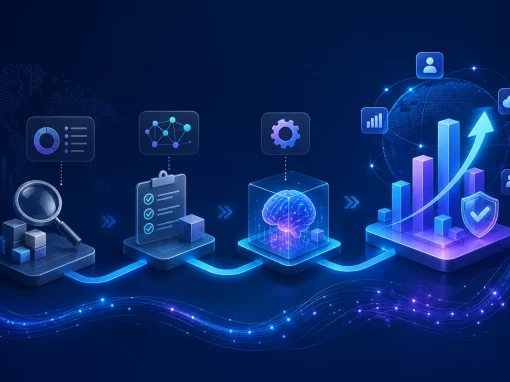
Before selecting a modernization strategy, run a structured diagnostic across the dimensions that determine project risk. Skipping this step is a common reason modernization projects choose the wrong strategy on day one and pay for it later.
Build a short checklist covering five areas: codebase age and documentation quality, data dependencies, compliance exposure, team skill coverage, and budget certainty. Score each dimension as low, medium, or high risk.
The pattern that emerges tells you where your real application modernization challenges sit, rather than relying on a generic list that assumes every legacy system has the same problems.
| Diagnostic Dimension | Low Risk Signal | High Risk Signal |
| Codebase age and documentation | Recent refactors, current ADRs, active maintainers | 10+ years old, no documentation, original developers gone |
| Data dependencies | Single source of truth, clean schema | Multiple systems reading/writing the same legacy database |
| Compliance exposure | No regulated data, internal-only use | HIPAA, PCI DSS, or SOX data in scope |
| Team skill coverage | In-house staff fluent in legacy and modern stacks | Skills gap on one or both ends |
| Budget certainty | Phased budget with contingency approved | Single fixed budget, no appetite for scope changes |
Use the diagnostic output to decide how much of the system actually needs to change. A system that scores low risk across the board may only need a rehost. One that scores high on data dependencies and compliance exposure needs a much more deliberate rearchitecting plan, with extra time built in for parallel-running old and new systems.
Treat this as a recurring exercise rather than a one-time audit. Legacy risk shifts as teams turn over, vendors change their support policies, and regulations get updated. A system that scored low risk last year can look very different after a key engineer leaves or a new compliance requirement takes effect.
The Core Technical Challenges in Modernizing Legacy Applications
The technical obstacles in legacy application modernization are well known in isolation. What matters for decision-makers is understanding how they compound and what business consequences follow when they’re left unaddressed.
Technical Debt in Legacy Code and Architecture
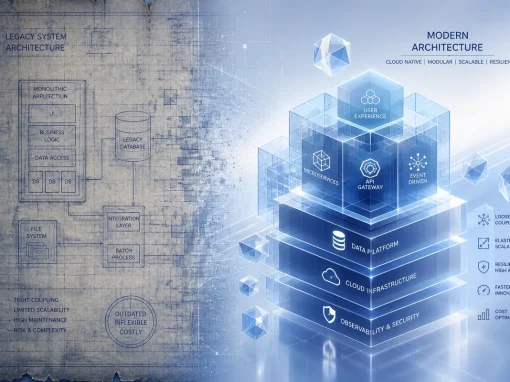
Technical debt shows up as legacy code written in outdated languages, frameworks that no longer receive security patches, and architecture too rigid to support incremental change.
Microsoft’s framework identifies these conditions as indicators of technical risk that directly complicate modernization efforts.
In practice, this debt doesn’t just slow down development. It extends timelines, inflates cost estimates once teams discover how much hidden complexity exists beneath the surface, and increases the likelihood that a seemingly simple change breaks an unrelated part of the system.
Data Migration Risk
Moving data out of a legacy database carries real operational risk: schema mismatches between old and new systems, data loss during transformation, and downtime during the actual cutover.
The risk compounds when a single legacy database feeds multiple downstream systems, reporting tools, billing platforms, or partner integrations that all expect data in a specific format. A migration plan that accounts for only the primary application and ignores these downstream dependents is one of the most common causes of post-launch outages.
Integration Complexity
Legacy applications rarely operate in isolation. Many connect to dozens of internal systems and third-party APIs that were never designed with decoupled, service-based architectures in mind.
When modernizing legacy applications, teams often discover integrations held together by tightly coupled, point-to-point connections rather than documented APIs. Untangling these dependencies, and deciding which should be preserved, replaced, or retired, is frequently more time-consuming than rebuilding the core application itself.
Security and Compliance Exposure During Transition
Security and compliance exposure rises during the transition window when legacy and modernized systems run in parallel. Each system may have different patch levels, authentication mechanisms, and audit logging, creating gaps that are easy to miss.
This is particularly consequential in regulated industries: healthcare software modernization projects must account for HIPAA requirements, while financial institutions subject to PCI DSS or SOX need to demonstrate compliance throughout the migration, not just at the finish line.
A parallel-run period that isn’t explicitly scoped for compliance monitoring is a common source of audit findings after go-live.
The Business and Organizational Challenges That Derail Modernization Projects
Technical challenges get the most attention in planning documents, but business and organizational challenges can also derail modernization projects once they’re underway.
These issues are interconnected: a budget overrun triggers stakeholder scrutiny, which stalls decisions, which extends the timeline, which drives further cost.
Budget Overruns from Underestimated Scope
Cost overruns in modernization projects typically trace back to underestimated scope, not vendor pricing.
Teams often plan around the application they know and discover mid-project the hidden integrations, undocumented business rules, and edge cases that weren’t visible during initial assessment.
The fix isn’t a bigger upfront estimate; it’s a phased budget with defined checkpoints, where each phase is scoped, delivered, and evaluated before the next phase is funded. This gives stakeholders a natural decision point to adjust scope or budget before costs compound.
Talent Gaps on Both Ends of the Transition
Legacy modernization frequently exposes a skills gap on both ends of the technology stack. Teams may have developers who understand the legacy codebase (COBOL, ColdFusion, ActionScript) but have never worked with modern cloud-native architectures, or vice versa.
This leaves organizations unable to confidently maintain either the system being replaced or the one being built.
Change Management and Stakeholder Resistance
Change management failures often come down to how the modernization business case gets communicated.
Technical architecture diagrams mean little to a finance or operations stakeholder. What resonates is downtime risk, customer impact, and compliance deadlines framed in business terms they already track.
Build a cross-functional steering group that includes finance and operations stakeholders alongside engineering leadership. Including these voices early reduces the risk of a surprise veto mid-project from someone who wasn’t part of the original decision but holds enough authority to stop it.
Choosing the Right Application Modernization Strategy and Partner
The right application modernization strategy depends on what your diagnostic assessment reveals, not on which approach is currently trending. Microsoft’s cloud migration guidance outlines a range of strategies, including rehosting, refactoring, and rearchitecting, each suited to different technical requirements and business goals.
Match the strategy to your diagnostic results. Before committing to any strategy, evaluate downtime tolerance, recovery objectives, and system dependencies. Working with an experienced modernization partner can help you assess these factors and determine the best path forward.
Look for proven legacy modernization experience in your specific technology stack, transparent phased pricing tied to the checkpoints described above, a willingness to document architecture decisions rather than treat them as proprietary, and realistic timelines instead of best-case estimates designed to win the deal.
For example, Scopic helped modernize Dr. Ceph’s legacy application, migrating its 25-year-old software to a modern framework while preserving critical functionality and compatibility with existing patient files. The project achieved a 28x+ improvement in engineering efficiency, with 21 hours spent compared to an estimate of over 600 hours.
Scopic’s team brings this kind of documented, stakeholder-aware approach to every custom application development engagement, pairing deep technical stack experience with phased pricing that tracks your diagnostic checkpoints rather than a one-size-fits-all estimate. engagement, pairing deep technical stack experience with phased pricing that tracks your diagnostic checkpoints rather than a one-size-fits-all estimate.
Where AI-Assisted Tooling Is Changing the Modernization Equation
AI-assisted tooling speeds up specific tasks in the modernization process, but it doesn’t replace the strategic judgment the project still requires. The realistic use cases fall into three categories.
AI-assisted code analysis can map dependencies and flag dead code across large legacy codebases far faster than a manual audit, which shortens the diagnostic phase described earlier and gives teams a clearer starting picture before scoping decisions get made.
Automated refactoring tools handle repetitive transformation tasks well, including syntax conversion and dependency updates, but they still require human review for decisions tied to business logic. A tool can convert syntax; it can’t reliably judge whether a quirky conditional statement encodes an intentional business rule or an old workaround.
AI-driven test generation helps close coverage gaps in legacy systems that were never properly tested in the first place, which reduces regression risk during cutover by catching behavior changes before they reach production.
Treat AI tooling as an accelerant for well-defined tasks within a modernization plan, not a substitute for the plan itself. The decisions about which strategy to pursue, how to sequence phases, and how to manage stakeholder risk still require human expertise grounded in your specific environment. This is where AI consulting services can help businesses identify practical opportunities for AI adoption and determine how to integrate these tools into their modernization strategy.
Measuring Success and Preventing New Technical Debt After Modernization
Success in a modernization project should be defined before the project starts, using metrics that extend well past go-live. Define deployment frequency, incident rate, page or transaction latency, and cost per release as your baseline metrics, and track them from the first weeks of the new system’s operation rather than treating “it’s live” as the finish line.
Total cost of ownership over the following 12 to 24 months gives a far more accurate picture of return on investment than the original project budget alone. Licensing changes, infrastructure costs, and the ongoing maintenance burden of the new system all factor into whether the modernization actually paid off.
Put architecture decision records and code review standards in place immediately after launch. Post-launch is exactly when new technical debt starts accumulating unnoticed, as teams move quickly to add features on the newly modernized foundation and skip the documentation discipline that made the system maintainable in the first place.
Schedule a structured reassessment at 6 and 12 months after going live. Usage patterns shift, new compliance requirements emerge, and the assumptions that shaped your original architecture decisions may no longer hold. A scheduled reassessment catches drift before it turns into the same kind of legacy risk you just spent months resolving.
Next Steps for Planning Your Modernization Project
Run the diagnostic checklist internally before engaging any vendor, even if you expect to bring that vendor in to help complete it. Walking into vendor conversations with at least a partial view of your actual risk profile, rather than a generic list of concerns, leads to proposals that are scoped to your environment instead of a one-size-fits-all package.
If you don’t have the internal bandwidth or expertise to run the checklist yourself, application modernization consulting can help you assess your risks and determine the right next steps. A vendor worth hiring should be willing to help you work through it as a first step, rather than skipping straight to a proposal.
Treat modernization as a phased program with measurable checkpoints, not a single large project tied to one go-live date. This structure gives you the ability to validate assumptions, adjust budget, and manage stakeholder expectations at defined intervals rather than finding out something went wrong only when the whole system is already in production.
Final Thoughts
Application modernization challenges come from treating a complex, interconnected system as if it were a simple swap of old code for new.
The organizations that get modernization right are the ones that diagnose before they commit, choose a strategy that matches their actual risk profile instead of the one that’s easiest to pitch, and keep validating assumptions at defined checkpoints rather than waiting for a single date to prove them right or wrong.
If you’re ready to move from diagnosis to execution, explore Scopic’s legacy software modernization services to talk through your specific environment with our team.
Frequently Asked Questions
What is the biggest challenge in application modernization?
Technical debt and unclear scope are the most common starting obstacles, since teams tend to underestimate them during planning. Budget overruns and stakeholder resistance surface later, once the project is underway and visible to a wider group of decision-makers.
How much does legacy application modernization cost?
Costs vary widely depending on system complexity and the chosen strategy. Rehosting is far cheaper than full rearchitecting, since it involves minimal code change, which is exactly why running a diagnostic assessment before setting a budget matters more than benchmarking against industry averages.
How long does modernizing a legacy application typically take?
Timelines can range from a few months for a straightforward rehost to a year or more for a full rearchitecture of a business-critical system with complex integration dependencies. The timeline for the modernization of legacy applications is driven by factors such as data complexity, the number of downstream integrations, and compliance requirements, not just the size of the codebase.
Should you rebuild a legacy application or modernize it incrementally?
Incremental modernization reduces business disruption and risk by allowing teams to validate each phase before moving to the next. A full rebuild makes sense only when the existing architecture genuinely cannot support current scalability or compliance needs, since starting from scratch carries significantly higher cost and timeline risk.
How do you measure ROI after application modernization?
Track deployment frequency, incident rate, latency, and total cost of ownership over the following 12 to 24 months rather than judging success at launch alone. A system that launches on time but generates high incident rates or unexpected maintenance costs hasn’t actually delivered the return the project was meant to produce.
Can AI tools reduce the risk of application modernization projects?
AI-assisted code analysis, refactoring, and test generation can speed up specific tasks like dependency mapping and closing test coverage gaps in systems that were never properly tested. Strategic decisions, including which modernization strategy to pursue and how to sequence the project, still require human judgment grounded in the specific business context.

About Application Modernization Challenges Guide
This guide was authored by Baily Ramsey.
Scopic provides quality and informative content, powered by our deep-rooted expertise in software development. Our team of content writers and experts have great knowledge in the latest software technologies, allowing them to break down even the most complex topics in the field. They also know how to tackle topics from a wide range of industries, capture their essence, and deliver valuable content across all digital platforms.