Table of Contents
Listen to article
Creating a custom software solution can be a game-changer for your business, but the ultimate question remains: how much does it cost to develop software?
Software development costs range from $5,000 for a basic MVP to $150,000+ for enterprise-grade systems.
Budgeting for software development is one of the most common pain points for product teams and business leaders. The range of software development costs you encounter online is enormous, and the factors driving those numbers are rarely explained in plain terms.
The reality? Most budget surprises don’t come from what you planned — they come from what you didn’t. Scope creep, underestimated QA cycles, post-launch maintenance, and third-party licensing fees are among the top reasons projects run over budget.
This guide cuts through the noise. We’ll show you the real cost of software development, typical price ranges by project type, what gets overlooked in most budgets, and how to structure yours for fewer surprises.
How Much Does Software Development Cost: 9 Key Factors
Software development costs are the sum of dozens of decisions made throughout the project lifecycle.
Below are the nine main factors shaping how much it costs to develop software.

Type of App
The type of app—whether it’s a web app, mobile app, or desktop software—affects the resources needed and, thus, the overall software development cost.
For example, a web or cloud-based CRM app can average around $100,000 to develop, , while a basic mobile app might start at $20,000–$30,000.
Building for both iOS and Android doubles the development work unless cross-platform frameworks like React Native or Flutter are used — each with its own tradeoffs in performance and UX. Web apps, while typically faster to create, still require considerations around responsiveness and browser compatibility.
Platform choice also matters beyond device type. Managed platforms like Salesforce reduce infrastructure complexity but come with licensing constraints. Cloud infrastructure like AWS or Azure offers more flexibility but may require specialized expertise that adds to hourly costs.
You need to also consider the features and functionalities you want to integrate. For example, if you’re going for more advanced ML or generative AI software development, this will require more extensive coding, higher developer expertise, and in-depth testing, which quickly add up to the bill.
Tip:
Decide on target platforms early, and be ruthless about which features belong in version 1.0. Launching on one platform and expanding later is often the smartest cost-control move you can make.

Complexity of the Software
Complexity is the single biggest lever on software development pricing. It determines how much engineering time is needed, what level of expertise the project requires, and how long QA will take.
Factors that drive complexity include:
- UI and UX design
- Third-party integrations
- Multi-platform or multi-region support
- Features and functionality
- Coding language and framework
- Scalability and localization
- AI/ML components
- Security and compliance requirements (HIPAA, GDPR, PCI-DSS)
Simple applications with basic functionality are generally quicker and cheaper to develop. Enterprise-grade platforms with complex workflows, legacy integrations, and high security demands can require teams of 10+ people working for a year or more.
Tip:
Break down complex features into phases. Not everything needs to ship in v1.

UX/UI Design Specifications
Design is often where the biggest false economies are made. Pre-built design templates or component libraries (like Material UI) can dramatically reduce design costs — but they can also make your product feel generic. Custom UX/UI design services, involving user research, wireframing, and iterative testing, adds cost to develop software upfront but often pays back in user adoption and retention.
A simple UI using a component library may cost $3,000–$8,000. Custom, research-driven UX/UI for a complex product can run $20,000–$60,000 or more, depending on scope.
Tip:
In early-stage builds, prioritize clarity over aesthetics. Invest more in UX as the product matures, and you have real user data to guide design decisions.

Cost of Software Development Team
Choosing the right software development partner is crucial. The cost of software developers is one of the most flexible and biggest variables in a project.
Think: Will you be working with an internal team, or will you outsource?
For example, in-house teams offer strong control and cultural alignment, but are expensive and slow to assemble. On the other hand, outsourced teams are the most common model: about 76% of business managers choose to outsource development, primarily to reduce costs.
When outsourcing, four variables shape your budget:
- Pricing model (fixed price, hourly, dedicated team — more on this below)
- Team location (offshore, nearshore, or onshore)
- Team size (more roles = more cost, but also more speed)
- Seniority level (senior engineers cost more per hour but often move faster and produce fewer bugs)
A standard project team includes a project manager, frontend developer, backend developer, UX/UI designer, and QA engineer. Specialized roles — cloud architect, security engineer, AI/ML specialist — add to this base.
Tip:
Define required roles and seniority levels before getting quotes. Misalignment on team structure is one of the fastest ways to break a budget.

Technology Stack
The choice of backend technologies, programming languages, frameworks, and tools is what makes up your technology stack.
Popular, widely supported technologies often come with a larger pool of developers, making the software development process more cost-effective. However, if your project requires cutting-edge or niche technologies, finding specialized developers can be challenging and may increase costs due to their expertise and limited availability.
Two stack decisions worth factoring into your budget:
Tip:
Discuss stack choices with a software development consultant before committing. The cheapest technology to build with isn’t always the cheapest to maintain.

Size & Scope of the Project
Scope defines the ceiling on your budget. A project with a clear, well-documented scope is far easier to estimate accurately than one with vague or shifting requirements.
Key elements to define upfront:
- Core features (must-have vs. nice-to-have)
- Target users and expected scale
- Performance benchmarks
- Security and compliance requirements
- Launch timeline
Scope creep (requirements expanding mid-project) is one of the leading causes of budget overruns. According to McKinsey, IT projects overrun their budgets by an average of 75%, and timelines extend by nearly 50%.
Tip:
Document your project scope formally before development begins and build a change-management process into your contract so that any scope additions go through a formal cost assessment.

Testing & Quality Assurance (QA)
Did you know that under-resourcing QA is one of the most common drivers of hidden software development costs?
QA usually takes about 20% to 40% of the overall development time and should be budgeted accordingly.
While automated testing can save time in the long run, manual testing is still a must for more complex applications, especially if you’re handling sensitive data and require to be 100% compliant with regulations like HIPAA or GDPR.
Tip:
Allocate QA resources from day one. Fixing bugs post-launch is significantly more expensive than catching them during development.

Maintenance and Ongoing Support
Post-launch services come with an ongoing cost. Industry benchmarks suggest budgeting 15–20% of your initial development cost annually for maintenance.
This usually includes:
- Bug fixes
- Security updates
- Performance optimization
- Feature updates based on user feedback
- Compatibility updates as operating systems and browsers evolve
Maintenance and ongoing support are usually provided by a dedicated support team, or they can be part of the software development services offered by the original dev team.
Tip:
To reduce costs at this stage, you can identify and eliminate any unused features or services. You can also determine the minimum resources you need for the software to run and terminate unused capacity.

Third-Party Integrations
Integrating third-party services (such as payment gateways and analytics platforms) can improve functionality, but this also increases the cost to develop software and adds a layer of complexity to your project.
Additionally, each integration requires time and testing for compatibility with your existing system, and it often involves third-party service licensing fees.
Tip:
Prioritize integrations by business impact. Build the most critical ones first and phase in others over time to spread both cost and risk.
The Average Cost Software Development: Estimations by Project Type
The average cost of software development varies widely by project type and complexity. To give you a clearer idea of potential expenses, here’s a detailed software development cost breakdown:
| Project Type | Cost Range | Time to Build | Examples |
| Simple App Development | $10,000 – $50,000 | 2-4 months | Basic fitness trackers, simple games |
| Custom App Development | $30,000 – $150,000+ | 3-8 months | SaaS platform, e-commerce store, CMS |
| Complex App Development | $60,000 – $250,000+ | 6-12 months | Marketplace, real-time data platform |
| AI/ML App Development | $75,000 – $400,000+ | 4 months – 1+ year | Predictive analytics tools, image recognition apps |
| Enterprise Software | $150,000 – $500,000+ | 9 months – 2+ year | ERP systems, custom CRM, regulated industry platform |
Note: These are starting points, not quotes. Every project is different, and complexity can push costs significantly in either direction. The best way to get an accurate software development cost estimation is to define your scope, choose your team model, and complete a proper discovery phase before full development begins. At Scopic, we offer product consulting and discovery engagements that help clients establish accurate budgets before committing to full-scale development.
Simple App Development
For simple applications, costs typically range from $10,000 to $50,000. These apps often have basic functionality, limited UI, and minimal backend requirements.
Common examples of such apps include:
- Fitness and budget trackers
- Recipe apps and to-do lists
- Simple games
These don’t require advanced features or integrations, making them quicker to build – about 2 to 4 months.
Custom Web Application Development
Building a custom web application can vary significantly in cost, ranging from $30,000 to $150,000+, and can take up to a year to build.
Simple platforms like blogs or small e-commerce sites fall on the lower end, while complex SaaS products with user management, payment integrations, and layered databases cost substantially more.
Complex App Development
More intricate projects take, on average, 9 months or more to complete, with costs ranging from $60,000 to $250,000 or more. These apps may feature real-time data processing, artificial intelligence or machine learning components, and custom UI/UX design.
Examples include:
- Finance and banking tools with analytics
- E-commerce marketplaces
- On-demand service apps
AI/ML App Development
For applications powered by AI or ML, costs generally fall between $75,000 and $400,000+. These apps often require specialized algorithms, extensive data processing capabilities, and customized training models.
Examples include:
- Predictive analytics tools
- Recommendation engines
- Image recognition applications
Enterprise Application Development
Enterprise solutions are tailored for specific organizational needs, offering extensive integration with legacy systems, high levels of security, and complex data management. Costs typically range from $150,000 to $1,000,000+, with timelines of 9 months to over two years.
Enterprise solutions include:
- ERP systems
- Custom CRMs
- Internal platforms for managing complex workflows
Budget Allocation Across the Development Lifecycle
One of the most practical things you can do when planning a software budget is to understand where the money goes — not just the total figure.
Here’s a typical budget allocation breakdown for a custom software project:
| Phase | Typical % of Budget | What it Covers |
| Discovery & Planning |
5–10% |
Requirements, architecture planning, roadmap |
| UX/UI Design |
10–15% |
Wireframes, prototypes, visual design, design system |
| Development (Frontend + Backend) |
40–55% |
Core feature engineering, APIs, databases |
| QA & Testing |
15–20% |
Manual + automated testing, bug fixes, performance |
| Project Management |
8–12% |
Coordination, reporting, stakeholder communication |
| Deployment & DevOps |
5–8% |
CI/CD setup, cloud configuration, launch |
| Post-Launch Maintenance |
15–20% annually |
Ongoing support, updates, security patches |
These proportions shift based on project type. Design-heavy consumer apps spend more on UX. AI products allocate more to data pipeline work and model training. Regulated industry platforms spend more on QA and compliance testing.
Takeaway: If a vendor’s quote is 90% development with almost nothing allocated to QA or design, that’s a red flag. Cutting these phases upfront almost always costs more later.
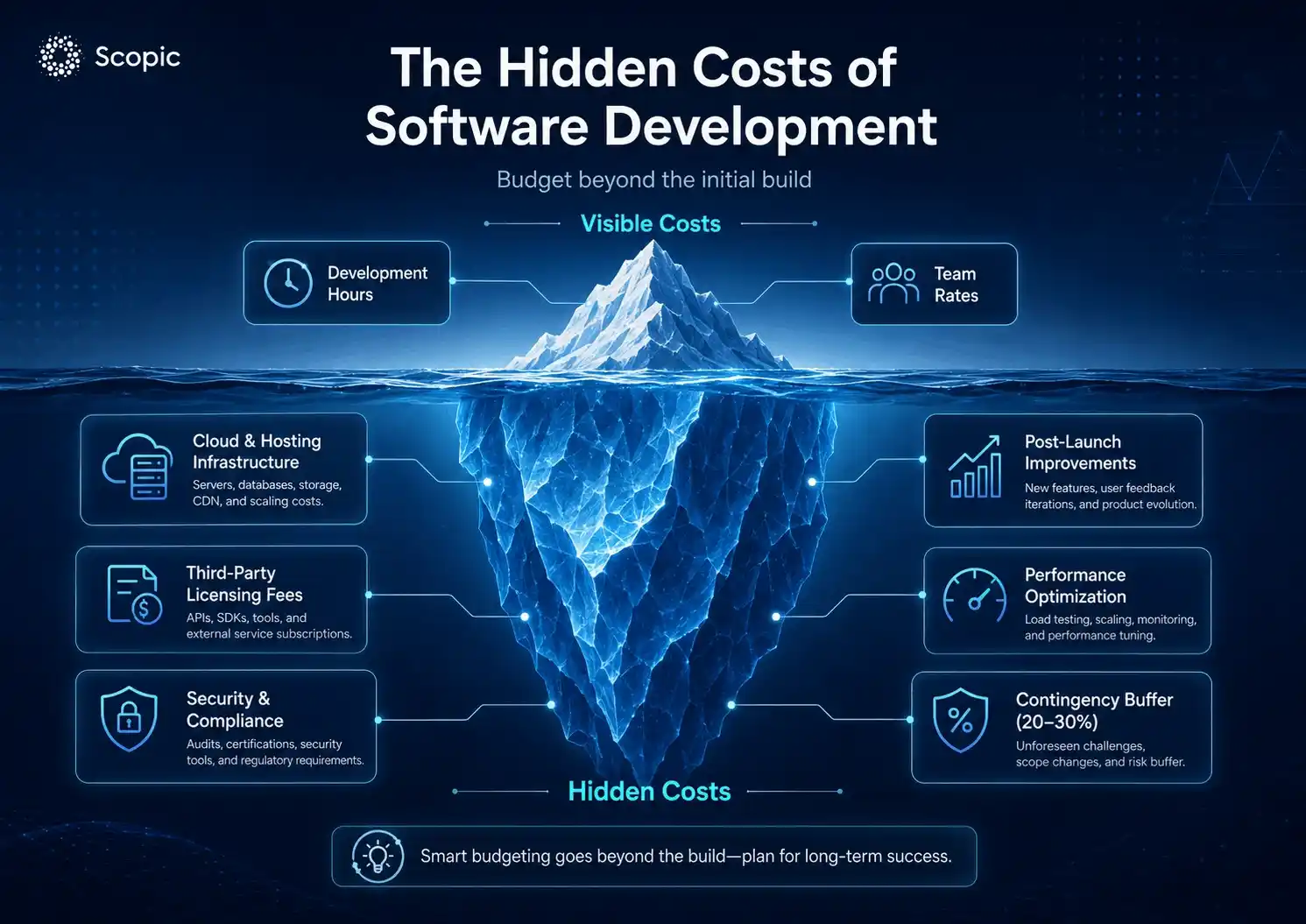
The Hidden Costs of Software Development
Most budget discussions focus on development time and team rates. The costs below regularly catch businesses off guard — and are a key part of any honest software development cost breakdown.
Cloud and Hosting Infrastructure
Cloud infrastructure costs scale with usage. A small app might cost $50–$200/month to host. A high-traffic platform processing real-time data can cost $5,000–$50,000+/month. These ongoing fees are rarely captured in initial project estimates.
Third-Party Licensing Fees
APIs, analytics platforms, payment processors, and SaaS tools integrated into your product all have their own pricing structures. These fees compound over time and are often not included in upfront development cost estimates.
Security and Compliance
For healthcare, finance, and other regulated sectors, compliance is a first-class cost. HIPAA-compliant architecture, SOC 2 audits, penetration testing, and GDPR data handling each add meaningful cost — both upfront and on an ongoing basis.
Post-Launch Improvements
User feedback after launch almost always surfaces features to improve, bugs to fix, and UX flows to optimize. Budgeting zero for this is budgeting for a product that stagnates.
Scaling and Performance Optimization
As your user base grows, your architecture may need to evolve — new database strategies, load balancing, caching layers, and infrastructure upgrades. These costs can be significant if not anticipated during the design phase.
Project Management Overhead
For longer projects, PM costs accumulate in ways that aren’t always visible in initial estimates. This includes time spent in status meetings, documentation, stakeholder alignment, and change management.
Rule of thumb: Add 20–30% to your core development estimate to account for hidden costs and contingencies. Projects that plan for this tend to land on budget. Projects that don’t, don’t.
Regional Hourly Rates: How Team Location Affects Your Budget
Where your development team is based has a direct impact on hourly rates — and by extension, on total software development costs. Here’s a realistic view of 2026 rates by region:
|
Region |
Average Hourly Rate |
Notes |
|
United States / Canada |
$120 – $200+/hr |
Highest rates, strong communication and quality |
|
Western Europe |
$80 – $150/hr |
High quality, often similar time zones for EU clients |
|
Eastern Europe |
$40 – $80/hr |
Strong talent pool, popular for quality + cost balance |
|
Latin America |
$35 – $75/hr |
Growing tech hubs, nearshore advantage for US clients |
|
India / South Asia |
$20 – $50/hr |
Large talent pool, ~65% of global IT outsourcing |
|
Southeast Asia |
$20 – $45/hr |
Emerging hubs, growing quality |
Lower rates don’t automatically mean lower total cost. Offshore teams in significantly different time zones require more documentation, more structured handoffs, and stronger project management — all of which carry their own costs.
The best value typically sits in regions that combine competitive rates with strong English proficiency, a high developer skill level, and manageable time zone overlap with your team. Eastern Europe and Latin America consistently score well on this balance.
Scopic operates with a global remote team across the US, Europe, Latin America, and APAC — which means clients get geographic flexibility without sacrificing communication quality.
Pricing Models Explained
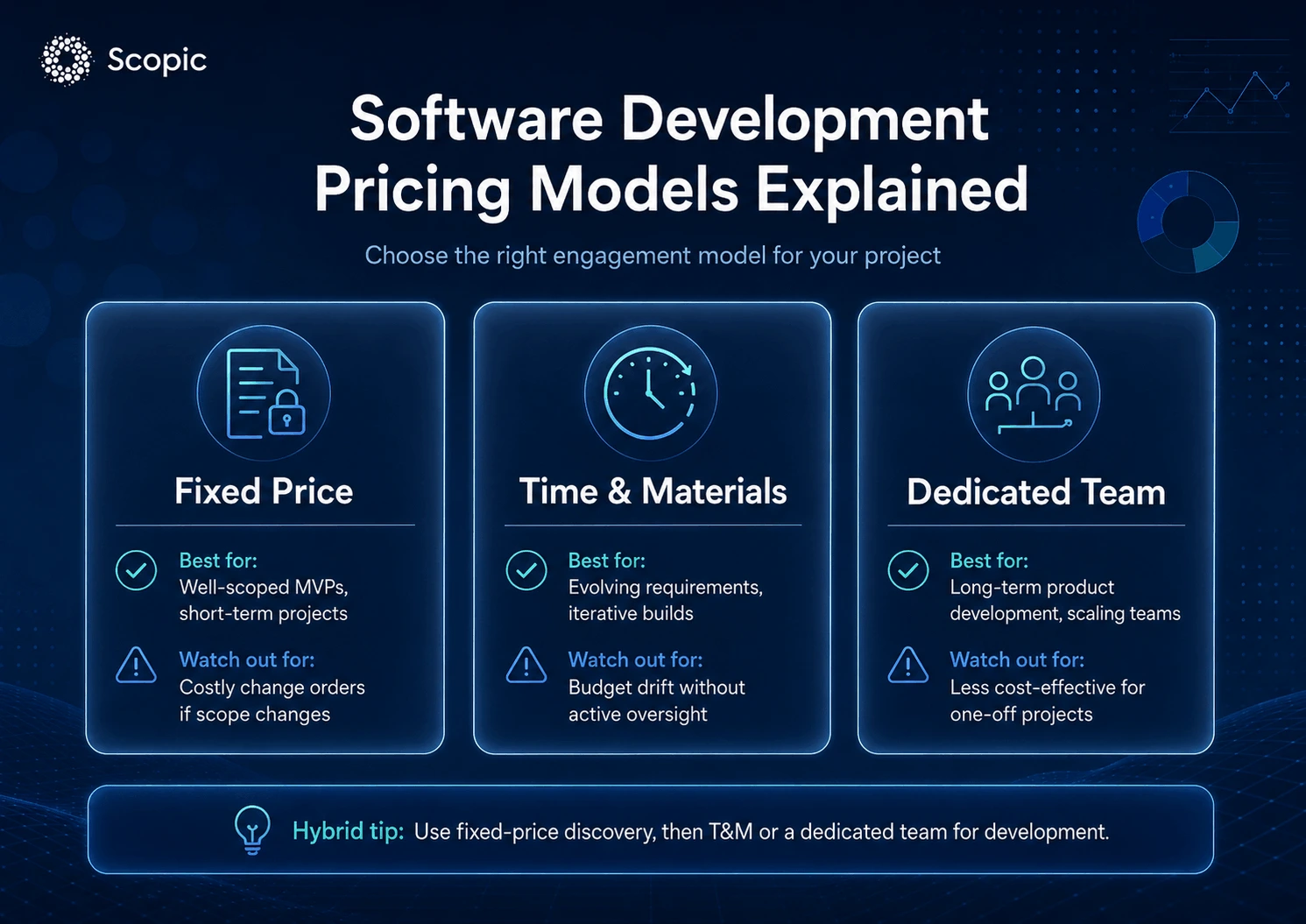
How you structure the engagement with your development team shapes your risk and flexibility as much as the hourly rate does. Understanding software development pricing models is key to choosing the right one for your project.
Fixed Price
You agree on a total cost before work begins. This works well when requirements are clearly defined and unlikely to change. It also provides maximum budget predictability.
Best for: Well-scoped MVPs, short-term projects with defined deliverables.
Watch out for: Scope creep. Changes after sign-off typically trigger costly change orders.
Time and Materials (Hourly)
You pay for actual time spent at an agreed hourly rate. This option is flexible and transparent but requires active oversight.
Best for: Projects where requirements are likely to evolve, or where an iterative approach is preferred.
Watch out for: Budgets can drift without regular check-ins and scope discipline.
Dedicated Team
You contract a dedicated team for an ongoing period, paying monthly based on team size and composition. This is closest to an in-house team in terms of integration and control.
Best for: Longer-term product development, scaling teams for established products, or companies that want an extended development partnership.
Watch out for: Less cost-effective for short or one-off projects.
Tip:
For most early-stage software builds, a hybrid approach works well — fixed-price discovery and design phases, followed by time-and-materials or dedicated team engagement for development and beyond. This gives you cost certainty early and flexibility as the product evolves.
How to Reduce Software Development Costs
Cutting costs doesn’t mean cutting corners. The following strategies are used by the most cost-efficient software development consultants.

Start with an MVP
Build only what’s needed to validate your core value proposition. An MVP lets you test real-world assumptions before committing to full-scale development, reducing the upfront cost of software development and giving you user data to drive better feature decisions.

Use Pre-built Solutions or Open-source Software
Mature open-source libraries exist for authentication, payment processing, UI components, database management, and more. Leveraging these instead of building from scratch can save weeks of development time — and significant cost.
Before adopting any open-source component, verify licensing terms and assess long-term maintainability.

Invest in Proper Planning
The most expensive bugs are the ones baked into the architecture. Upfront planning can help you prevent the kind of rework that derails budgets.
Working with a software development company during discovery can save far more than it costs by surfacing technical and business risks early.
For more insights on how to efficiently plan your development budget — especially for modern technologies like AI and blockchain — check out this expert article by GoodFirms, which includes contributions from our Scopic team.

Choose the Right Team and Engagement Model
Selecting the right bespoke web development company is crucial to managing costs effectively. Evaluate team location, seniority mix, and pricing model together. A senior developer at $80/hr who ships clean, maintainable code often costs less overall than a junior developer at $30/hr who creates technical debt. If you’re considering outsourcing, nearshore development teams offer a strong balance of cost savings and communication quality.

Adopt Agile Development
Agile‘s iterative approach means you’re always building the highest-value features first. Regular sprint reviews keep stakeholders aligned, reduce late-stage surprises, and make it easier to course-correct before costs compound.

Automate Testing and QA
Automated test suites have an upfront cost but pay dividends by catching regressions early and reducing manual QA hours over time. For any project expected to run beyond six months, test automation is a cost-saver, not a cost addition.

Use Cloud Infrastructure Wisely
On-demand cloud infrastructure means you’re not paying for capacity you don’t yet need. Start lean, design for scalability, and monitor usage from day one to avoid bill shock as you grow.
Conclusion
Software development costs are shaped by dozens of variables — but they’re not unpredictable when you know what to look for. The biggest driver of budget overruns isn’t the hourly rate but the gap between what was planned and what was actually needed.
At Scopic, we specialize in custom software development services that are scoped, priced, and delivered transparently. Whether you’re planning your first product or scaling an existing platform, our team can help you build a realistic roadmap and budget from day one.
Contact us today to discuss your project.
FAQs
Software development can be complex, so if you still have questions about costs, timelines, and budgeting strategies, we’ve got you. Here are the answers to some of the most common questions:
What are the hidden costs of software development?
The “not-so-obvious” costs in software development, which often receive less attention than they should, include:
-
Ongoing cloud and hosting fees
-
Third-party licensing costs
-
Post-launch maintenance (typically 15–20% of initial build cost annually)
-
QA and testing (especially for regulated industries)
-
Performance optimization as usage scale
Building a contingency buffer of 20–30% into your initial budget significantly reduces budget surprises.
How long does software development typically take?
The timeline for software development varies based on the project’s complexity and scope. Simple apps may take 2-4 months, while complex, enterprise-level software can require over two years.
How can I avoid going over budget during software development?
To avoid budget overruns, start with a well-defined project scope, prioritize essential features, and maintain regular communication with your development team. Using an MVP approach, leveraging open-source tools, and setting a clear project timeline also help prevent unexpected expenses.
How much does custom software development cost?
How much custom software development costs depends on scope, team, and technology. Typical ranges run from $10,000 for a simple MVP to $500,000 or more for complex, enterprise-grade solutions. The more defined your requirements, the more accurate the estimate you’ll receive.
What pricing model is best for custom software development?
It depends on your project.
Fixed price works well when requirements are clearly defined and unlikely to change. Time and materials is better for iterative projects or when flexibility is needed. Dedicated team models suit longer engagements where you want ongoing capacity.
Many clients use a hybrid: fixed-price discovery and design, time-and-materials for development.
What affects software cost more: features, team, or timeline?
All three are deeply connected. Features drive complexity, complexity drives team size and duration, and team size and duration drive cost. In practice, scope (features) is the biggest lever — reducing scope is the fastest way to reduce cost. Timeline compression, on the other hand, often increases cost by requiring a larger team to work in parallel.

About Creating Software Development Costs Guide
This guide was authored by Vesselina Lezginov, and reviewed by Alan Omarov, Solutions Architect at Scopic.
Scopic provides quality and informative content, powered by our deep-rooted expertise in software development. Our team of content writers and experts have great knowledge in the latest software technologies, allowing them to break down even the most complex topics in the field. They also know how to tackle topics from a wide range of industries, capture their essence, and deliver valuable content across all digital platforms.