
Table of Contents
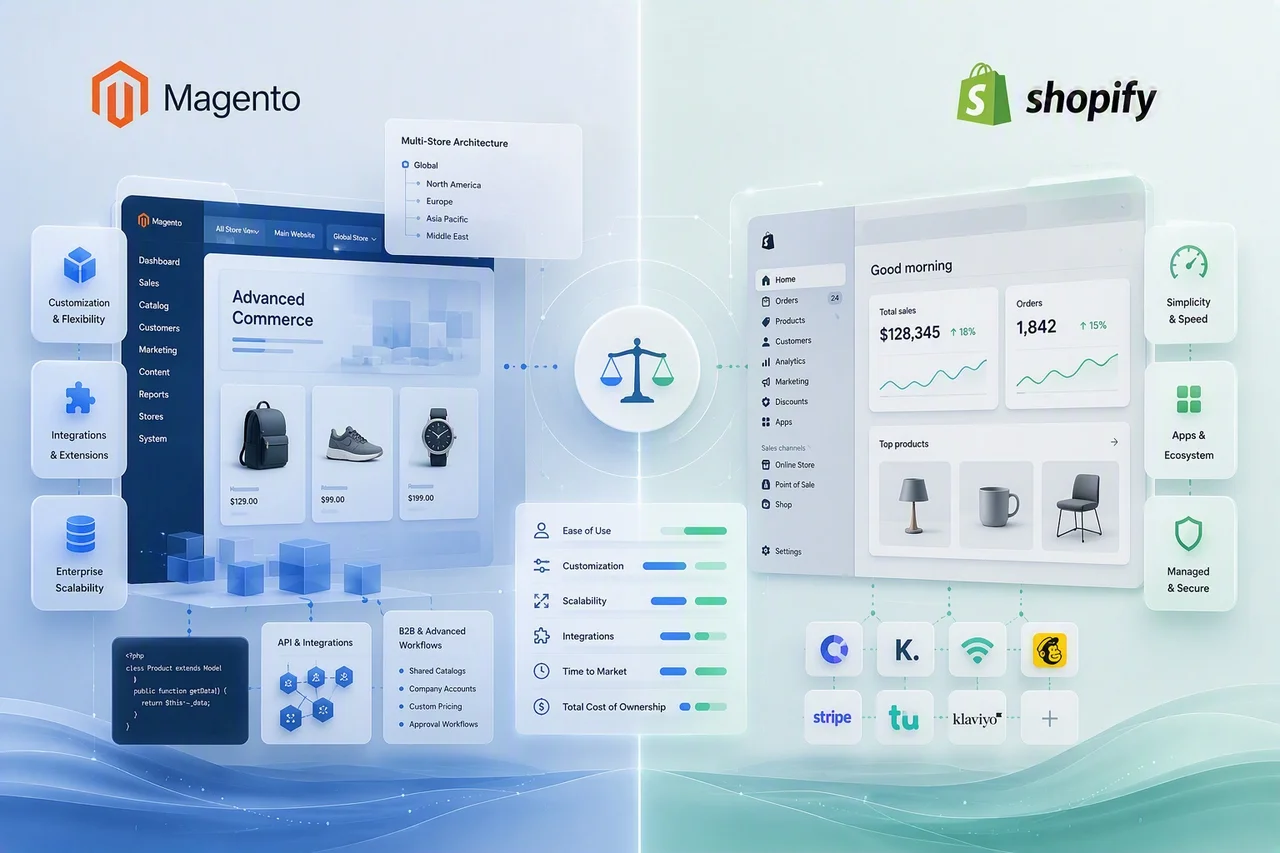
Choosing between Magento and Shopify is not about finding a universally better eCommerce platform. The Magento vs Shopify decision depends on how much customization, operational responsibility, commerce complexity, and technical control your business needs.
Shopify is a hosted SaaS platform that manages the underlying commerce infrastructure and core platform updates. Magento Open Source is an open-source, self-managed platform, while Adobe Commerce adds enterprise capabilities and supports different deployment models, including on-premises, Adobe-managed PaaS, and SaaS. The right choice therefore depends on factors such as B2B requirements, integrations, multi-store needs, internal technical resources, and total cost of ownership.
Key Takeaways
- Shopify reduces infrastructure and core-platform management through its SaaS model, while operational responsibility varies between Magento Open Source and the different Adobe Commerce deployment models.
- Magento Open Source and Adobe Commerce PaaS or on-premises deployments provide extensive in-process customization, while Adobe Commerce as a Cloud Service uses a SaaS extensibility model based on APIs and external applications.
- Shopify now provides native B2B capabilities across its Basic, Grow, Advanced, and Plus plans, although advanced features and limits differ by plan.
- Total cost of ownership depends on platform fees, hosting, development, apps or extensions, integrations, maintenance, upgrades, and internal technical resources. Neither platform is automatically cheaper.
- Custom workflows, B2B complexity, integrations, international operations, and multi-store requirements often matter more than company size when choosing a platform.
Magento vs Shopify: What Is the Core Difference?
The core difference lies in the platforms’ operating models and the amount of technical responsibility the merchant retains. Shopify is a hosted SaaS platform: Shopify manages the core software, hosting infrastructure, and platform updates.
Magento Open Source follows a different model. Businesses host and manage the open-source application themselves, which provides extensive control but also creates greater responsibility for infrastructure, maintenance, security, and upgrades. Adobe Commerce builds on the Magento ecosystem with commercial enterprise capabilities and is available through on-premises, Adobe Commerce on Cloud as a PaaS offering, and Adobe Commerce as a Cloud Service as a SaaS offering. For a broader look at platform selection and implementation considerations, see our guide to eCommerce software development.
The comparison is therefore not simply “SaaS versus self-hosted.” It is a decision about customization, extensibility, infrastructure responsibility, business complexity, and how much technical ownership the organization wants to retain.
Magento vs Shopify: Key Differences
Evaluating these platforms requires analyzing how technical control impacts operational overhead. The table below outlines the core trade-offs across critical decision factors.
| Decision Factor | Magento/Adobe Commerce | Shopify/Shopify Plus | Decision Implication |
|---|---|---|---|
| Architecture & Hosting | Magento Open Source is self-managed. Adobe Commerce can be on-premises, Adobe-managed PaaS, or SaaS. | Fully hosted SaaS. | Decide how much infrastructure and platform responsibility the business wants to retain. |
| Setup & Implementation | Can require significant architecture, development, hosting, and integration work, depending on deployment and customization. | Typically faster for standardized implementations; complexity increases with custom integrations or storefront requirements. | Simpler requirements generally favor faster SaaS implementation. |
| Customization | Magento Open Source and Adobe Commerce PaaS/on-premises support extensive in-process customization. Adobe Commerce SaaS uses out-of-process extensibility. | Customization through themes, apps, APIs, Shopify Functions, and other platform-supported extension points. | Compare the required depth of customization, not simply the number of available features. |
| Total Cost of Ownership | Depends on edition, deployment, hosting, development, extensions, maintenance, upgrades, and support. | Subscription-based, with additional costs for apps, development, integrations, payments, and enterprise requirements. | Compare lifecycle cost rather than platform price alone. |
| B2B Functionality | Adobe Commerce supports company accounts, hierarchies, shared catalogs, quotes, purchase orders, and other B2B workflows. Magento Open Source may require additional extensions or custom development. | Core B2B features are available across paid Shopify plans; Plus provides additional catalog and payment capabilities. | Match specific purchasing workflows and pricing requirements to actual plan capabilities. |
| Hosting & Maintenance | Responsibility varies substantially by Magento/Adobe Commerce deployment model. | Shopify manages the commerce infrastructure and core platform maintenance. | Shopify reduces infrastructure management; Magento options provide different control/responsibility balances. |
| Security Responsibility | Magento Open Source places more responsibility on the merchant. Adobe Commerce PaaS uses shared responsibility; SaaS shifts more platform responsibility to Adobe. | Shopify manages platform infrastructure and maintains PCI DSS compliance, while merchants remain responsible for store configuration, access, apps, and data practices. | Neither platform eliminates merchant security responsibilities. |
| Apps & Extensions | Large extension ecosystem plus custom development options. | Large app ecosystem plus APIs and custom-app capabilities. | Evaluate dependency, maintenance, compatibility, and recurring app/extension costs. |
| Custom Integrations & APIs | Supports extensive integrations; available integration patterns depend on the deployment model. | Strong API and app ecosystem, with API limits and capabilities varying by plan. | Integration architecture may be more important than platform brand. |
| Scalability | Depends on architecture, deployment model, implementation quality, infrastructure, and operations. | Infrastructure scaling is platform-managed, subject to platform, API, architecture, and plan constraints. | Assess traffic patterns and application complexity rather than assuming one platform scales better. |
| SEO Control | Extensive application and technical control in appropriate deployment models. | Strong built-in SEO functionality with more platform-defined conventions in traditional Shopify storefronts. | Magento can provide deeper control; Shopify reduces implementation complexity. |
| International Commerce | Supports websites, stores, store views, currencies, languages, catalogs, and regional configurations. | Shopify Markets supports localized currencies, products, pricing, content, domains, and languages. | Both support international commerce using different organizational models. |
| Multi-Store / Multi-Brand | Website/store/store-view hierarchy can support multiple storefront structures from one Commerce installation. | Markets supports regional experiences from one store; Shopify Plus also supports additional stores for greater separation. | Choose based on whether regions or brands need shared or independent operations. |
| Platform & Code Control | Magento Open Source and Adobe Commerce PaaS/on-premises provide greater application-level control; Adobe Commerce SaaS has a locked core and external extensibility model. | Shopify controls the core platform and exposes supported extension points. | Greater control creates greater implementation and maintenance responsibility. |
| Technical Team Requirements | Can require substantial Commerce development and operational expertise depending on deployment. | Lower infrastructure burden, although complex custom implementations still require experienced developers. | Consider internal capacity and long-term support needs. |
| Migration Complexity | Depends heavily on source platform, custom functionality, integrations, data structures, and deployment choice. | Also depends on source-system complexity and how closely existing functionality maps to Shopify’s architecture. | Neither direction should be treated as a simple data transfer. |
This comparison highlights that choosing between these ecosystems is a strategic decision balancing execution speed against architectural freedom.
Architecture, Hosting, Maintenance, and Ownership
Architecture is one of the most important differences in a Magento vs Shopify decision. Shopify follows a SaaS model in which Shopify manages the core commerce platform, hosting infrastructure, and platform-level updates. This reduces infrastructure responsibility but means merchants customize the platform through Shopify-supported themes, apps, APIs, Functions, and other extension mechanisms rather than modifying the core platform itself.
The Magento ecosystem provides several operating models. Magento Open Source gives businesses control over their own hosting and application environment. Adobe Commerce on-premises and Adobe Commerce on Cloud provide extensive application-level customization with different infrastructure responsibilities, while Adobe Commerce as a Cloud Service uses a managed SaaS architecture with a more API- and App Builder-oriented extensibility model. Favor Shopify when reducing platform-management responsibility is a priority. Favor a Magento or Adobe Commerce model when its level of customization and control better matches the commerce requirements and the organization has the resources to support it.
Magento vs Shopify Cost: Compare Total Cost of Ownership
Comparing Magento vs Shopify on cost requires looking beyond the platform fee. Shopify uses subscription-based pricing, but total cost can also include payment processing, third-party transaction fees where applicable, paid apps, theme or custom development, integrations, migration, and ongoing support. Third-party transaction fees can apply when merchants use external payment providers rather than Shopify Payments, with rates depending on the plan and region.
Magento Open Source does not charge a platform license fee, but businesses must budget for hosting, implementation, development, extensions, security, upgrades, maintenance, and technical support. Adobe Commerce adds commercial platform costs that vary according to the product and agreement. In both ecosystems, complex integrations and custom requirements can become more important TCO drivers than the platform fee itself.
The practical comparison is therefore not “free Magento versus paid Shopify.” Businesses should compare the full lifecycle cost of implementing, operating, maintaining, and evolving each option.
Customization, B2B, Extensions, and Integrations
Customization is one of the clearest differences between the ecosystems, but the level of control depends on the Magento or Adobe Commerce deployment model being considered. Magento Open Source and Adobe Commerce PaaS or on-premises deployments support extensive application-level customization for checkout logic, product structures, pricing rules, workflows, and integrations. Adobe Commerce as a Cloud Service instead uses out-of-process extensibility through APIs, events, webhooks, and Adobe Developer App Builder.
Shopify supports customization through themes, apps, APIs, Shopify Functions, and custom applications while protecting the underlying SaaS platform. Both ecosystems can integrate with ERP, CRM, PIM, inventory, payment, and fulfillment systems. The deciding factor is whether the required business logic fits the platform’s supported extension model and whether the organization wants to maintain highly customized application code.
Shopify Plus vs Magento for B2B
Shopify B2B is no longer limited to Shopify Plus. Basic, Grow, Advanced, and Plus support core capabilities such as companies and company locations, B2B catalogs, quantity rules, payment terms, and self-service ordering. Plan limits still matter: Shopify Plus supports unlimited B2B market catalogs, direct catalogs assigned to individual companies or locations, and additional payment capabilities such as deposits, partial payments, and payment requests per fulfillment.
Adobe Commerce approaches B2B differently. Its B2B capabilities include company accounts and company hierarchies, shared catalogs with company-specific pricing, negotiated quotes, purchase orders, quick ordering, and requisition lists. Availability and implementation depend on the Adobe Commerce product and configuration.
The Shopify Plus vs Magento decision should therefore be based on the required account hierarchy, pricing model, purchasing and approval workflows, integrations, customization depth, and operating model. Neither should be treated as universally stronger for B2B.
Scalability, Security, SEO, and International Commerce
Scalability
Both platforms can support significant commerce workloads, but scalability is achieved differently. Shopify manages the underlying SaaS infrastructure, reducing the merchant’s responsibility for capacity planning while still imposing platform, API, and architectural constraints. Magento Open Source scalability depends heavily on hosting architecture and implementation quality, while Adobe Commerce’s managed deployment models shift different infrastructure responsibilities to Adobe. High traffic alone is therefore not enough to determine which platform is a better fit.
Security
Security responsibility also depends on the operating model. Shopify maintains Level 1 PCI DSS compliance and manages the security of its core platform and hosting infrastructure, while merchants remain responsible for areas such as account access, store configuration, applications, customer-data practices, and applicable compliance requirements.
Magento Open Source places more infrastructure and application-security responsibility on the merchant. Adobe Commerce on Cloud follows a shared-responsibility model in which Adobe secures and operates core platform infrastructure while merchants remain responsible for areas including custom code and third-party integrations. Adobe Commerce as a Cloud Service shifts additional core-application and infrastructure responsibilities to Adobe.
Shopify confirms Level 1 PCI DSS compliance. Adobe’s August 4, 2026 documentation explicitly describes Adobe Commerce on Cloud as a shared-responsibility model.
SEO
Both platforms provide the technical foundation for strong SEO, but they differ in the amount of control available. Magento Open Source and applicable Adobe Commerce deployments can provide deeper control over application behavior, routing, templates, and technical implementation. Shopify provides built-in support for important SEO requirements while retaining more platform-defined conventions in its traditional Online Store architecture. Headless implementations can change that trade-off substantially.
SEO performance ultimately depends more on implementation quality, site architecture, content, performance, crawlability, and migration discipline than on the platform name alone.
International and Multi-Store Commerce
Magento Open Source and Adobe Commerce use a website, store, and store-view hierarchy that can support multiple storefronts, brands, languages, catalogs, and configurations within a Commerce implementation. Shopify Markets takes a different approach, allowing merchants to customize product availability, pricing, currencies, theme experiences, domains, and languages for different markets from a single store.
Shopify Plus can provide additional organizational capabilities when greater storefront separation is required. The better architecture depends on whether the company needs localized experiences within one operating model or genuinely separate brand, catalog, legal-entity, or storefront structures.
Shopify Markets currently supports market-specific currency, catalogs, theme settings, domains, and languages.
Magento vs Shopify: Which Is Better for Your Business?
The best platform depends on the business scenario rather than company size alone. The following recommendations should be treated as starting points for platform evaluation, not universal rules.
| Business Scenario | Likely Fit | Why | Main Watch-Out |
|---|---|---|---|
| DTC brand with a lean technical team | Shopify | Managed infrastructure and a broad app ecosystem can reduce operational burden. | Heavy customization may increase app dependency or custom-development needs. |
| Growing brand prioritizing fast operations | Shopify | SaaS delivery can simplify platform management and standardized commerce workflows. | Confirm that future workflow and integration requirements fit the platform model. |
| Complex B2B distributor or manufacturer | Depends: Adobe Commerce or Shopify / Shopify Plus | Both now offer native B2B capabilities, but their account, catalog, pricing, workflow, and customization models differ. | Validate exact workflows and plan-specific capabilities before selecting. |
| Highly customized pricing or commerce workflows | Adobe Commerce / Magento Open Source, depending deployment | Applicable Magento/Adobe Commerce models support extensive custom business logic. | Greater customization can increase implementation and maintenance complexity. |
| Multi-brand or multi-store international business | Depends | Magento’s store hierarchy and Shopify Markets solve different organizational problems. | Determine whether storefronts need shared or independent catalogs, operations, entities, and codebases. |
| Deep ERP, PIM, or CRM integrations | Depends | Both ecosystems support enterprise integrations; architecture and middleware requirements determine fit. | Integration complexity, synchronization, API limits, and long-term maintenance. |
| Enterprise wanting SaaS simplicity | Shopify Plus or Adobe Commerce as a Cloud Service | Both provide SaaS operating models with different commerce and extensibility approaches. | Compare enterprise features and extension requirements carefully. |
| Business requiring extensive in-process code-level control | Magento Open Source or Adobe Commerce PaaS/on-premises | These models provide greater access to and control over the application implementation. | Requires stronger engineering, maintenance, upgrade, and security capabilities. |
Migration Complexity: Magento to Shopify or Shopify to Magento
Migrating between Magento and Shopify is more than a product-and-customer data transfer. A migration can involve catalog structures, customer and order history, URLs and redirects, SEO metadata, custom functionality, checkout behavior, apps or extensions, analytics, and integrations with systems such as ERP, CRM, PIM, inventory, and fulfillment platforms.
Moving from a highly customized Magento implementation to Shopify may require redesigning functionality that does not map directly to Shopify’s extension model. Moving from Shopify to Magento Open Source or Adobe Commerce may introduce new application, infrastructure, and broader eCommerce web development requirements depending on the chosen deployment. Thorough testing, redirect mapping, data validation, and cutover planning can reduce the risks of downtime, transaction issues, tracking errors, and lost organic-search equity.
Decision Framework: Magento or Shopify?
Your platform decision should be based on commerce complexity and the desired operating model rather than organizational size alone.
- Choose Shopify when: managed infrastructure, lower platform-maintenance responsibility, rapid implementation, and standardized commerce workflows are priorities, and your requirements fit Shopify’s supported customization model.
- Consider Shopify Plus when: you need Shopify’s enterprise capabilities, such as higher API capacity, more extensive B2B catalog and payment functionality, greater checkout customization, additional storefront capacity, or enterprise organizational controls.
- Consider Magento Open Source or Adobe Commerce PaaS/on-premises when: extensive application-level customization, specialized business logic, complex integrations, or multi-site requirements justify greater implementation and maintenance responsibility.
- Consider Adobe Commerce as a Cloud Service when: you want Adobe’s enterprise commerce capabilities in a SaaS operating model and your required customizations can be delivered through its supported out-of-process extensibility approach.
The practical question is not whether Magento or Shopify is “better.” It is which operating model gives the business the right balance of commerce functionality, extensibility, technical responsibility, and lifecycle cost.
Conclusion: Choosing Between Magento and Shopify
If your team is evaluating platforms, planning a migration, or building a customized commerce solution, Scopic’s eCommerce development services can help you assess platform fit, integrations, scalability, security, and long-term development requirements. Scopic also has hands-on Magento experience: for the Mobile Outfitters Magento project, our team refreshed and maintained an existing Magento 1 wholesale eCommerce site, working on customizable pricing and workflows, stock and product information, role-based access, SKU-based ordering, and front-end and back-end functionality. Contact us to discuss your eCommerce project.
FAQ
Is Magento better than Shopify?
The comparison of Magento vs Shopify hinges on your organization’s technical resources and operational preferences. Magento provides complete architectural control, allowing deep database modifications and custom code deployment for businesses with dedicated development teams requiring bespoke integrations. Conversely, Shopify offers a fully managed SaaS environment that reduces operational overhead and accelerates time-to-market. The decision depends on whether your priority is complete ownership of the software stack or a streamlined, hosted solution that minimizes ongoing maintenance demands.
Is Magento the best eCommerce software?
Whether Magento is the best eCommerce software depends on the requirements. Magento Open Source can be a strong fit for businesses that need substantial application control and have the technical resources to manage the platform. Adobe Commerce adds enterprise and B2B capabilities with several deployment models, including PaaS and SaaS. Businesses prioritizing lower infrastructure responsibility or a standardized SaaS model may find Shopify more suitable. “Best” should therefore be evaluated against specific business and technical requirements.
How do Shopify Plus and Magento compare for enterprise brands?
Shopify Plus and Magento or Adobe Commerce solve enterprise commerce requirements through different operating models. Shopify Plus combines managed SaaS infrastructure with enterprise features, higher API capacity, advanced checkout customization, and additional B2B capabilities. Adobe Commerce provides extensive B2B and enterprise functionality, but its customization and operational model varies by deployment. PaaS and on-premises deployments support traditional in-process customization, while Adobe Commerce as a Cloud Service uses a SaaS architecture with external extensibility. Enterprise buyers should compare specific workflows, integrations, organizational complexity, and operating responsibility..
How does Magento compare with other eCommerce platforms?
Magento Open Source differentiates itself from many SaaS eCommerce platforms through open-source code access and extensive control over the application and hosting environment. Adobe Commerce extends the ecosystem with commercial enterprise, B2B, multi-site, and cloud capabilities. However, Magento and Adobe Commerce should not be treated as one uniform architecture because responsibility and extensibility differ by deployment. Businesses should compare those requirements with the managed operating models offered by platforms such as Shopify rather than choosing based on flexibility alone..
This guide was written by Scopic Team
Scopic provides quality and informative content, powered by our deep-rooted expertise in software development. Our team of content writers and experts have great knowledge in the latest software technologies, allowing them to break down even the most complex topics in the field. They also know how to tackle topics from a wide range of industries, capture their essence, and deliver valuable content across all digital platforms.