Table of Contents
Listen to article
Digital manufacturing uses advanced technologies to make production smarter, faster, and more efficient. As AI, automation, rising costs, and the growing need for supply chain resilience reshape the industry, more manufacturers are investing in smarter, more connected operations to stay competitive.
It’s no surprise, then, that 92% of surveyed manufacturing executives agree or strongly agree that smart manufacturing will be the main driver of competitiveness in the manufacturing industry.
But what does digital transformation in manufacturing actually involve and where should businesses start?
In this article, we explore what digital manufacturing is, its benefits, the technologies used, and the various stages of digital transformation.
What Is Digital Transformation in Manufacturing?
Digital transformation in manufacturing is the process of integrating digital technologies, data, automation, and artificial intelligence (AI) into manufacturing operations to improve efficiency, productivity, quality, and decision-making.
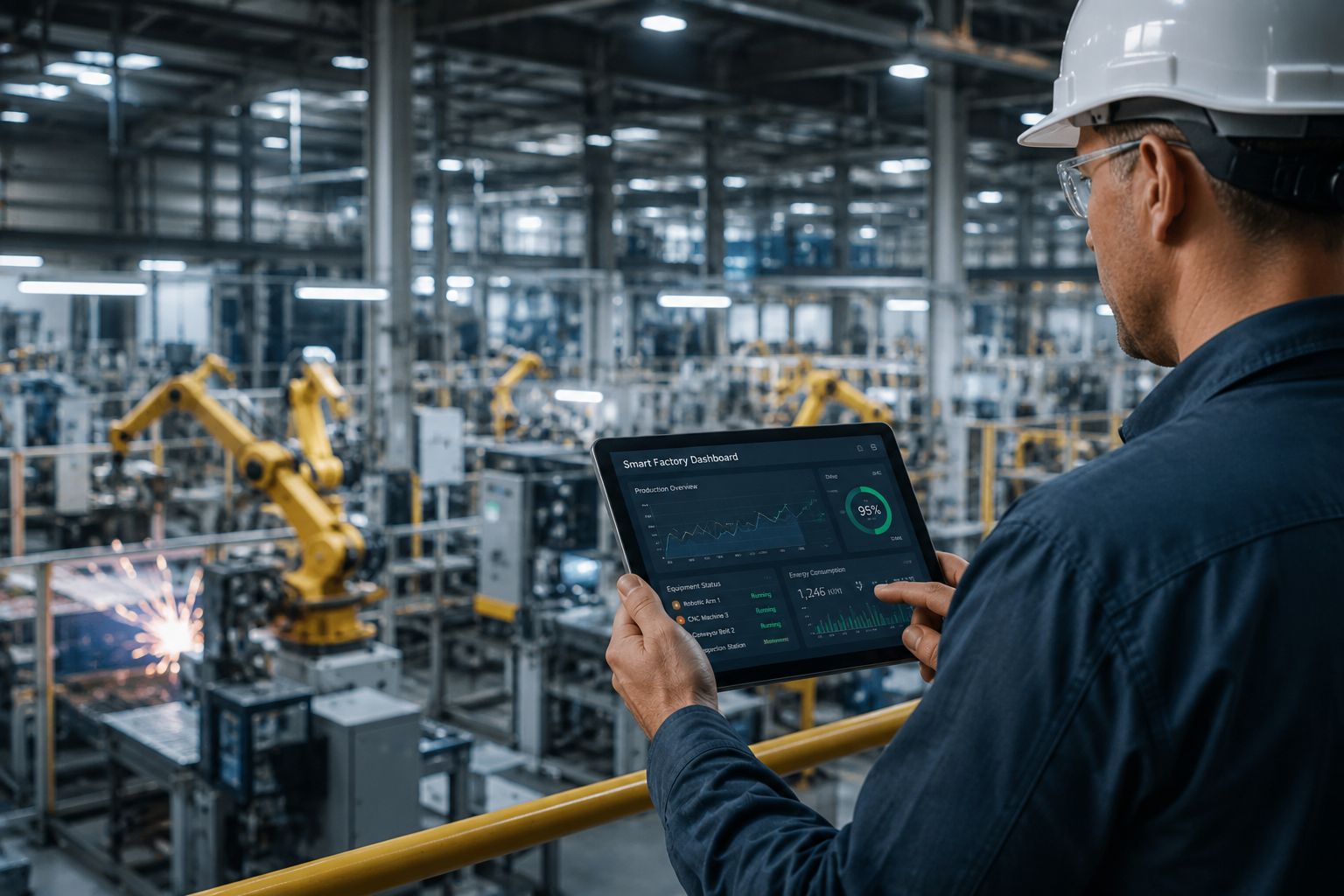
Using technologies like AI, the Internet of Things (IoT), and robotics, manufacturers can connect the physical and digital worlds to streamline production, optimize operations, reduce downtime, and make more informed decisions.
Digital Manufacturing vs. Traditional Manufacturing
Digital manufacturing differs from traditional manufacturing in several ways. Traditional manufacturing relies on manual labor, specialized machinery, large inventory, and long lead times to produce goods.
Digital manufacturing, on the other hand, utilizes advanced technologies to design, create, and deliver products. This enables manufacturers to respond more quickly to changing demand, reduce waste, maintain leaner inventories, and deliver more customized products.
Another key difference between the two is the level of automation. Rather than relying heavily on manual processes, digital manufacturing uses robotics and automation to streamline production, reducing the need for manual labor.
Finally, digital manufacturing offers improved quality control. By using AI-powered inspection systems, sensors, and real-time analytics to spot defects and errors early in the production process, businesses can reduce the risk of product recalls and improve the overall quality of their products.
Why Digital Transformation Is Reshaping the Manufacturing Industry
There are numerous reasons why digital transformation in the manufacturing industry is gaining traction. From rising operational costs to supply chain disruptions and an increasing demand for real-time visibility, manufacturers are using digital technologies to address long-standing challenges and improve operational resilience.
Labor shortages are also accelerating this shift. It’s estimated that up to 3.8 million additional manufacturing workers could be needed between 2024 and 2033, making automation, AI, and other digital technologies increasingly important for improving productivity and closing workforce gaps.
At the same time, customers are placing greater emphasis on sustainability, while AI is enabling manufacturers to optimize resource use, reduce waste, and build more efficient production processes.
Benefits of Digital Transformation in Manufacturing
Embracing digital manufacturing technology offers numerous advantages to companies. This innovative approach empowers businesses by streamlining processes, optimizing resource utilization, and ultimately strengthening their competitive advantage in an increasingly demanding market.
Let’s take a closer look at the benefits of digital transformation in manufacturing.
Increased Efficiency and Productivity
By automating processes and integrating data-driven technologies, digitalization in manufacturing streamlines operations, helping manufacturers eliminate repetitive tasks, reduce production bottlenecks, and strengthen productivity.
With these advancements, producers can create higher-quality products in less time and with fewer resources.
Reduced Costs
Digital transformation in manufacturing can significantly lower the costs of production by minimizing waste, optimizing the use of resources, and reducing the need for manual labor through automation and predictive maintenance.
This enables businesses to maintain a competitive edge while increasing profitability.
Enhanced Flexibility and Customization
Digital manufacturing technology allows manufacturers to quickly adapt production lines and create highly customized products using flexible production systems and automation.
This flexibility enables businesses to respond to changing customer demands while delivering personalized products more efficiently, resulting in greater customer satisfaction and brand loyalty.
Reduced Downtime Through Predictive Maintenance
By using AI, IoT sensors, and real-time equipment monitoring, manufacturers can identify potential issues before they lead to equipment failure. This allows maintenance to be scheduled proactively, helping reduce unplanned downtime, extend equipment lifespan, and keep production running smoothly.
Improved Quality and Consistency
By integrating advanced inspection systems and leveraging AI-powered analytics, digital manufacturing helps businesses ensure that products consistently meet the desired quality standards by detecting defects early and monitoring production in real time.
The result? Fewer defects, returns, recalls, and a strengthened company reputation in the market.
Data-Driven Decision Making
Digital manufacturing generates vast amounts of data that, when properly analyzed, can shed valuable light on the various aspects of the production process.
With a better understanding of production, manufacturers can make better-informed decisions, optimize operations, and identify new opportunities for improvement.
Supply Chain Optimization
Digital transformation in manufacturing allows companies to monitor operations in real time and strengthen communication across the supply chain through connected systems and shared data.
This improves coordination among suppliers, manufacturers, and distributors, helping companies reduce production times, strengthen inventory management, and respond more quickly to changes in demand.
Increased Sustainability
By minimizing waste, reducing energy consumption, and optimizing resource use through smart monitoring and automation, digital manufacturing software helps promote environmentally friendly practices.
While this is good news for the planet, it also helps strengthen a company’s brand image and attract more eco-conscious consumers.

Technologies Driving Digital Transformation in Manufacturing
Digital transformation in smart manufacturing relies on a range of advanced technologies to automate processes, improve visibility, and optimize production. Some of the most common technologies include:
Artificial Intelligence
In digital manufacturing, AI analyzes large volumes of data to optimize production, identify patterns, and improve decision-making. It’s also instrumental in the Design for Manufacturing (DFM) process, where it evaluates CAD files, creates digital twins, and generates accurate price quotes.
AI also facilitates collaboration between automation and humans, enabling real-time changes during production. Manufacturers can automate tasks, improve quality control, predict maintenance needs, and optimize workflows with AI-powered systems.
Internet of Things (IoT)
IoT devices collect and transmit data from equipment, sensors, and production lines. This gives manufacturers real-time visibility into their operations, allowing them to monitor equipment performance, identify issues early, and make informed decisions about production based on the data they receive.
Robotics and Automation
By employing advanced technologies such as robotics, vision systems, and automation software, companies can automate repetitive and precision-based tasks, optimizing production processes for better efficiency, reduced waste, improved safety, and more consistent product quality.
Additive Manufacturing (3D Printing)
3D printing simplifies the manufacturing process by reducing tooling costs and increasing design flexibility. It also enables rapid prototyping, reduces production time and material waste, and drives innovation and efficiency.
Digital Twin Technology
Digital twin technology is the process of creating a virtual replica of physical assets, production lines, end products, or operations. This technology enables manufacturers to identify potential issues, defects, and inefficiencies within their production systems.
By adopting digital transformation in manufacturing, businesses can simulate, test, and optimize their operations in a digital environment, reducing the need for physical prototypes and improving efficiency.
Cloud Computing
Cloud computing enables manufacturers to securely store, access, and analyze production data from anywhere while supporting real-time collaboration across teams and facilities. For example, a manufacturer can monitor production across multiple factories through a single cloud-based dashboard.
Digital Transformation Examples in Manufacturing
We don’t want to just tell you about the benefits of digital transformation in the manufacturing industry. We want to show you how it’s being applied in the real world.
While there are many ways to incorporate advanced technologies into manufacturing operations, here are some of the most common examples:
Smart Inventory Management
Predictive analytics helps manufacturers improve demand forecasting, leading to better inventory management, production planning, and supply chain coordination.
For example, one British luxury car manufacturer used machine learning to analyze historical customer demand and improve inventory forecasting. After just two months, the manufacturer reduced the inventory value of its safety stock by 18% while improving first-time availability to 97.1%.
Rapid Prototyping and 3D Printing
3D printing has proven to be key for speeding up product development by allowing manufacturers to prototype, test, and produce products faster while reducing production costs and material waste.
For example, Lindar Corporation adopted additive manufacturing to accelerate the production of prototype tooling. By using 3D printing, the company reduced lead times by more than 80%, from 8 to12 weeks to just 1 to 2 weeks.
AI-Powered Quality Inspection
AI-powered computer vision systems can inspect products in real time, detecting defects and inconsistencies that may be difficult for the human eye to spot.
For example, BMW uses AI-powered quality inspection in its production facilities to recommend tailored quality checks for each vehicle on the assembly line. By analyzing production data and identifying potential defects early, the company has improved inspection accuracy, streamlined quality control, and strengthened overall production efficiency.
“As a third-generation cabinetmaker running G&M Craftsman Cabinets, I’ve integrated Canva’s AI Design tools into our custom kitchen visualization process. This lets my team quickly generate multiple design concepts showing clients how their space will look with different materials and layouts before we build anything.
The efficiency gain was immediate – what used to take us days of manual drafting now takes hours. We complete 30% more consultations monthly and close deals faster since clients can visualize their dream kitchens earlier in the process. I’ve also been surprised how the AI helps bridge communication gaps when clients struggle to articulate exactly what they want.
For small manufacturing businesses considering AI, start with customer-facing applications where you can immeduately measure impact. When we first introduced AI visualizations, our close rate jumped 22% because clients could see themselves living in the space. Begin with tools that improve what you already do well rather than trying to reinvent processes that aren’t broken.
The hidden benefit was in our supplier relationships. We now use AI to analyze material usage patterns, which helps us negotiate better with suppliers by accurately forecasting our needs. This data-driven approach reduced our inventory costs by 15% while ensuring we never run short on critical materials for high-end projects. “
Brent Goschnick, Director, G&M Craftsman Cabinets
Digital Transformation in Automotive Manufacturing
It’s hard to talk about digital transformation in manufacturing without mentioning the automotive industry. This is clear from the examples above, where we discussed its role in producing an electric car and improving quality inspections.
Since digital transformation plays such an important role in this sector, it’s worth taking a closer look at how these technologies are shaping automotive manufacturing.
- Connected factories: Connected machines, sensors, and production systems share real-time data to improve visibility, streamline operations, and enable faster decision-making.
- Robotics: Advanced robotics automate repetitive and precision-based tasks, increasing production speed, consistency, and workplace safety.
- Vision inspection: AI-powered computer vision systems inspect components and finished vehicles for defects, helping improve quality while reducing manual inspections.
- Predictive maintenance: AI and IoT sensors continuously monitor equipment to identify potential failures before they cause costly downtime.
- Supplier integration: Digital platforms connect manufacturers with suppliers, improving communication, inventory management, and supply chain coordination.
- EV manufacturing: Digital technologies help optimize battery production, improve assembly processes, and support the efficient manufacturing of electric vehicles.
- Digital twins: Virtual replicas of vehicles, production lines, and manufacturing facilities allow manufacturers to simulate, test, and optimize processes before implementing changes.
Common Challenges of Digital Transformation in Manufacturing
While digital transformation offers significant benefits, adopting new technologies isn’t without its challenges. Before investing in digital manufacturing, businesses should consider the following:
- High upfront investment: Implementing technologies like AI, robotics, IoT, and 3D printing often requires a significant initial investment, along with the cost of upgrading infrastructure and training employees.
- Skills gaps: Digital manufacturing relies on specialized expertise in areas such as CAD, CAM, robotics, and data analytics. Finding and retaining employees with these skills can be difficult, particularly in regions where digital adoption is still emerging.
- Legacy systems: Many manufacturers still rely on outdated software and equipment that wasn’t designed to support modern digital technologies. Modernizing or replacing legacy systems can be a complex and time-consuming process.
- Integration complexity: Connecting new digital technologies with existing ERP systems, manufacturing execution systems, supply chain software, and production equipment can be challenging. Without proper integration, businesses may struggle to unlock the full value of digital transformation.
- Workforce adaptation: While automation can improve efficiency and reduce costs, it may also change existing job roles or reduce the need for manual labor. Businesses should plan for workforce training, reskilling, and change management to support a smooth transition.
The good news? These challenges can be addressed with the right strategy and technology partner.
At Scopic, our experienced development team can help manufacturers modernize legacy systems, integrate new technologies, and build scalable custom manufacturing software that supports long-term growth.
The 5 Stages of Digital Transformation in Manufacturing
Digital transformation in manufacturing doesn’t happen overnight. Instead, businesses typically move through a series of stages as they collect data, optimize processes, integrate digital technologies, and continuously improve operations.
While every organization’s journey is different, most digital transformation initiatives follow these five stages:

Data Collection and Analysis
The first stage involves collecting data from sources such as sensors, IoT devices, machines, and enterprise resource planning (ERP) systems. Manufacturers analyze this information to identify inefficiencies, uncover trends, and pinpoint opportunities for improvement.

Process Optimization
Using these insights, manufacturers optimize production workflows by automating repetitive tasks, improving resource allocation, and reducing bottlenecks. This stage lays the foundation for a more efficient and connected operation.

Digital Implementation
Once opportunities have been identified, manufacturers begin implementing digital technologies such as AI, IoT, robotics, cloud platforms, and digital twins. These solutions are deployed where they can deliver the greatest operational value.

System Integration
Next, businesses integrate their digital technologies with existing software, equipment, and production systems. Connecting data across departments enables real-time visibility, better collaboration, and more informed decision-making.

Continuous Improvement
Digital transformation is an ongoing process rather than a one-time initiative. Manufacturers should continuously monitor performance, analyze operational data, and refine their processes to improve efficiency, productivity, quality, and sustainability over time.
How to Get Started with Digital Transformation in Manufacturing
Knowing where to begin can often be the biggest challenge. Rather than transforming every part of your business at once, it’s best to start with a clear strategy and scale your initiatives over time.
Follow these 8 steps:

Top Digital Transformation Trends in Manufacturing
Digital transformation is evolving rapidly, with new technologies changing how manufacturers automate operations, improve efficiency, and make decisions.
Here are three trends shaping the future of manufacturing:
- Agentic AI: Unlike traditional AI tools that simply respond to prompts, agentic AI can make decisions and complete multi-step tasks with minimal human intervention. In manufacturing, AI agents have the potential to manage production schedules, coordinate supply chains, optimize workflows, and respond to operational issues in real time.
- Hyperautomation: Manufacturers are moving beyond automating individual tasks and toward automating entire workflows. By combining AI, robotics, IoT, and robotic process automation, businesses can create connected processes that reduce manual work, improve productivity, and streamline operations from end to end.
- Sustainable Manufacturing: Sustainability is becoming a business priority rather than just a compliance requirement. Digital technologies help manufacturers monitor energy consumption, reduce waste, optimize resource usage, and lower emissions while improving operational efficiency and supporting long-term environmental goals.
Final Thoughts
Digital transformation in manufacturing is changing the way manufacturers operate, helping businesses improve efficiency, reduce waste, and stay competitive in an increasingly digital world.
Whether you’re just beginning your digital transformation journey or looking to expand your existing capabilities, the key is to start with a clear strategy and the right technology. By taking a step-by-step approach, manufacturers can build more connected, efficient, and future-ready operations.
At Scopic, we combine manufacturing software development and AI development services to help manufacturers modernize legacy systems, automate processes, and build custom solutions that support long-term growth.
Interested in learning more? Schedule a free consultation today.
FAQs about Digital Transformation in Manufacturing
How is digital transformation different from Industry 4.0?
Digital transformation is the broader process of using digital technologies to improve business operations, workflows, and decision-making. Industry 4.0 is a specific phase of manufacturing that focuses on connected technologies such as AI, IoT, robotics, cloud computing, and smart factories to enable more intelligent and automated production.
What technologies drive digital transformation?
Some of the most common technologies driving digital transformation include AI, IoT, cloud computing, robotics, automation, digital twins, machine learning, and advanced data analytics.
What are examples of digital transformation in manufacturing?
Digital transformation in manufacturing examples include AI-powered quality inspection, predictive maintenance, smart inventory management, digital twins, connected factories, robotic automation, and 3D printing.

About Digital Transformation in Manufacturing Guide
This guide was authored by Lesley Comeau, and reviewed by Nhat Bui, Deputy Director of Engineering at Scopic Software. It has since been updated by Baily Ramsey.
Scopic provides quality and informative content, powered by our deep-rooted expertise in software development. Our team of content writers and experts have great knowledge in the latest software technologies, allowing them to break down even the most complex topics in the field. They also know how to tackle topics from a wide range of industries, capture their essence, and deliver valuable content across all digital platforms.