Table of Contents
Listen to article
eLearning is quickly transforming how schools, institutions, and companies approach online learning and training.
And while the old-school pen-and-paper approach may still work for some organizations, it’s hard to deny that creating your own educational software is key to staying relevant in the ever-evolving educational industry.
Many questions are probably coming to mind: How do I navigate this process? What features should I implement? What does my target audience need?
With custom software development services like those provided by Scopic becoming increasingly essential, these are just some of the questions that need clear answers.
Dive into this topic with us as we explore different types of educational software, key features, and how to choose the right education software development company.
Understanding the Educational Software Market
The global education technology market is projected to reach 437.54 billion dollars by 2033, growing at a CAGR of 10.8% from 2026 to 2033.
From academic and institutional use to industrial and commercial applications, educational software solutions are quickly transforming how students and individuals access and interact with educational content. By replacing traditional in-person learning and pen-and-paper tests with digital platforms, real-time feedback, and instant grading, users are quickly realizing the benefits of these applications.
As adoption continues to grow, it’s important to recognize that education is not one-size-fits-all. The educational landscape is vast, with many different policies, practices, techniques, and norms. This creates opportunities for companies and institutions to develop software that aligns with the modern learning environment.
Many institutions are also finding value in understanding the unique needs of diverse learners. Though generic learning apps work for some, custom eLearning software enables more personalized, adaptive learning experiences tailored to individual needs and learning styles.
With the rise of AI, many platforms now incorporate intelligent tutoring systems, predictive analytics, and adaptive learning paths to further enhance engagement and outcomes.
“Technology has transformed the way students interact with educational material. In my finance classes, introducing simulation software has enabled students to apply theoretical concepts to real-world scenarios. This hands-on approach not only deepens understanding but also boosts engagement.”
– Dennis Shirshikov, Head of Education at itutor
Different Types of Education Software Development
Educational software development caters to a wide range of educational needs, including:
- Learning Management System (LMS) Development: Software applications that are used to plan, implement, and assess a specific learning process.
- Courseware Development: Educational material that provides self-paced learning, such as lessons, assessments, and activities.
- Assessment and Testing Tool Development: Tools like ProProfs Quiz Maker are used to measure a student’s academic abilities and skills in a specific subject.
- Educational Game Development and Gamification Tools: Software that turns educational content into fun, interactive games.
- Simulation Tool Development: Learning tools that allow students to apply their knowledge to “real-world” situations.
- Tutorial Software Development: Software that helps instructors create interactive learning tools for students.
- Virtual Classrooms: A video conferencing tool that allows teachers and students to connect from anywhere in the world.
- Language Learning Software Development: Software programs that are designed to help users improve their foreign language skills.
- Special Educational Needs (SEN) Software Development: Custom applications that provide learning aids to students with special education needs.
- Classroom Management Software Development: Software that helps teachers manage and organize various aspects of their classroom.
- Student Information System (SIS) Development: Software that helps educational institutions manage and organize important student data.
- Collaborative Learning Tool Development: Platforms designed to facilitate collaborative learning experiences among students.
- Multimedia Creation and Editing Tool Development: Software designed for creating, editing, and enhancing multimedia content, including a PowerPoint to SCORM converter for transforming presentations into e-learning modules.
- Interactive Whiteboard Software Development: An interactive classroom tool that lets teachers show presentations to the whole classroom.
- Adaptive Learning Software Development using AI and ML: Technology that tailors learning experiences to individual learners’ needs and abilities, reflecting the latest modern education trends in data-driven personalization.
- Parent-Teacher Communication Software Development: Platforms that streamline communication between parents and teachers.
- Library Management Software Development: Software designed to manage all the functions of a library, including collections, resources, and operations.
Developers and clients must work closely throughout custom educational software development to create software that meets the needs of their specific audience. By carefully defining the target audience, must-have features, and navigation of the app, businesses can create educational software that provides personalized learning experiences.
“Since adopting personalized learning software, we’ve observed a notable increase in student retention rates and overall academic performance. For example, course completion rates have risen by 15%, and there has been a marked improvement in assessment scores across subjects. These metrics underscore the positive impact that well-implemented technology can have on education.”
– Dennis Shirshikov, Head of Education at itutor
Educational Software by Audience and Use Case
Companies interested in building educational software must have a clear target audience in order to meet their unique needs. For instance, if you’re training employees, you wouldn’t give them a parent-teacher communication system, would you?
Of course not. And while that may seem obvious, matching your target audience with the right platform is the foundation of successful development efforts.
Here’s a guide to the types of platforms typically used by different audiences:
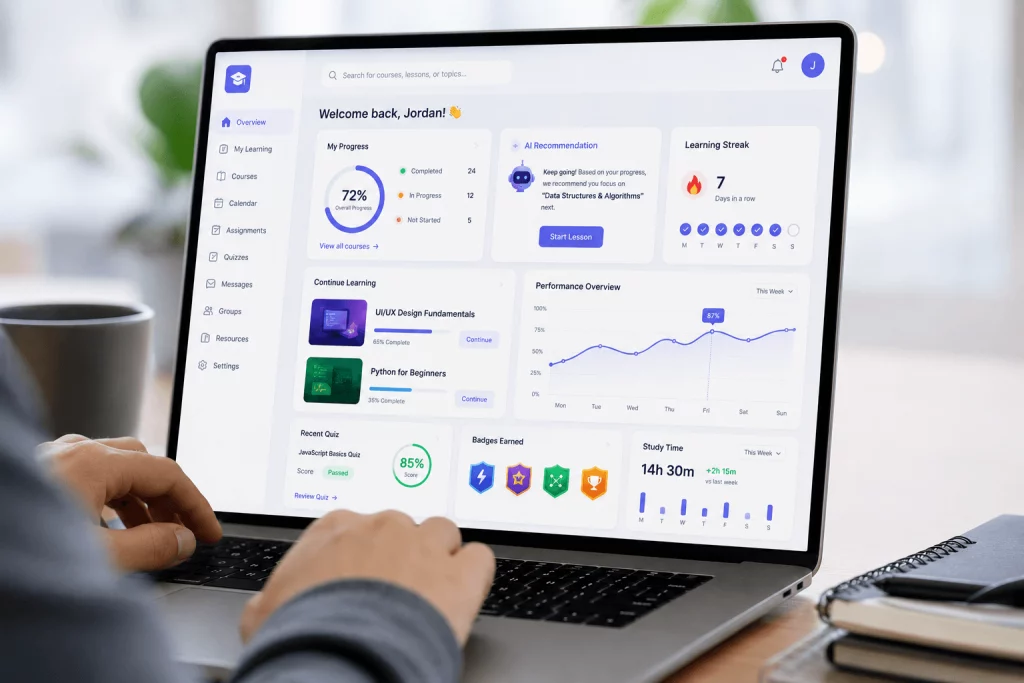
K–12 Education → Focuses on interactive learning, gamification, and accessibility features, often using tools like educational games, tutorial software, and classroom management systems to support younger learners.
Higher Education → Prioritizes scalability, advanced analytics, and integrations, typically leveraging learning management systems, student information systems, and virtual classrooms to manage large volumes of users and data.
Tutoring / Coaching Platforms → Emphasize personalized learning experiences, one-on-one communication, and scheduling, and are commonly built with courseware, assessment tools, and collaborative learning platforms.
Corporate Training / Compliance Learning → Designed for employee development, these platforms often include certifications, compliance tracking, and reporting, frequently incorporating LMS platforms, assessment tools, and AI-driven learning systems.
Key Features of Modern Educational Software
With all the different types of educational software on the market, it can be hard to determine what features your specific project requires. While the exact features are determined based on your custom education software, here are the key features that are commonly found in these types of applications:
- Content delivery: Many educational software solutions rely on learning materials, such as documents, videos, and modules, to be distributed to users, ensuring easy access and the security of sensitive learning materials.
- Assessments and feedback: Platforms with built-in assessment tools make it easier for schools and institutions to deliver exams, grade answers, and evaluate results efficiently.
- Gamification: Game-like elements such as scoring systems, badges, and interactive challenges help keep users engaged and encourage ongoing participation and knowledge retention.
- Analytics/progress tracking: Real-time analytics, attendance tracking, and AI-powered tools that provide insights into students’ progress help keep users on track and reduce the time associated with manual follow-ups.
- AI-powered interactive learning: AI in educational software, such as personalized recommendations, adaptive learning paths, and intelligent tutoring systems, enhances engagement and improves learning outcomes.
- Accessibility: To ensure everyone can access and engage with an application, certain features should be implemented, such as text-to-speech, high-contrast displays, and customizable interfaces for ease of use.
- Offline access: Offline learning enables users to download and complete materials even without a stable internet connection, thereby removing potential learning barriers.
- Integrations: Seamless integrations with third-party tools, such as learning management systems, communication platforms, and payment gateways, help streamline workflows and enhance functionality.
- User-friendly interface: Clear dashboards, easy navigation, and readable data, among other elements, enable a smooth learning experience and reduce the learning curve.
Considerations for Development and Implementation
Educational software developers must carefully plan every step of the process and take necessary precautions throughout development. But what considerations are at the forefront of the development process?
Keep reading to explore this topic in more detail.
Technology Stack
A tech stack is a collection of tools, programming languages, and technologies that support software. Education software developers must build a tech stack with the following in mind:
- Budget. The client’s budget has a direct impact on how a tech stack is built. Developers must find the best available options that comply with both budget constraints and technology requirements.
- Compatibility with Educational Needs: Before choosing a tech stack, developers must consider the educational goals of the software, the target audience, where they will be using it, and what functions are required. This will help them choose the right tools and programming languages to fulfill the needs of the system.
- Scalability and Flexibility: The eLearning system should be created with the ability to expand as the needs of the business grow. This flexibility allows businesses to adapt to the number of users they may have in the future and helps them stay relevant as educational needs evolve.
- User Experience: A huge part of educational software development is creating an app that’s easy to navigate and has intuitive user interfaces. Educational software developers work to ensure that the tech stack aligns with creating an engaging system that attracts and retains users.
- Accessibility and Compliance: eLearning applications must comply with educational and accessibility standards to ensure consistency and quality in education. WCAG, for instance, guarantees that web content is accessible to all individuals, including those with disabilities. Developers must keep this in mind during custom education software development.
User-Centric Design
Developers work closely with their clients to create a user-centric design that is developed with the user in mind. The goal of UX design for education is to create an intuitive learning experience that’s engaging, involves users at every stage of the design process, and considers both educators and students.
As mentioned, one of the concerns is designing software that is accessible to all users, including those with disabilities. Below, we outline the core WCAG standards that help ensure accessibility.
Security and Data Privacy
Taking direct security and data privacy measures helps protect personal student information, academic records, financial details, institutional data, and even health records. Some of the ways this information is protected are through regular security updates and training, transparent privacy policies, incident response protocols, role-based data access permissions, data encryption, and secure access control.
Software also must comply with relevant data privacy laws and regulations. At Scopic, we prioritize security and data privacy throughout every step of educational software development. Our team follows all required laws and regulations to create a trustworthy atmosphere for learning.
Deployment and Implementation Strategy
Developers should have a software implementation plan in place that plans, manages, and controls the software release through various stages. This plan defines the tasks that must be accomplished by different members of the team, clearly outlining timelines, resource allocation, and rollout phases.
Software development companies should also be prepared to handle potential challenges during implementation. Common problems include user resistance, technical issues, scope creep, resource constraints, project management challenges, and scalability, among others.
A detailed software implementation plan helps manage potential problems through careful planning, risk assessments, and a clear project management strategy.
What You Need to Know About Compliance in Educational Software
You could build the most advanced and engaging application on the market, but if it doesn’t meet compliance standards, you could be at risk of legal issues, fines, and loss of user trust.
Here’s a summary of key compliance regulations:
- SCORM / xAPI / LTI: By supporting standards such as SCORM, xAPI, and LTI, educational software can deliver interoperable content, track learner activity, and integrate with external learning systems more efficiently.
- WCAG: WCAG standards ensure that software is perceivable, operable, robust, and understandable for all users. Some of the strategies that designers use to accomplish this include offering keyboard navigation alternatives, making menus and buttons obvious and consistent, and making interactive features predictable.
- FERPA / COPPA / GDPR: Educational software must comply with key data privacy regulations depending on the market and audience. FERPA protects student records in the U.S., COPPA regulates data collection from children under 13, and GDPR governs personal data protection in the European Union.
With Scopic’s product development consulting, you can navigate these compliance requirements and build secure and reliable educational software solutions tailored to your needs.
Cost & Timeline of Educational Software Development
With different types of applications, features, and strategies, there’s a looming question that we all want to know: What is the cost of custom development, and how long does it take?
The price can range from anywhere from $10,000 to over $100,000, with timelines ranging from a few months to over a year, largely depending on the project’s complexity.
Take a look at the following chart to better understand how costs and timelines vary across different project sizes:
|
Size of Project |
Examples |
Cost |
Timeline |
|
MVP/Basic Learning Project |
Simple e-learning app, basic course platform, quiz-based app, apps with limited user roles |
$10,000 – $30,000+ |
2 – 4+ months |
|
Mid-Level Platform |
LMS with user dashboards, progress tracking, integrations, gamification features |
$30,000 – $70,000+ |
4 – 8+ months |
|
Enterprise/Multi-Role System |
Advanced LMS with multiple user roles (admins, teachers, students), AI features, analytics, integrations, scalability support |
$70,000 – $100,000+ |
8 – 12+ months |
Want a more detailed quote? Scopic offers custom application development services tailored to each client’s unique needs. Contact us to learn more.
How to Choose the Right Education Software Development Company
Choosing an experienced software development partner is key to your project’s success. But what qualities should a business look for when choosing a software development company?
Here are some of the most important factors to consider:
- Experience with education workflows
- Interoperability/integration experience
- Accessibility expertise
- Security/privacy familiarity
- Experience with multi-role products
- Ability to create scalable software
- Reliable end-to-end testing measures
- Communication and customer service skills
- Industry-specific expertise reflected in past reviews and case studies
Aside from these factors, a huge part of custom educational software development is choosing a company that does just that: creates customized solutions based on the specific needs of your project. A reliable company will take the time to truly understand what you want and need from your eLearning application.
Scopic’s education software development services are perfect for businesses wanting to bring customized solutions to their classroom or employees. Our team will work closely with you to create an intuitive platform that brings your vision to life.
Our Expertise in Educational Software Development
Scopic develops unique education software solutions for both companies and educational institutions. We have a large educational software development portfolio for you to explore. Here are some of our favorite projects:

FindUniquelyU
FindUniquelyU partnered with Scopic to create a global platform that allows students to interact with industry leaders. The goal of this eLearning application is to connect students with instructors in small, interactive workshop groups.
To bring their vision to life, Scopic’s team of developers created a learning platform with advanced features, including live workshops with recorded sessions, an events calendar, a campus store, a U-classroom space for U-instructors, and workshop browsing and purchase. This partnership resulted in a successful eLearning app that created a community of creators and students.

Datability Mobile App
The vision behind Datability Mobile App was to streamline the Individualized Education Plan, a program for children with disabilities that identifies learning opportunities specific to them. To use the data from this program more efficiently and create future strategies, the founder of Datability Mobile App contacted Scopic for custom software development.
Scopic’s team created an easy-to-use app that makes it simple to access important data, generate student data reports, and improve compliance.

Language Dynamics Group
Language Dynamics Group empowers students by providing innovative assessments that target their language skills. To increase brand awareness and reach a wider audience, they partnered with our marketing team, who successfully ran various marketing campaigns, including email and social media marketing, Google Ads, and Amazon marketing.
Our team also managed the theme development of their WordPress site and set up products and payment options on the WooCommerce platform. Through a combination of our expertise in website development, WooCommerce, Mailchimp, and ads, Language Dynamics Group now offers language learning tools to a variety of students.
Final Thoughts
Custom education software development is becoming increasingly important in today’s technology-driven world. Used in both the classroom and in the workplace, eLearning apps tailor to different levels of education and learning strategies.
At Scopic, we understand the importance of developing an app that’s credible, compliant, and engaging. If you’re looking for a software product development company, contact us today.
Education Software Development FAQs
What Are the Challenges in Educational Software Development?
Education technology software development faces multiple challenges that are specific to education. This includes alignment with pedagogy, user engagement, accessibility and inclusivity, integration with existing systems, regulatory compliance, and security. However, an experienced education software developer will know how to address all of these challenges.
Can Educational Software Be Customized for Different Educational Levels?
Yes, educational software can be customized for different levels of education and various target audiences. The key to custom educational software development is working with a company that has experience customizing key features and learning paths to better assist your users.
What Is the Future of Educational Software Development?
The education technology market is on the rise and is expected to continue growing over the coming years, with both students and staff depending on it even more. As technology evolves, we expect that educational software development will also adjust to keep up with trends and education requirements. We predict an increase in artificial intelligence, eLearning networks, and virtual reality.
What standards should education software support?
Educational software should support key interoperability, accessibility, and data privacy standards to ensure effective and compliant functionality. This includes SCORM, xAPI, and LTI for seamless integration and content delivery, WCAG for accessibility, and regulations like FERPA, COPPA, and GDPR to protect user data based on region and audience.
How do you choose between custom and off-the-shelf education software?
The decision between off-the-shelf and custom education software depends on your specific functionality needs and budget. Custom software typically involves higher upfront costs but offers greater personalization, scalability, and flexibility to improve the user experience over time, while off-the-shelf solutions are more cost-efficient and quicker to implement but provide less customization and long-term adaptability.
What makes educational software accessible and scalable?
Educational software is accessible and scalable when it supports diverse users while maintaining performance as demand grows. This includes WCAG-compliant features for accessibility and a flexible, cloud-based infrastructure to handle increasing users and data efficiently.

About Education Software Development Guide
This guide was authored by Baily Ramsey, and reviewed by Vyacheslav Korchagin, Principal Engineer with experience in leading and delivering complex software and application development projects.
Scopic provides quality and informative content, powered by our deep-rooted expertise in software development. Our team of content writers and experts have great knowledge in the latest software technologies, allowing them to break down even the most complex topics in the field. They also know how to tackle topics from a wide range of industries, capture their essence, and deliver valuable content across all digital platforms.