

Table of Contents
Listen to article
Note: This post was updated on December 30, 2025, to reflect new information.
A single-visit crown that used to require two weeks now takes an hour. Root canals that once relied on guesswork now use three-dimensional imaging showing every canal before treatment begins
Digital dentistry solutions are transforming clinical practice at an accelerating pace. The global market is growing rapidly and is projected to reach $9.22 billion by 2032 as practices across all specialties adopt these technologies.
This guide covers the essential digital dentistry solutions modern practices need. You’ll learn what each technology does, what it costs, how different specialties use it, and how to plan implementation that fits your practice type and patient volume.
What Is Digital Dentistry?
Digital dentistry solutions replace traditional manual processes, physical impressions, film X-rays, paper charts, with computer-based technologies that capture, analyze, and share patient data digitally. Modern digital dentistry solutions span three interconnected areas:
- Clinical Technology: Intraoral scanners, CBCT imaging, CAD/CAM systems, and 3D printers that digitize patient anatomy and fabricate restorations.
- Software Systems: Practice management platforms, treatment planning software, and design programs that process clinical data and coordinate workflows.
- Integration Infrastructure: The often-overlooked layer of APIs, data standards (DICOM, STL, HL7), and custom interfaces that enable different digital dentistry solutions to exchange information seamlessly.
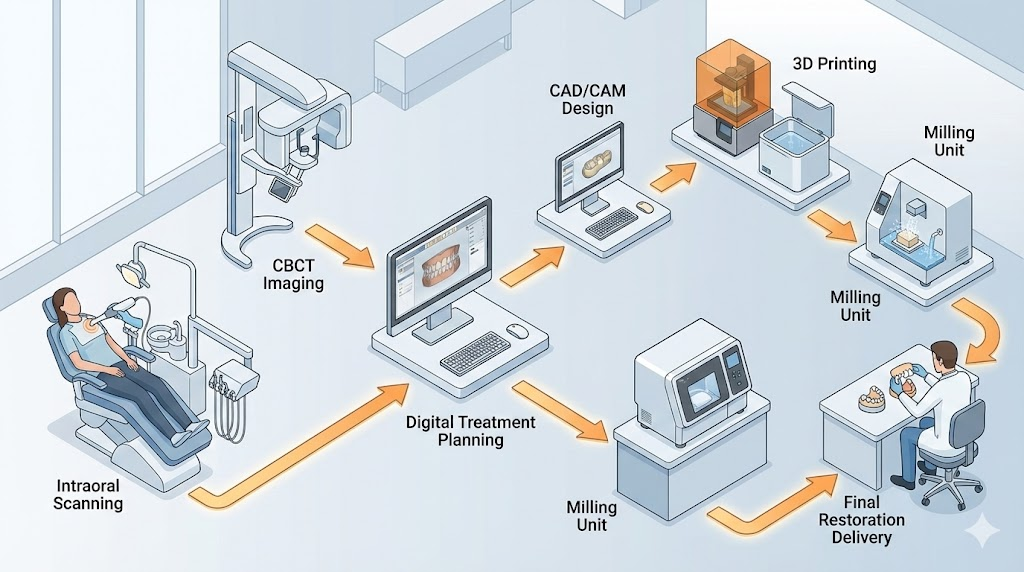
While industry surveys show that the vast majority of dental professionals recognize the value of digital technology, successful implementation requires more than purchasing equipment. It demands a coherent software strategy that connects clinical tools with administrative systems, ensuring data flows efficiently from initial scan to final billing.
Key Differences Between Traditional and Digital Dentistry
The shift to digital dentistry solutions changes practice operations in ways that aren’t obvious until you’re actually using the technology. The clinical benefits get most of the attention, but the operational differences matter just as much.
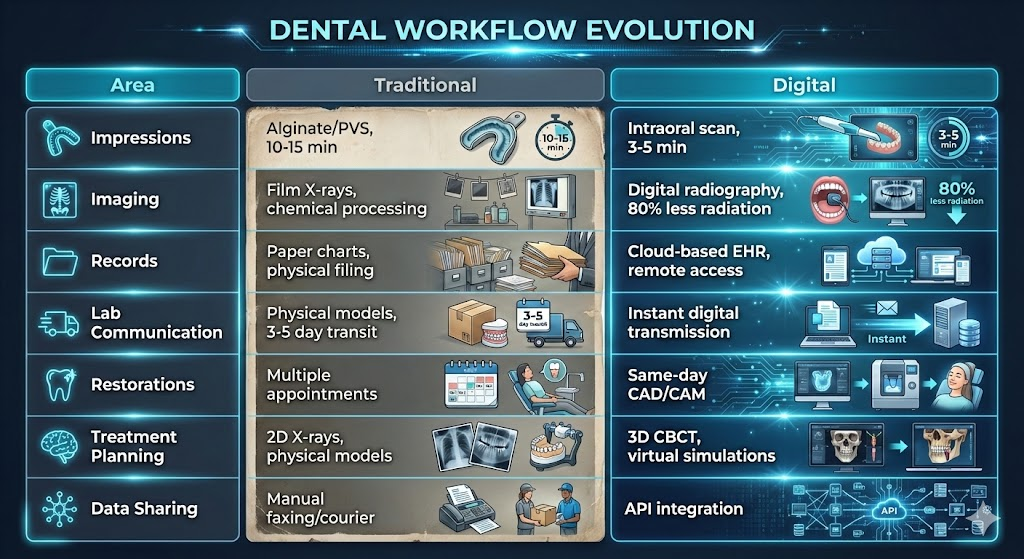
Impressions
- Traditional: Alginate or PVS materials, 10-15 minutes per impression, patient discomfort, frequent retakes
- Digital: Intraoral scanner, 3-5 minutes, comfortable for patients, immediate digital file
Imaging
- Traditional: Film X-rays, chemical processing, physical storage, higher radiation
- Digital: Digital radiography, less radiation, instant viewing, image enhancement
Patient Records
- Traditional: Paper charts, physical filing rooms, manual copying for referrals
- Digital: Cloud-based EHR, access from anywhere, instant secure sharing
Lab Communication
- Traditional: Physical models shipped via courier, 3-5 day transit time
- Digital: Digital files transmitted instantly, no shipping delays or damage
Restorations
- Traditional: Multiple appointments, temporary placements, two-week wait times
- Digital: Same-day CAD/CAM fabrication possible, single-visit treatment
Treatment Plan
- Traditional: 2D X-rays, physical study models, limited visualization
- Digital: 3D CBCT imaging, virtual simulations, precise planning
Data Sharing
- Traditional: Photocopies, fax machines, courier services for records
- Digital: Secure electronic transmission, automatic documentation
Digital Dentistry Solutions by Specialty
Digital dentistry solutions impact different specialties in distinct ways. The following sections explain how restorative, orthodontic, implant, endodontic, and prosthodontic practices leverage digital technology to transform their specific clinical workflows.
Restorative Dentistry
Restorative dentistry repairs or replaces damaged teeth through crowns, bridges, veneers, and inlays. Digital dental technology transformed this specialty by enabling single-visit treatment through chairside fabrication, replacing uncomfortable impression materials with optical scanning, and shifting restoration design from manual laboratory wax-ups to computer-aided design where practitioners adjust margins and occlusion on-screen before fabrication.
Orthodontics
Orthodontics corrects misaligned teeth through gradual repositioning to improve function and appearance. Digital technology and AI transformed orthodontics by replacing physical model analysis with computer simulation showing tooth movement from start to finish, enabling clear aligner therapy through digital scanning and computer-aided planning, and introducing remote monitoring systems that track progress between office visits.
Implant Dentistry
Implant dentistry replaces missing teeth with titanium posts surgically placed in jawbone. Digital dentistry solutions transformed this specialty through three-dimensional imaging that reveals complete surgical site anatomy, virtual positioning that accounts for anatomical constraints and prosthetic needs simultaneously, and fabricated surgical guides that transfer digital plans to the operating field while reducing complications.
Endodontics
Endodontics treats diseased dental pulp through root canal therapy by locating, cleaning, and sealing all canals within a tooth. Digital dentistry technology transformed this specialty through three-dimensional imaging that detects complex anatomy before treatment, software visualization that identifies additional canals and unusual configurations invisible on two-dimensional films, and digital documentation providing objective evidence of treatment completion quality.
Prosthodontics
Prosthodontics replaces missing teeth through removable or fixed prostheses including dentures and implant-supported restorations. Digital technology transformed this specialty by capturing tissue surfaces without compression through optical scanning, positioning teeth based on phonetic requirements and facial measurements simultaneously in design software, and enabling immediate prosthesis reproduction from stored digital designs when patients lose or damage devices.
Benefits of Digital Dentistry Solutions
Digital dentistry solutions deliver measurable improvements across every aspect of practice operations. The benefits extend beyond individual tools to affect diagnostic accuracy, treatment outcomes, workflow efficiency, and patient satisfaction.
Enhanced Digital Diagnostics in Modern Dentistry
Digital imaging technologies detect conditions that traditional methods miss. Cone Beam Computed Tomography provides a clear example: in comparative studies, CBCT identified root resorption in 33 instances where conventional radiography found only 13 cases. That 154% improvement in detection rate means dentists catch problems earlier and plan treatments with greater precision.
The diagnostic advantage extends beyond individual scans. When imaging systems connect with practice management software, documentation happens automatically. Treatment plans generated from CBCT data flow directly into patient records without manual re-entry, reducing administrative time while improving accuracy.
Streamlined Workflows
Digital dentistry solutions eliminate steps that consumed significant staff time in traditional workflows. Physical impressions required mixing materials, waiting for them to set, packaging models, and shipping to labs. Digital scans capture the same information in minutes and transmit files instantly.
The time savings compound across the practice:
- Appointment scheduling around lab turnaround times disappears when digital files arrive in minutes instead of days
- Chart documentation that required manual entry into multiple systems happens automatically when platforms connect
- Treatment coordination between specialists improves when everyone accesses the same digital records
Practices report treating more patients monthly after implementing digital workflows, not by working longer hours but by eliminating inefficient manual processes.
Improved Treatment Accuracy
Chair-side CAD/CAM systems demonstrate how digital dentistry solutions improve clinical outcomes. Traditional crown fabrication involved impressions, temporary placements, and hoping the final restoration fit properly when it returned from the lab. Digital workflows scan the preparation, design the crown with precise margin specifications, and mill the restoration while the patient waits.
The accuracy difference is measurable. Digital workflows achieve margin fits within 50-80 microns compared to 100-150 microns for traditional lab work. That precision means:
- Fewer chairside adjustments during delivery
- Better long-term restoration survival rates
- Reduced need for remakes due to fit issues
- Single-visit treatment completion
The accuracy depends on clean data transfer from scanner to design software to milling machine. Practices achieving the best results ensure their equipment communicates properly rather than relying on manual file exports and imports between systems.
Increased Patient Comfort
Patient comfort improves in tangible ways with digital dentistry solutions. Intraoral scanners eliminate gagging, and discomfort associated with impression materials. Scans take 3-5 minutes compared to 10-15 minutes with traditional methods, and patients don’t experience the unpleasant taste or texture of impression compounds.
Digital radiography reduces radiation exposure significantly compared to film X-rays while producing higher-quality images. Patients see the results immediately on screens, which helps them understand diagnoses and recommended treatments.
Personalized Treatment Plans
Digital dentistry solutions enable treatment planning based on each patient’s specific anatomy. Implant planning demonstrates this clearly: practices combine CBCT scans, intraoral scans, and photographs to create comprehensive surgical plans.
Treatment planning software uses this data to:
- Position implants based on bone quality and prosthetic requirements
- Generate surgical guides for precise execution
- Create provisional restorations before surgery
- Simulate final outcomes for patient review
This level of personalization requires combining data from different sources. Modern treatment planning software handles multiple file formats, though practices should verify their systems communicate properly.
The Top 7 Digital Dentistry Tools You Need to Know About
Digital dentistry solutions span multiple technology categories, each addressing specific clinical or operational needs. The following seven digital dentistry tools represent the core technologies practices use to digitize workflows, from diagnostic imaging and treatment planning to chairside fabrication and patient communication.

Digital Imaging and CBCT Technology
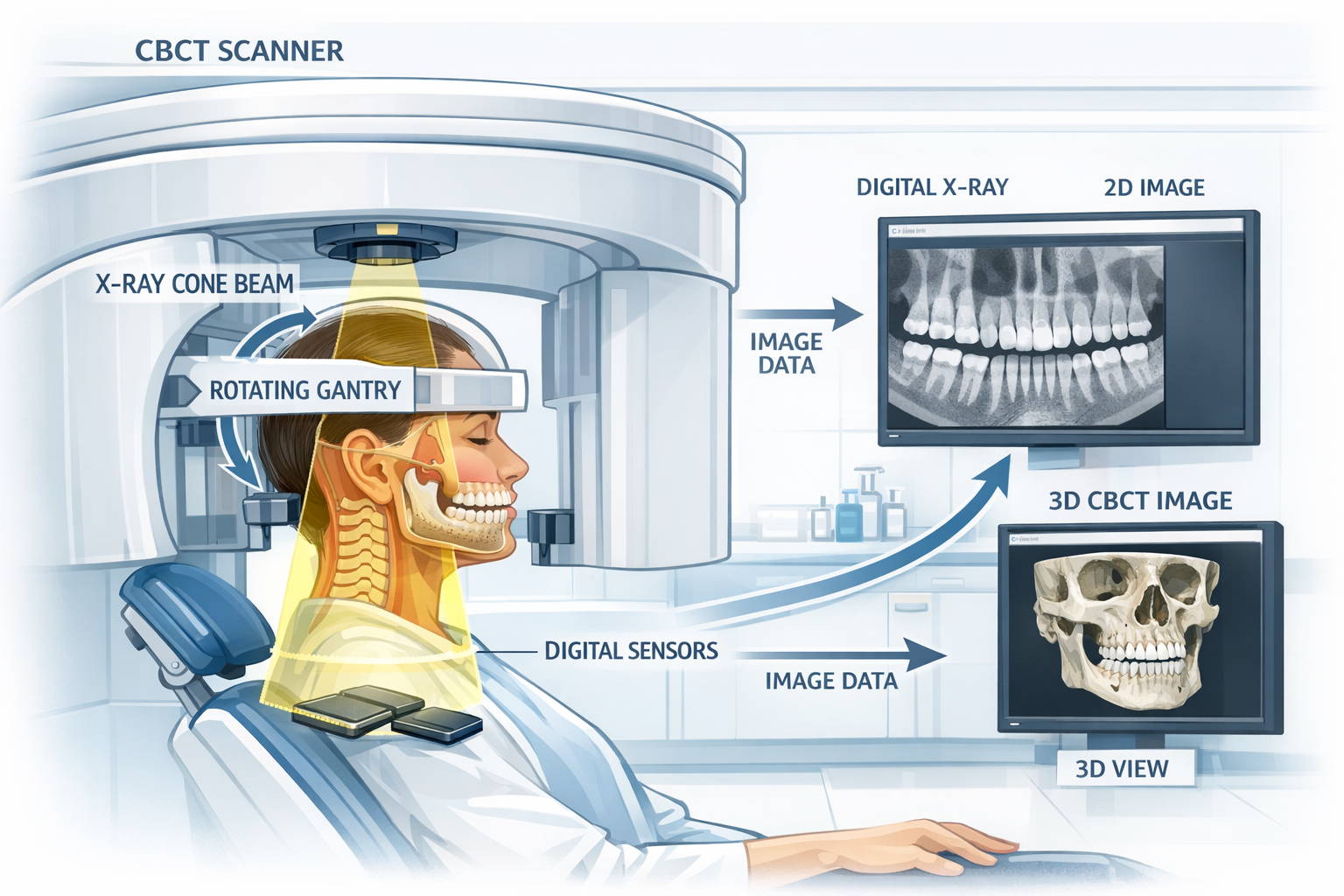
Advanced digital imaging technologies have improved dental diagnostics. Cone Beam Computed Tomography (CBCT) provides detailed 3D images of teeth, soft tissues, nerves, and bone structure in a single scan. This precision enables dentists to:
- Plan precise implant placements
- Detect oral health issues earlier
- Evaluate bone structure accurately
- Create detailed treatment plans
Leading providers: Planmeca, Dentsply Sirona, Carestream Dental;
CBCT generates DICOM files requiring compatible viewing software and adequate storage. Systems should integrate with implant planning software for cases combining CBCT data with intraoral scans.
Units range from $40,000 to $150,000 depending on field of view and resolution. Practices performing regular implant work or complex endodontics typically see ROI within 18-24 months through increased case acceptance and reduced specialist referrals.

Digital Radiography & 3D Imaging
Building on advanced imaging capabilities, digital radiography in dentistry takes diagnostics further by reducing radiation exposure by up to 80% compared to traditional X-rays. Integrated with a radiology information system, this technology produces instant, high-quality images that can be enhanced, stored, and shared digitally. Benefits beyond radiation reduction:
- Instant image viewing without development time
- Image enhancement tools for contrast adjustment and measurement
- Immediate retakes if positioning was incorrect
- Digital storage eliminates physical filing space
- Easy sharing with specialists and insurance companies
Leading providers: Dexis, Schick by Dentsply Sirona, Carestream Dental;
Digital radiography systems should connect with practice management software for automatic patient record documentation. Most modern systems support this, though older platforms may require updates.
Complete digital radiography setup including sensors and software typically costs $8,000 to $15,000 for a single operatory. Sensor longevity averages 5-7 years with proper handling.

CAD/CAM Systems
As part of modern digital dentistry solutions, Computer-Aided Design and Computer-Aided Manufacturing (CAD/CAM) systems revolutionize restorative procedures. The global dental CAD/CAM market is projected to grow from $2.40 billion in 2024 to $4.61 billion by 2032, demonstrating the increasing adoption of this digital technology in dentistry.
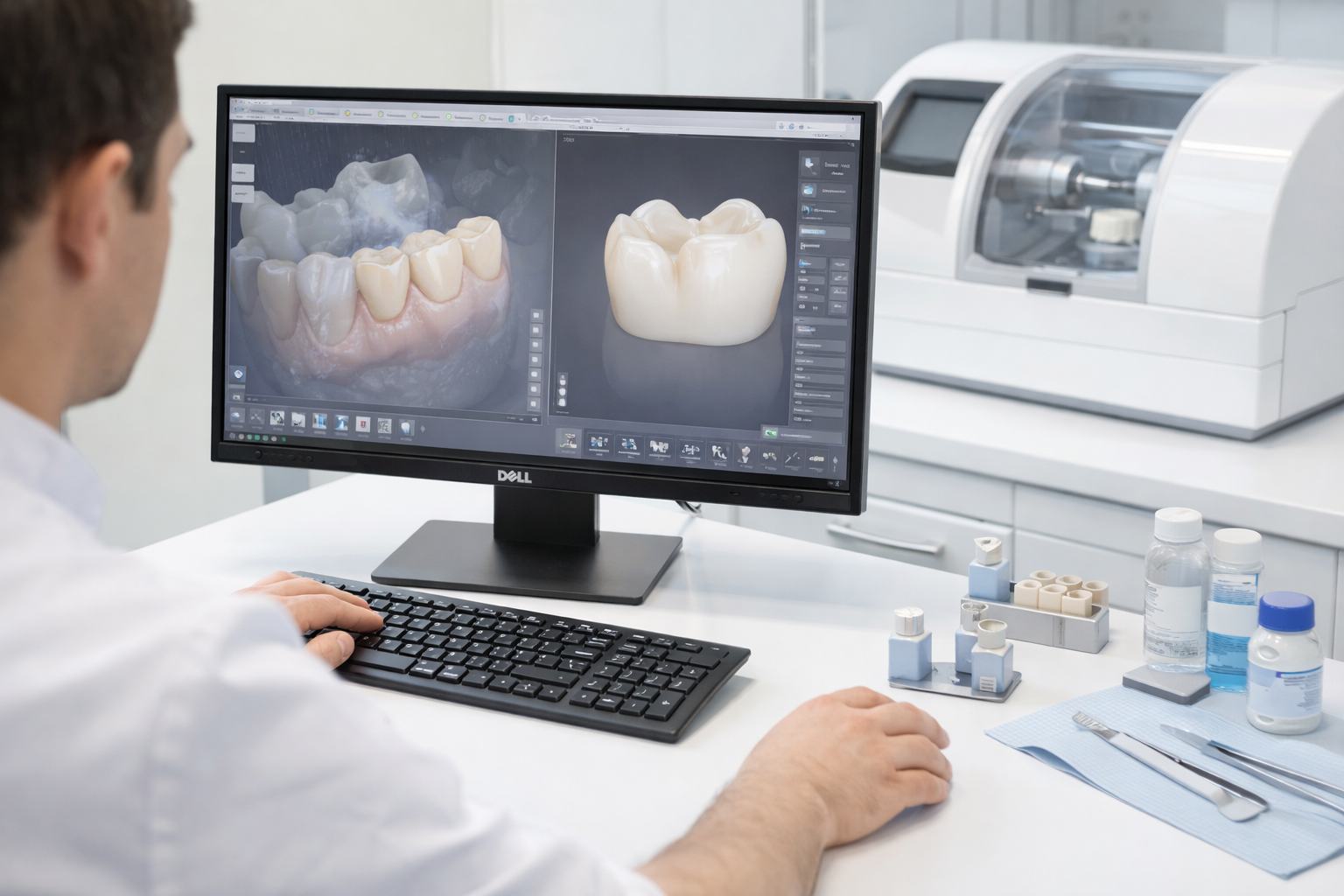
Dentists use these systems to scan, design, and mill crowns, veneers, and other restorations in a single visit. These advanced tools improve restorative dentistry by enabling:
- On-site design and creation of precise dental restorations
- Same-day crown and veneer delivery
- Accurate fits through digital measurements
- Reduced wait times between appointments
Leading providers: Dentsply Sirona CEREC, Planmeca PlanCAM, Roland DWX series;
Systems should transfer design files to practice management software for documentation. Some integrate directly, others require manual case entry.
Complete chairside systems cost $50,000 to $150,000 including scanner, design software, and milling unit. Practices doing 8-10 crowns monthly typically reach profitability within 2-3 years.

Intraoral Scanners
Intraoral scanners capture 3D digital impressions in 2-4 minutes without impression materials. The handheld wand scans teeth and tissue while displaying real-time results on screen.
Key advantages:
- Eliminates patient discomfort and gag reflex from impression trays
- Immediate retakes of specific areas without restarting
- Digital files transmit instantly to labs instead of physical shipping
- Superior accuracy for most cases compared to traditional impressions
Leading providers: 3Shape TRIOS, Dentsply Sirona Primescan, iTero by Align Technology, Medit i700;
Scanners should output STL files compatible with your lab’s design software. Most support open formats, but some use proprietary files limiting lab choices. Verify compatibility with labs you work with before purchasing.
Scanners range from $15,000 to $40,000. Practices sending 15-20 cases monthly typically offset costs within 18 months through reduced remakes and faster turnaround.

3D Printing for Dental Restorations & Aligners
3D printing brings precision and speed to creating dental products in the office. Combined with advanced orthodontic technology, this innovation uses digital designs to create physical dental items layer by layer. Dentists can now make custom-fitted devices while patients wait, instead of sending orders to outside laboratories.
Common 3D-printed dental products include:
- Clear aligners for straightening teeth
- Surgical guides for precise implant placement
- Models for planning complex procedures
- Temporary crowns for immediate use
Leading providers: Formlabs, SprintRay, Asiga, Stratasys;
3D printers require STL files from design software or intraoral scanners. Most printers work with standard STL formats, though each manufacturer provides specific software for print preparation.
Dental 3D printers cost $2,500 to $8,000 for entry-level units suitable for models and guides. Professional-grade printers for aligner production range from $8,000 to $15,000.

Digital Smile Design (DSD) & Virtual Treatment Simulations
Digital Smile Design helps patients see their future smile before treatment begins. This technology takes photos and measurements of a patient’s face and teeth to create realistic previews of treatment results.
The process works in three simple steps:
- Capturing detailed images of the patient’s face and teeth
- Creating a digital design of the proposed dental work
- Showing patients a preview of their new smile
Leading providers: Digital Smile Design (DSD), Planmeca Romexis Smile Design, 3Shape Smile Design;
Treatment simulations should be accessible through patient portals so people can review proposed work between appointments. This requires connection between design software and patient communication platforms.
Digital smile design software ranges from $1,500 to $5,000 depending on features and capabilities. Many practice management systems now include basic smile design tools.

AI-Powered Diagnostic Tools
Digital dentistry solutions demonstrate the transformative impact of AI in healthcare, particularly in detecting oral health problems earlier and more accurately. These tools analyze digital X-rays and scans to find issues that might be hard to spot with the human eye alone. For example, AI can identify early signs of cavities or gum disease, helping dentists save time and create more personalized treatment plans.
AI models are trained to recognize patterns in dental conditions through:
- Analysis of thousands of verified dental images
- Validation by expert dentists
- Regular updates based on new clinical data
- Continuous performance monitoring
Leading providers: Overjet, Pearl, Dentistry.AI, VideaHealth;
AI diagnostic tools need access to your imaging systems. Most integrate with existing radiography platforms through plugins or direct connections.
AI diagnostic software typically costs $200 to $500 monthly on subscription basis. Some imaging equipment manufacturers include AI analysis as part of their software packages
Challenges of Implementing Digital Dentistry Solutions
Dental practices face four primary barriers when considering digital adoption. Understanding these challenges and their practical solutions enables practices to plan implementation more effectively and avoid common pitfalls that delay or derail digital transformation.
High Equipment Costs
Equipment costs create the primary barrier to digital adoption. Complete systems require substantial upfront investment that smaller practices struggle to justify. However, digital workflows eliminate ongoing consumable costs and increase patient capacity through same-day procedures.
Practices can offset initial expenses through financing programs that structure payments around current lab fees. Most practices see ROI within two to three years for regular restorative work, though the timeline depends heavily on case volume and procedure mix.
Selecting Digital Dentistry Technology
The variety of available options creates decision paralysis. Practices must evaluate multiple manufacturers for each technology category while deciding whether to adopt unified systems or mix vendors.
Start by identifying which manual processes consume the most staff time, then target investments toward solving those specific bottlenecks. Match technology to actual case types rather than purchasing based on general trends. A practice focused on cosmetic dentistry needs different tools than one centered on implant procedures.
Staff Training and Adoption
Learning new technology temporarily reduces productivity, which creates legitimate concern. Modern equipment requires several days of initial training followed by regular practice before staff develop proficiency. Implement technology gradually rather than transforming the entire practice simultaneously.
Start with one operatory to build team confidence, then expand as skills develop. Most practices report that productivity returns to baseline within four to six weeks. Designating one team member as the internal expert accelerates adoption.
System Integration with Existing Software
Integration challenges arise when equipment from different manufacturers must share data. Imaging systems, scanners, and healthcare software each use different file formats and communication protocols.
Verify compatibility before purchasing by asking vendors specific questions about data exchange with your current systems. Most modern equipment supports industry-standard formats that enable integration, though older practice management software may require updates to communicate with newer digital tools.
Take the Next Step with Digital Dentistry
Digital dentistry is no longer optional for practices aiming to deliver competitive patient care. The technologies covered in this guide, from diagnostic imaging and intraoral scanning to chairside fabrication and AI diagnostics, represent the foundation of modern dental practice. Early adopters gain measurable advantages through improved clinical outcomes, streamlined operations, and enhanced patient experiences that traditional workflows cannot match.
At Scopic, we take dental practices beyond basic digital adoption. Our dental imaging software solutions create unique patient experiences while transforming practice efficiency through tailored workflows. We help you stay ahead of industry changes with scalable, future-ready technology that adapts to your growth.
Ready to become a leader in digital dentistry? Get in touch today.
Frequently Asked Questions
What is digital dentistry?
Digital dentistry is the use of computer-based technologies to capture, analyze, and share patient data in dental practice. It replaces traditional manual processes like physical impressions, film X-rays, and paper charts with digital workflows that improve diagnostic accuracy and treatment efficiency.
How much does digital dentistry equipment cost?
Digital dentistry equipment costs vary by technology:
- Digital radiography sensors: $8,000-$15,000 per operatory
- Intraoral scanners: $15,000-$40,000
- CBCT units: $40,000-$150,000
- 3D printers: $2,500-$15,000
- CAD/CAM systems: $50,000-$150,000 (complete system)
- AI diagnostic software: $200-$500 monthly subscription
Which digital dentistry tools should I buy first?
Start with diagnostic technology like digital radiography or CBCT, which integrate easily with existing practice management software. Once diagnostic systems stabilize, add intraoral scanners for digital impressions. Implement CAD/CAM fabrication systems last due to their complexity and learning curve. This phased approach minimizes disruption while building staff confidence.
Do digital dentistry solutions integrate with existing practice management software?
Most modern digital dentistry equipment supports industry-standard file formats including DICOM for imaging, STL for 3D models, and HL7 for patient records. Before purchasing, verify compatibility by asking vendors about data exchange with your current systems. Older practice management software may require updates to communicate with newer digital equipment.
How does digital dentistry improve patient care?
Digital dentistry improves patient care through enhanced diagnostic accuracy, faster treatment times, and increased comfort. Digital imaging detects conditions traditional methods miss, intraoral scanners eliminate uncomfortable impression materials, and same-day workflows reduce the need for temporary restorations and multiple appointments.
What is teledentistry, and how does it benefit practices?
Teledentistry enables remote consultations and patient monitoring through digital platforms. It expands practice reach to underserved areas, improves patient access to care, and enables efficient follow-up appointments without requiring office visits. Teledentistry platforms integrate with digital imaging systems, allowing dentists to review scans remotely.

About Creating Digital Dentistry Solutions Every Modern Practice Should Know About
This guide was authored by Mikheil Kandaurishvili, and reviewed by Alan Omarov, Solutions Architect at Scopic Software.
Scopic provides quality and informative content, powered by our deep-rooted expertise in software development. Our team of content writers and experts have great knowledge in the latest software technologies, allowing them to break down even the most complex topics in the field. They also know how to tackle topics from a wide range of industries, capture their essence, and deliver valuable content across all digital platforms.



 Message Scopio