
Table of Contents
Listen to article
72% of companies integrate AI into at least one business function, and as advanced AI technologies reshape the tech sphere, product development stands out as a promising and rapidly growing approach.
Think about it: Product development is crucial for business growth, and AI enables faster time-to-market, increased efficiency, and data-driven insights—some would even go as far as saying that this is the perfect duo.
To put it into perspective, big industries like automotive, aerospace and defense, telecommunications, medical devices, and consumer products expect a third of their sales—equating to $30 trillion in revenues over the next five years—to come from successful product development projects.
And with custom AI solutions, achieving this goal just got a lot easier. However, businesses must know how to navigate AI product development, addressing challenges related to security, regulations, and misconceptions for a successful end product.
To make informed decisions about AI product development, it’s important to understand not just the technology but how it drives real business outcomes. Below, we break down the key benefits, real-world applications, and critical considerations needed to build a successful AI product strategy.
What is AI Product Development?
AI product development is the application of artificial intelligence (AI) technologies to automate and optimize various stages of the development process. From enhancing design and prototyping to making recommendations and creating personalized features based on user data, AI has proven to be a valuable tool in creating efficient and high-quality products.
The key technologies in AI-powered product development include machine learning development services, deep learning, generative AI, and natural language processing.
Role of AI in Product Development: How Does It Work?
AI automates processes, enhances decision-making, and accelerates innovation. In other words, it’s a business’ and product developer’s dream, helping them address challenges associated with traditional methods, such as long development cycles and high costs resulting from manual research, iterative prototyping, and human-driven testing. For an AI software engineer, these capabilities unlock faster experimentation and more efficient development workflows.
By using AI—particularly large language models—businesses can transform this approach by rapidly analyzing vast datasets, predicting market trends, and generating new design concepts in minutes rather than weeks.
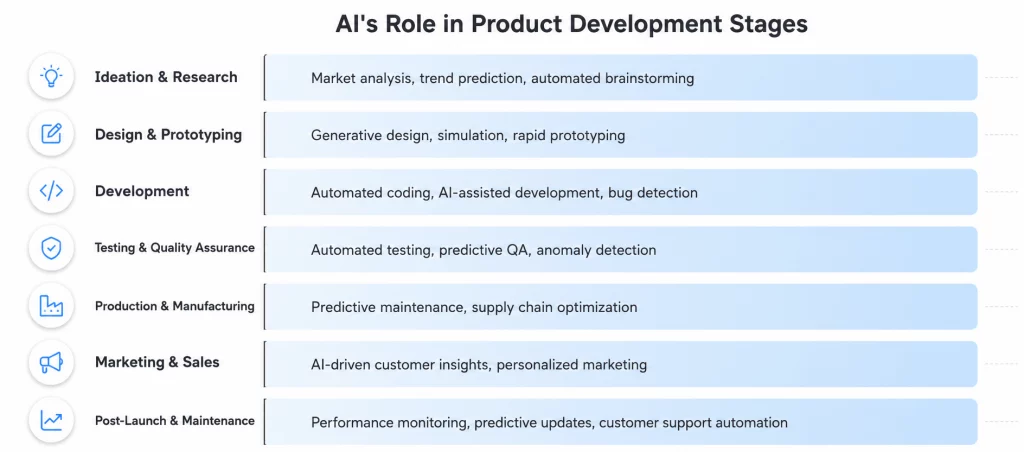
However, there’s no better way to understand AI’s role in product development than by exploring how it affects every stage of the development process. Check out the image below for a detailed look at AI’s impact on modern product development.
Key Benefits of Leveraging AI in Product Development
In today’s technology-driven world, there’s no longer a need to rely on outdated techniques that are time-consuming and prone to errors. With AI, you can streamline processes, increase efficiency, and improve product quality.
Tim Burr, Founder and CEO of Scopic, states that “AI turns software development into a predictive, data-driven process.”
As technology advances, AI software development is becoming more like hardware development: more predictable, verifiable, and structured, reducing uncertainty and improving reliability.
That said, the key benefits of AI-powered product development include:

Data-Driven Predictive Analysis and Decision-Making
Thanks to advances in technology, you no longer have to guess what works and what doesn’t. Businesses that leverage machine learning can forecast market trends, uncover insights that drive product development, and ensure every decision is data-backed and strategically informed.
Higher Efficiency and Productivity
Ever heard of the phrase “work smarter, not harder”? Well, this truly applies to AI product development. From streamlining design prototyping to suggesting features and identifying errors, AI tools reduce time-to-market while developing accurate and successful end products.
Higher Product Quality and Customizability
Product developers can leverage advanced algorithms to detect defects, optimize material selection, streamline testing, and generate data-driven design variations. With the global hyper-personalization market valued at $11.4 billion in 2025 and projected to exceed $52 billion by 2034, this highlights the growing importance of delivering highly tailored customer experiences.
Reduced Product Development Costs
AI analyzes vast amounts of data to generate reports, uncover trends, and provide real-time insights in seconds. This saves developers valuable time and resources, enabling more cost-effective product development without compromising quality.
Improved Security and Risk Management
AI improves security and risk management in product development by identifying vulnerabilities, detecting anomalies, predicting potential threats, and automating compliance checks. By prioritizing security as a core principle, your company can inspire trust among customers and stakeholders.
Competitive Advantage and Continuous Relevance
For the above reasons—including increased efficiency, customized solutions, and enhanced product quality—your company can stand out from the competition and drive long-term growth.
What Is the ROI of AI Product Development?
AI’s value isn’t just in what it can do; it’s in how it impacts the bottom line. As adoption grows, companies are placing more emphasis on measurable outcomes, making ROI a critical part of any AI strategy.
While ROI can vary by use case, the most consistent areas of impact include:
- Operational efficiency: 80% of respondents say their companies set efficiency as an objective of their AI initiatives, and for good reason. AI reduces the time and effort required to complete repetitive or resource-heavy tasks. This leads to faster workflows, fewer bottlenecks, and better use of internal resources without increasing headcount.
- Faster time-to-market: Shorter development cycles allow teams to launch and iterate more quickly. This not only reduces development costs over time but also enables businesses to respond faster to market demands. In our whitepaper, we highlight how AI-driven development achieved a 90% reduction in development time compared to traditional methods.
- Cost optimization: AI helps lower costs by automating manual processes, improving resource allocation, and reducing rework. In many cases, it also minimizes the need for additional tools or large support teams.
- Support efficiency: AI-powered systems can handle a significant portion of customer inquiries, reducing support volume and allowing teams to focus on more complex issues. This directly impacts operational costs and scalability.
- Revenue impact: More personalized and responsive user experiences often lead to higher engagement, improved conversion rates, and stronger customer retention over time.
- Consistency and quality at scale: AI systems can deliver more consistent outputs and reduce variability, which improves overall product reliability and reduces the risk of costly errors.
Real-world Use Cases of AI Product Development
Are companies currently using AI in product development? Are their efforts successful?
In short, yes and yes. AI’s advanced capabilities are widely recognized, meaning new solutions and real-world case studies are increasing by the day.
Let’s explore how AI product development is being used today.
Healthcare Product Development
Machine learning, deep learning, natural language processing, and computer vision can all be leveraged in the healthcare industry to improve diagnostics, treatment, and administrative efficiency.
While there are various ways that AI can be applied in this field, machine learning models’ ability to be trained on vast amounts of patient data—including electronic health records, medical imaging, and genetic information—is key to identifying patterns and making predictions. This is crucial in healthcare, where early detection and accurate predictions can significantly improve treatment effectiveness.
A study on Artificial Intelligence in Healthcare states that “AI could significantly reduce inefficiency in healthcare, improve patient flow and experience, and enhance caregiver experience and patient safety through the care pathway.” It then goes on to say, “In the long term, we expect that healthcare clinics, hospitals, social care services, patients and caregivers to be all connected to a single, interoperable digital infrastructure using passive sensors in combination with ambient intelligence.”
“As the CMO and Principal Investigator at Parameters Research Laboratory, I’ve integrated AI into our medical device testing workflow to solve a critical data management challenge we faced – processing thousands of arterial line blood pressure measurements against prototype wearable devices. We implemented custom AI analysis tools that automate the comparison between reference standards (arterial line measurements) and test devices, identifying measurement drift patterns that human analysts would miss. This has reduced our data processing time by 68% while increasing accuracy in our FDA submission packages. The most significant ROI comes from our AI-powered participant matching system, which analyzes our database against specific study requirements (skin tone diversity, BP ranges, age distributions) to create perfectly balanced cohorts. For a recent smartwatch validation study, this reduced recruitment time from 3 weeks to 4 days and improved our first-time qualification rate from 62% to 91%. I absolutely recommend AI tools to other medical device testing organizations – particularly for reducing human error in data validation. The key is maintaining human oversight on all clinical interpretations while leveraging AI for pattern recognition and statistical analysis where it excels.”
Arthur Cabrera, Principal Investigator, Parameters Research Laboratory
Case Study:
OrthoSelect had a vision of using AI-driven technologies to improve accuracy in orthodontic treatments. To accomplish this goal, they partnered with Scopic to create DIBS AI, an integrated software and hardware solution that provides automated case setups through advanced bracket-positioning software.
By integrating AI into their solution, they were able to improve their treatment planning capabilities, offering features like AI-powered teeth segmentation and automated workflow enhancements. This helped them improve accuracy, increase efficiency by reducing technician time, and enhance the user experience.
Manufacturing and Supply Chain
Manufacturers are increasingly recognizing the role of machine learning, computer vision, and natural language processing in transforming traditional production processes.
By leveraging AI integrations for business, including ntelligent automation, real-time data analysis, and predictive modeling, manufacturers can enhance production efficiency, optimize logistics, and adapt processes in real-time. An important part of this advancement is AI’s ability to analyze sensors and predict potential failures before they occur, thereby reducing downtime and saving businesses money.
The ability to offer mass customization so quickly also marks a major shift for manufacturers who previously struggled with long lead times and complex production processes.
Within the manufacturing industry, 59% of respondents in a study stated that quality control is the most important use case for artificial intelligence, with inventory management coming in second place.
Software and Web Development
AI product development is reshaping how software is built, tested, and deployed. Developers that leverage intelligent software development can easily automate coding tasks, gain real-time insights, and facilitate data-driven decision-making during product development.
The same applies to AI in web development, where machine learning, generative AI, natural language processing, and neural networks enhance user experiences, automate design and content generation, and improve website performance.
In coding, AI-powered tools—such as GitHub Copilot and Tabnine—assist developers by suggesting code snippets, automating repetitive coding tasks, and detecting bugs before deployment, thereby reducing development time and minimizing errors.
Quality Assurance
AI-driven quality assurance tools leverage machine learning and pattern recognition to identify anomalies, optimize test coverage, accelerate debugging, and automate key testing tasks such as documentation analysis, bug reporting, and test creation and execution. Understanding agentic AI vs generative AI is increasingly important in this context, as different AI approaches support different testing objectives. By reducing human error, like using outdated test data or overlooking scalability, AI ensures more comprehensive and efficient testing while lowering costs.
AI also significantly reduces the time required to develop a minimal viable automated test suite, allowing QA engineers to focus on strategic testing decisions while AI handles repetitive coding tasks. This ensures test suites stay aligned with evolving application requirements without slowing down development cycles.
One of the biggest challenges in software development, particularly for startups, is adapting to constantly evolving user requirements. AI helps QA teams keep testing documentation and automation code up to date as requirements shift, ensuring test coverage remains relevant without excessive manual intervention.
AI is also transforming usability testing in UI/UX design. A great example of this is UXAgent, an LLM-based usability testing framework. The system features an LLM-Agent module and a universal browser connector, enabling the automatic generation of thousands of simulated user interactions with a target website.
Beyond functional testing, AI is also making strides in non-functional testing, such as security and performance testing, by identifying vulnerabilities and optimizing system performance under varying conditions.
Graphic and Product Design
Machine learning algorithms analyze trends, user preferences, and past designs to provide data-driven recommendations, enabling designers to create more visually appealing and functional products with greater speed and precision.
From prototyping to image generation and 3D modeling, AI tools and technologies streamline various stages of the product design lifecycle. Integrating the AI life cycle process into design workflows helps teams manage everything from data collection and model development to deployment, monitoring, and continuous improvement. AI also plays a crucial role in personalization and scalability, analyzing user behavior to create tailored experiences while dynamically adjusting systems to meet growing demands.
A review on generative AI in product design comments on this, stating, “From product packaging to car components and retail displays, gen AI enables industrial designers to explore more ideas and product experiences, including previously unimagined ones, and develop initial design concepts significantly faster than with traditional methods.”
Customer Service
Companies that integrate machine learning, natural language processing, and generative AI into customer service operations, often with the support of AI integration consulting, can handle high volumes of inquiries, reduce response times, and deliver more accurate support.
One of the key advantages of AI technologies is their ability to deliver personalized experiences that enhance user satisfaction and engagement. By leveraging machine learning services, companies can monitor and evaluate user preferences, habits, and interactions through their entire buying journey.
AI has countless real-world applications, from chatbots and AI contact center solutions to natural language processing for call transcription and sentiment analysis—each enhancing efficiency and user experience.
This means that long after a product is developed, AI will continue to improve overall user experience, thereby increasing sales and supporting long-term growth.
Case Study:
Akillion, a customer data and email marketing platform, needed a more intuitive way to manage complex datasets and run targeted campaigns. Scopic built a sleek web interface and integrated a conversational AI assistant to simplify segmentation, campaign creation, and reporting.
By leveraging AI-powered natural language processing, we enabled users to generate advanced data filters using plain-English queries, automate campaign workflows, and gain real-time insights—all while ensuring secure data handling through multi-factor authentication and encryption.
How do these use cases apply to your business? Generative AI services from Scopic can help turn these ideas into practical, scalable solutions.
Build vs. Buy vs. Hybrid: Which Approach Is Right for Your Company?
Deciding between building your own AI product, purchasing an off-the-shelf solution, or taking a hybrid approach is a common challenge for companies looking to implement AI.
Let’s take a look at how each option compares to help guide your decision.
Building Your Own AI Solution
When you build a custom AI solution, you can define exactly which features you need, how they integrate into your workflows, and how they align with your business goals.
This level of customization is hard to achieve with ready-made tools and can lead to stronger long-term ROI and improved user experiences.
However, one of the main considerations is the upfront AI product development costs, which includes data preparation, model training, system integration, and ongoing optimization.
While the initial cost may be higher, it’s often justified by the long-term flexibility, scalability, and competitive advantage a fully tailored AI solution can provide.
Using Third-Party APIs or Tools (Off-the-Shelf)
With AI becoming more widely adopted, there are now many third-party tools and APIs available that companies can use right away.
This is typically the more cost-effective and faster option upfront, as off-the-shelf solutions require less development effort and fewer internal resources.
While this approach works well for companies that don’t need deep customization, costs can increase over time due to subscription fees, usage limits, and add-ons. That’s why it’s important to evaluate how much flexibility and control your solution requires.
Starting Hybrid and Evolving Over Time
With a hybrid approach, companies can use existing AI tools as a foundation while adding custom features where needed.
This allows you to launch faster while still leaving room for customization and scalability as your needs grow. Over time, you can gradually shift toward more custom-built components if AI becomes a core part of your product or operations.
However, this approach can introduce added complexity, as teams must manage both third-party tools and custom components, which may lead to integration challenges over time.
Your Quick Decision Framework
There are several factors to consider when choosing the right approach for your company. That said, here’s a simple guideline to give you an idea of the right approach:
If you need full control and deep customization → Build
If you need a fast, cost-effective solution and don’t require much customization → Buy (off-the-shelf)
If you need a balance of speed and flexibility → Hybrid
Not sure if building a custom AI solution is right for you? Our AI strategy consulting services can help you identify the best approach, define your requirements, and create prototypes to test your ideas quickly and cost-effectively.
Is Your Company’s Data Ready for AI?
Successful AI adoption doesn’t start with algorithms; it starts with your data. If your data isn’t ready, even the most advanced AI solution will struggle to deliver meaningful results.
To build AI systems that are accurate, scalable, and compliant, your data needs to align with your business goals and be structured in a way AI can actually use. Put simply, there’s no “winging it” when it comes to data.
The key is understanding whether your data can realistically support your AI goals. Start by asking the right questions:
- Data quality: Is your data accurate, complete, and free of errors or duplication? Is it consistently formatted across systems?
- Proprietary vs. third-party data: What unique data does your business own? Are you relying on external data, and do you have the rights to use it?
- Regulated and sensitive data: Does your data include personal or regulated information? Are you equipped to stay compliant and manage risk? Do you have clear policies for data access, storage, and usage across teams?
- Data structure and labeling: Is your data organized and ready for AI use, or does it require significant cleaning and labeling first? Do you have processes in place to maintain data consistency as new data is added?
- Use case feasibility: Do you have enough relevant data to support your AI use case? And is AI actually the right solution to the problem?
Need help evaluating your data readiness? Scopic’s expert team can help you create an AI product strategy and guide you through the process.
AI Governance: Turning Strategy into Accountability
Building an AI-ready data foundation is only part of the equation. To scale AI responsibly, companies need clear governance practices that define how systems are approved, monitored, and held accountable.
In practice, this means establishing approval processes before deployment, maintaining auditability through proper documentation and version tracking, and ensuring human oversight for higher-risk decisions. It also involves classifying use cases based on risk levels and clearly defining accountability, whether models are developed in-house or rely on third-party providers.
With the right structures in place, companies can scale AI confidently while minimizing risk.
How to Ensure an Efficient AI Product Development Process? 6 Steps
There are 6 key steps involved in effectively adopting AI in product development:
- Step 1: Assess AI Readiness and Define Business Needs: The first thing your company should do is take an AI readiness assessment to evaluate its ability to adopt, deploy, and leverage AI. With AI strategy consulting, you can develop an AI solution that addresses your unique business needs and industry-specific challenges, ensuring your company is ready for AI integration.
“You cannot hand a complex client problem to a generic, off-the-shelf AI and expect a premium result. To build a defensible, automated product, you must first identify the hidden ‘wisdom’ and proprietary rules that explain how your firm consistently gets results.”
— Ben Crystal, Sales Account Executive at Scopic
- Step 2: Conduct Market Research: Do your objectives align with market demands? Analyzing industry trends, competitor strategies, and customer needs provides valuable insights to enhance your product’s quality and relevance.
- Step 3: Develop an AI Product Development Strategy: Having a comprehensive and detailed strategy helps your company effectively manage risks and challenges, optimize operations, ensure compliance, and support long-term sustainability. Key components of an AI product development strategy include conducting data analysis, choosing the right AI infrastructure and technologies, and establishing a performance assessment plan.
- Step 4: Pick an AI Product Development Partner: Choosing the right development partner is key to creating an AI business solution that meets your unique needs. When comparing AI development companies, we recommend evaluating their technical expertise in AI development, flexibility and scalability, technology stacks, and past reviews.
- Step 5: Implement AI into Product Development Stages: Your AI development partner will identify which stages—such as prototyping, testing, or user personalization—can benefit from automation and data-driven insights. They’ll then integrate the right AI models, ensuring seamless deployment while providing ongoing optimization and support.
- Step 6: Monitor Performance and Refine the Processes Iteratively: Your AI development partner should then continuously monitor performance, analyze key metrics and user feedback, and refine processes to enhance accuracy, efficiency, and overall product effectiveness.
How to Evaluate AI Performance Before Deployment
Before moving an AI solution into production, it’s essential to clearly define what success looks like, whether that’s accuracy, relevance, or user satisfaction. From there, teams should evaluate performance using a combination of automated testing and human review to ensure outputs are both reliable and aligned with business goals.
It’s equally important to identify potential failure points, such as incorrect responses or hallucinations, early in the process. By testing how the AI performs in real-world scenarios, companies can better understand its limitations and risks.
Only once the solution consistently meets performance benchmarks and delivers dependable results should it be considered ready for full deployment.
Post-Launch Monitoring and Optimization
In step 6 above, we mention monitoring as the final stage of the AI development process, but it’s worth emphasizing that this isn’t a “set it and forget it” step.
Once your AI product is live, performance can shift over time. User behavior changes, data evolves, and what worked at launch may not hold up months later. That’s why ongoing monitoring is what keeps your solution effective.
This typically includes:
- Monitoring outputs: Companies should continuously evaluate whether responses remain accurate, relevant, and aligned with user expectations. Tracking metrics like latency, response quality, hallucinations, and cost helps ensure the solution delivers real business value.
- Drift and degradation: As data and user behavior change, model performance can gradually decline. Identifying these shifts early allows teams to make adjustments before they impact decision-making or user experience.
- User feedback loops: Interaction data, engagement patterns, and direct feedback provide critical insight into how the product is actually being used. This helps uncover gaps that metrics alone don’t fully capture, especially around user experience.
- Incident handling: Clear processes should be in place to detect, investigate, and resolve issues quickly. This is especially important for AI systems, where errors can scale fast and directly affect user trust.
Launching an AI product is just the starting point. Long-term value depends on recognizing when performance slips, such as declining accuracy, inconsistent outputs, rising costs, or repeated user complaints, and taking action to retrain, tune, or switch providers.
With the right AI development services, these adjustments become part of a continuous improvement process rather than reactive fixes.
Challenges and Considerations of AI Product Development
While AI has the ability to transform product development, companies must be aware of the potential challenges associated with AI, including:
- Bias and Ethical Considerations: When AI models are trained on biased data, they can inherit and perpetuate these inaccuracies, leading to biased outcomes. To address these concerns, developers should implement diverse training data, establish fairness guidelines, continuously monitor AI outputs, and ensure transparency in decision-making processes.
- Knowledge and Skills Gap: While AI technologies are becoming increasingly integrated into business processes, many professionals still don’t know how to use them to enhance product development. For this reason, companies must work with experienced AI consulting companies who not only create successful AI products but will teach your team how to adopt new tools.
- Data Privacy, Security, and Surveillance Concerns: Concerns about data privacy, security, and surveillance in AI product development stem from risks like unauthorized data access, biased monitoring, and regulatory non-compliance. To mitigate these risks, companies must implement robust encryption, strict access controls, and transparent data practices while ensuring compliance with regulations like GDPR and CCPA.
- Generative AI Adoption and Resistance Issues: There are various reasons why professionals may resist AI adoption, including concerns about data privacy and security, fears of job displacement or automation, skepticism about the accuracy and fairness of AI algorithms, and apprehensions about unintended consequences of AI technologies. With Scopic’s AI consulting services, your team can better understand how to implement new technologies into existing workflows.
- AI Liability and Accountability: As AI systems handle more decision-making responsibilities, concerns about AI liability for errors, failures, and harmful outcomes continue to grow. Businesses must establish clear accountability frameworks, implement AI governance policies, and stay compliant with evolving regulations to mitigate legal risks.
Conclusion and Key Takeaways
Not only can AI streamline every stage of product development, but it can also be implemented into products to create advanced, intelligent features that enhance functionality and user experience.
However, companies must know how to address common challenges and obstacles to create a successful end product that supports growth.
With Scopic’s AI development services, your company can leverage AI technologies—including machine learning, generative AI, computer vision, and more—to enhance efficiency and stay ahead of the competition.
Contact us today to learn more about our AI-powered product development solutions.
FAQs about AI Product Development
Should I build or buy AI capabilities?
It depends on your use case, timeline, and need for differentiation. Companies often buy for speed and lower upfront costs, while building makes sense when AI is core to the product and requires customization or proprietary data.
How do you measure ROI in AI product development?
ROI is measured by tracking improvements in efficiency, cost reduction, revenue growth, or user engagement tied to the AI feature. The key is defining clear success metrics upfront and continuously evaluating performance post-launch.
What data is needed to build an AI product?
You need high-quality, relevant, and well-structured data that directly supports your use case. While having enough data is important, its accuracy, consistency, and alignment with the problem you’re solving ultimately determine how effective the AI will be.
How do you evaluate an AI feature before launch?
Evaluation should include testing for accuracy, performance, and reliability under real-world conditions. It’s also important to validate outputs with users and ensure the feature aligns with business goals and user expectations.
What governance controls should AI products have?
AI products should include clear approval processes, auditability, and defined ownership for model performance. They should also incorporate human oversight and risk-based controls, especially for high-impact or sensitive use cases.

About AI Product Development Guide
This guide was authored by Baily Ramsey, and reviewed by Tim Burr, Founder and CEO of Scopic.
Scopic provides quality and informative content, powered by our deep-rooted expertise in software development. Our team of content writers and experts have great knowledge in the latest software technologies, allowing them to break down even the most complex topics in the field. They also know how to tackle topics from a wide range of industries, capture their essence, and deliver valuable content across all digital platforms.