Table of Contents
Healthcare is under unprecedented pressure.
For example, did you know we’re moving towards a global shortage of 10 million healthcare workers by 2030? On top of that, EHR and administrative tasks continue consuming physicians’ time well beyond working hours. The system is strained, and demand isn’t slowing down.
This is exactly the environment where AI agents in healthcare have moved from curiosity to operational necessity. Agentic AI is finally mature enough to deploy — but most organizations remain stuck between a hype-driven pilot and a working production system.
This guide is for those trying to close that gap: what AI agents are, why now is the moment to act, which use cases deliver the best ROI, and how to reach scaled production without the compliance landmines.
What Are AI Agents in Healthcare?
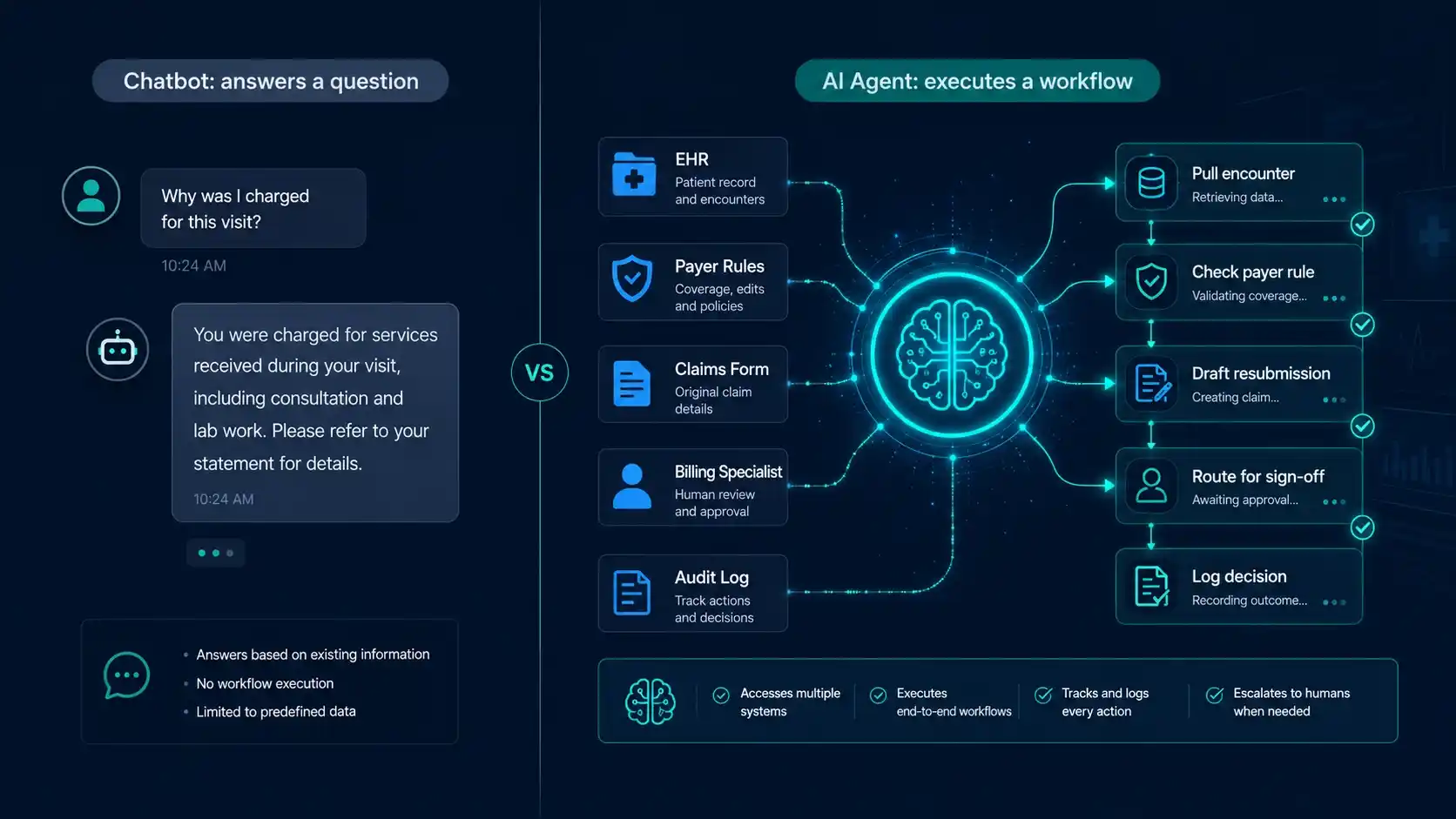
An AI agent is an autonomous, LLM-backed software system that can perceive inputs, reason across multiple data sources, and take action — not just generate a response. That’s what makes them fundamentally different from the chatbots and RPA bots most healthcare organizations already have.
The difference matters. A standard chatbot tells a patient their claim has been denied. An agentic AI in healthcare pulls the encounter, identifies the payer rule that triggered the denial, drafts a corrected resubmission, and routes it to the billing specialist for sign-off — all without a human initiating each step. It executes, rather than just answers.
The core building blocks: the agent perceives inputs, reasons over clinical context, uses APIs to act across external systems, maintains memory, and escalates to a human when needed. You’re not deploying a smarter FAQ bot. You’re deploying something that owns a workflow end to end.
If you’re coming from a conversational AI in healthcare background, the distinction is significant: conversational AI answers; agentic AI acts.
Why Implement AI Agents in Healthcare Now?
The honest answer: because the problems are getting worse faster than traditional solutions can solve them. Here are the four pressure points that make the business case for AI in healthcare obvious.
- Workforce gap: The WEF’s 10-million-worker shortage projection isn’t abstract. It means clinical and admin teams will be asked to do more with fewer people. This makes automation that handles repetitive work more than just a nice-to-have.
- Administrative overhead: Over 25% of total US healthcare spend goes to administration. Physicians logging 13.5 hours a week on documentation aren’t spending that time on patients.
- Revenue leakage: Health systems spend around $20 billion annually contesting denied claims, while 15% of claims are denied on first submission. Most of those denials are preventable.
- Patient experience: No-show rates hit 30% in some specialties, and 56% of appointments are still booked by phone — both are solvable workflow problems.
Traditional automation handles individual, linear tasks. Healthcare workflows — claims, documentation, care coordination — are multi-step and multi-system. That’s exactly the problem AI agents are built for.
Agentic AI Use Cases in Healthcare
Here we review the categories where organizations are seeing real, measurable impact with AI for healthcare today — organized by who benefits most.
You might think patient-facing AI solutions are the most effective since they’re the most visible. However, in practice, claims agents and documentation agents are where most healthcare organizations will see the fastest, cleanest ROI — and they carry significantly lower clinical risk. Keep that in mind when prioritizing your first deployment.
Provider-Facing Use Cases
- Clinical documentation agents that listen to a patient visit (with consent), draft the SOAP note, apply the right billing codes, and flag any missing fields before the physician finalizes it. This is where most documentation time goes — and where agents are already in production at major health systems.
- Pre-visit preparation agents that pull together a patient’s relevant history, recent labs, and active medications into a structured brief before the appointment — so the physician walks in prepared instead of scanning charts on the fly.
- Care coordination agents that book follow-ups, confirm discharge paperwork is complete, and escalate stalled handoffs before they become missed transitions of care.
Patient-Facing Use Cases
- Triage and intake agents that handle symptom checks, appointment booking, and pre-visit intake forms — reducing front-desk workload while giving patients a faster path to care.
- Billing assistance agents that explain claim status in plain language and route patients toward financial assistance options, reducing call volume and confusion.
- Post-discharge adherence agents that follow up on medication reminders, post-op instructions, and escalate to a care team member if a patient reports worsening symptoms.
Operational and Payer Use Cases
- Claims pre-check agents that run coding against payer-specific rules before submission, flag likely denials, auto-correct where possible, and route edge cases to a human specialist — this alone can cut denial rates significantly.
- Credentialing agents that manage primary source verifications, track outstanding responses, and trigger system access once approvals are received — compressing a months-long process into weeks.
- Compliance and audit agents that maintain a live audit trail of every agent decision — inputs, rules applied, outcomes — so that an audit is a report pull rather than a crisis response.
How to Implement AI Agents in Healthcare: A Step-by-Step Guide
The six steps below reflect what it actually takes to move from a workflow idea to a production-grade deployment — without cutting corners on compliance or change management.
Step 1: Assess AI Readiness and Pick the Right First Workflow
Start with where work is getting stuck, not where AI sounds exciting. The best first candidates are high-volume, repetitive, multi-system workflows with low clinical risk: claims pre-checking, documentation drafting, intake, and scheduling.
Before committing, run a quick AI readiness check across four dimensions:
- Data: Can you query it through an API, or is it locked in a legacy system?
- Integrations: Is data flowing through FHIR R4 or HL7, or will significant ETL work be needed first?
- Governance: Is there a named clinical lead and privacy officer willing to own this?
- Change appetite: Will the people doing this work every day actually use it? This one kills the most pilots.
End with a single, specific metric you’re committing to move — for example, reducing denial rates from 14% to 9% within six months.
Step 2: Set the Compliance and Governance Boundaries Up Front
Before writing a line of code, map every system the agent will touch, classify the PHI in each one, and decide what can be de-identified versus what requires full PHI access.
From there, three things need to be locked in before you build:
- BAAs with every vendor in the stack. If your LLM provider can’t sign one, they don’t belong in a HIPAA workflow.
- A defined human oversight model. What does the agent handle autonomously? What needs clinician sign-off? Document it before development starts.
- An audit trail standard. Every agent decision should log the inputs it saw, the policy it applied, and the outcome — this is how you manage AI liability and improve the agent over time.
Step 3: Decide Build vs. Buy vs. Partner
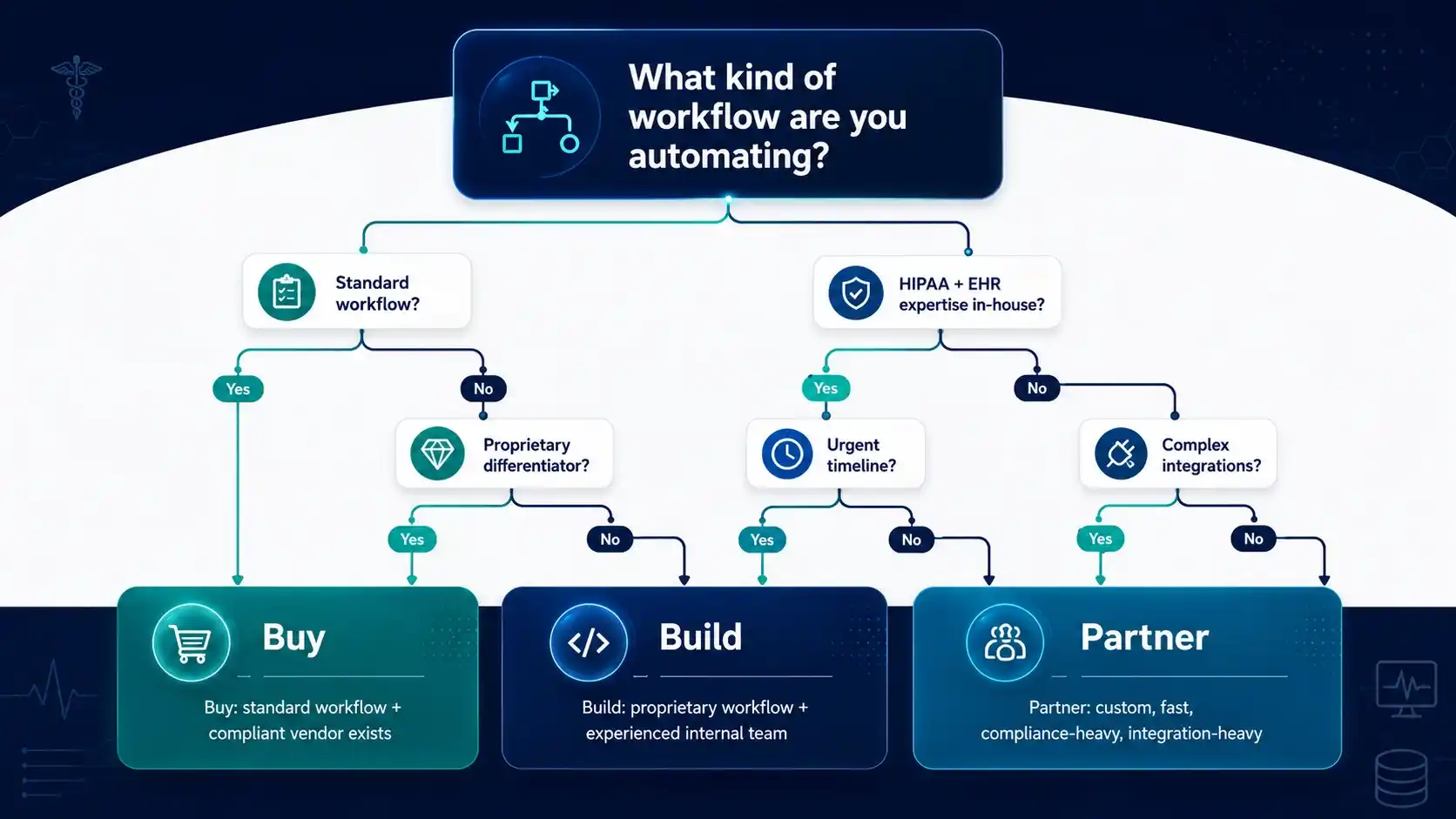
The right answer depends on the workflow, your internal capabilities, and your timeline. There are three options, each with a clear fit:
- Buy when the workflow is industry-standard and a HIPAA-compliant vendor has already solved the hard problems.
- Build when the workflow is a genuine competitive differentiator and you have senior ML engineers and a compliance-fluent team in place.
- Partner when you need something custom, fast, and built by people who already know HIPAA and EHR integrations — which is the right call for most organizations.
Before deciding, run through these questions:
- How proprietary is this workflow?
- Does our ML team have hands-on HIPAA experience?
- What’s our real deadline pressure?
- Does this require data we can’t expose to third-party vendors?
Our AI consulting services can help you work through this decision before you commit.
Step 4: Pilot with a Narrow Scope and Real Human Oversight
Keep the pilot tight: one workflow, one site, one clinical team. Going broader before you understand the failure modes is a reliable way to create a high-profile problem that sets back AI adoption organization-wide.
Run the agent in shadow mode first — it makes recommendations while a human does the actual work, giving you a clear side-by-side before handing over the reins.
Before go-live, define your kill-switch criteria: what constitutes a bad outcome, who can pause the deployment, and at what error rate does the pilot stop. Pick one or two success metrics — denial rate, time saved, no-shows — and hold to them.
Step 5: Integrate Deeply with EHRs, FHIR and Payer Systems
Most of the value in deploying AI agents into medical systems comes from embedding them inside the tools clinicians already use — not building a separate interface they have to switch to. Launch inside the EHR workflow (Epic, Cerner, etc.) where the work actually happens.
Confirm FHIR R4 availability in your environment — don’t assume it. For payer-facing agents, each payer’s EDI flow and prior-auth API is different; budget time and money for that.
And don’t underestimate unstructured data — roughly 80% of healthcare data arrives as PDFs, faxes, and clinical notes. Your agent needs to read and reason over all of it.
Step 6: Measure, Govern and Scale to the Next Workflow
Resist the urge to scale everything at once. Pick the next workflow closest to your pilot and carry forward what you learned. Build a review rhythm: monthly for active metrics, quarterly for drift and compliance, annually for a full governance audit.
Track three categories: workflow impact (is the process actually better?), agent performance (accuracy, confidence, error rate), and adoption (are the right people actually using it?).
The end goal isn’t one agent — it’s a coordinated set that hands off context across claims, documentation, scheduling, and follow-up. That’s where custom AI solutions create durable competitive advantage.
Common Pitfalls When Implementing AI Agents in Healthcare
These aren’t theoretical risks. They’re the patterns that show up repeatedly in stalled or failed deployments.
- Buying an ‘AI agent’ that’s actually a chatbot. If the vendor demo is just Q&A with no workflow execution, it’s not an agent. Ask for a complete audit trail of a real end-to-end workflow.
- Failing to get a BAA from the model provider. A HIPAA-compliant app on top of a non-HIPAA LLM is not compliant. The chain has to cover every system that touches PHI.
- Over-automating clinical judgment. High-accuracy models still get edge cases wrong. Keep a human gate on anything touching diagnosis or treatment.
- Building a separate UI instead of integrating. Agents that live outside the EHR get ignored. If clinicians have to switch interfaces, adoption will be low regardless of how good the agent is.
- Treating change management as a launch-week task. Clinician adoption is the single biggest predictor of ROI. Get two or three frontline users involved from day one.
- Measuring task volume instead of workflow outcomes. “The agent processed 1,200 messages” tells you nothing. “Denial rate dropped 5 points” tells you everything.
How to Choose an AI Agent Development Partner
Most organizations shouldn’t build their first healthcare AI agent entirely in-house. If you’re evaluating AI agent development services, here’s the checklist that actually matters:
- Healthcare delivery history: Projects shipped in clinical, payer, or healthtech settings — not generic enterprise AI. Ask for their longest-running deployment, not their latest demo.
- HIPAA expertise beyond policy: Engineers should speak fluently to PHI classification, BAA structures, and audit trail architecture — without escalating to a consultant.
- EHR and payer integration experience: FHIR R4, HL7, SMART on FHIR, payer EDI — a capable partner rattles these off in the first conversation.
- Multi-agent orchestration: Can they show you a production multi-agent system managing handoffs and audit trails — not just a single-agent demo?
- Pilot-to-production track record: A lot of vendors can run a pilot. Fewer can scale one.
Case Study
Scopic’s work on Mediphany is an example of what this looks like in practice — an AI-powered healthcare tool built to address real clinical workflow challenges, with the integration depth and compliance posture that healthcare actually requires.
An AI strategy consulting engagement is often the right first step if you’re still figuring out which workflows to prioritize and what your build/buy/partner decision should look like.
Conclusion and Key Takeaways
AI agents in healthcare aren’t about adding a feature — they’re about owning workflows end to end. Most implementations stall not because the technology fails, but because organizations underestimate compliance, integration, or clinician adoption. All three have to work, simultaneously, from day one.
The organizations that move now don’t just cut costs — they capture process data and build operational muscle that competitors will spend years trying to replicate.
If you’re ready to go from concept to production, Scopic’s AI agent development team can take you there — from first workflow selection through to scaled AI development services.
FAQs
How long does a typical AI agent deployment in healthcare take?
A focused pilot — one workflow, one site — typically takes 8 to 16 weeks from requirements through to shadow-mode testing. Getting to full production, including EHR integration and governance sign-off, usually adds another 4 to 8 weeks. Organizations that try to rush past the governance steps tend to add months to the timeline, not subtract them.
What does it cost to deploy an AI agent in healthcare?
Costs vary significantly based on integration complexity, workflow scope, and whether you’re building custom or configuring an existing platform. A realistic budget for a first production pilot ranges from $75K to $250K. The more important number is ROI: a claims pre-check agent that reduces denial rates by 5 percentage points typically recoups that investment within the first two to three months at scale.
Are AI agents in healthcare automatically HIPAA-compliant?
No. HIPAA compliance is an architectural property, not a feature toggle. The agent, the LLM provider, every API it calls, and every data store it writes to all need to meet HIPAA requirements, and BAAs need to be in place across the chain. Assume nothing — verify everything.
What's the difference between an AI agent and a healthcare chatbot?
A chatbot responds to inputs with text. An AI agent takes action across systems — querying EHR records, checking payer databases, drafting documents, routing tasks, and logging decisions — autonomously and across multiple steps. The distinction matters enormously when you’re deciding what to deploy.
Can AI agents replace doctors, nurses, or clinicians?
No, and the organizations deploying AI agents effectively aren’t trying to. The value comes from handling the repetitive, administrative, and rules-based work so clinicians can focus on the judgment-intensive work that actually requires their training. The agent handles the pre-visit prep, documentation draft, and billing check — the physician handles the patient.
What's the best first use case for an AI agent in a hospital or clinic?
For most organizations, claims pre-checking or clinical documentation drafting. Both are high-volume, rule-based, involve multiple systems, and don’t require the agent to make clinical judgments. They’re also where the ROI math is clearest and the compliance risk is most manageable.
How do AI agents integrate with EHRs like Epic or Cerner?
Through FHIR R4 APIs and, for more complex bi-directional workflows, SMART on FHIR applications that embed inside the EHR interface. Epic and Cerner both have established partner programs and app marketplaces. The integration work is real but well-documented — the key is building to the right standards from the start rather than retrofitting compliance later.
Are AI agents worth it for small clinics as well as large hospital systems?
Yes, but the first use case should be different. Small clinics typically see the fastest ROI from intake automation and appointment scheduling agents — high-volume, repetitive work that consumes front-desk time without requiring deep EHR integration. Large systems usually start with claims or documentation because those are where the dollar values are largest.

About Creating AI Agents in Healthcare Guide
This guide was authored by Vesselina Lezginov, and reviewed by Viet-Anh Nguyen, Machine Learning Lead with experience in delivering AI-powered software projects.
Scopic provides quality and informative content, powered by our deep-rooted expertise in software development. Our team of content writers and experts have great knowledge in the latest software technologies, allowing them to break down even the most complex topics in the field. They also know how to tackle topics from a wide range of industries, capture their essence, and deliver valuable content across all digital platforms.