Table of Contents
Choosing between fixed price vs time and material is one of the first commercial decisions a company makes when hiring a software development partner. The right model affects budget predictability, delivery flexibility, change management, vendor accountability, and how much detail must be defined before development begins.
A fixed price contract can work well when the scope is clear, documented, and unlikely to change. A T&M software contract can work better when the product is evolving, requirements are still being validated, or the team needs flexibility to adjust priorities. This guide compares both models and explains when a hybrid milestone or capped-T&M approach may offer a better balance.
Key Takeaways
- Fixed price software development works best when the scope, requirements, acceptance criteria, timeline, and deliverables are clearly defined before work begins.
- A T&M software contract is usually better when requirements may change, discovery is still ongoing, or the product needs iterative development.
- Fixed price offers stronger budget predictability, but changes often require formal change requests and may increase delivery friction.
- Time and material offers more flexibility, but buyers need governance, transparent reporting, sprint planning, and budget controls.
- Hybrid milestone, fixed-scope discovery, or capped-T&M models can reduce risk when the buyer wants flexibility without losing budget control.
Fixed Price vs Time and Material at a Glance
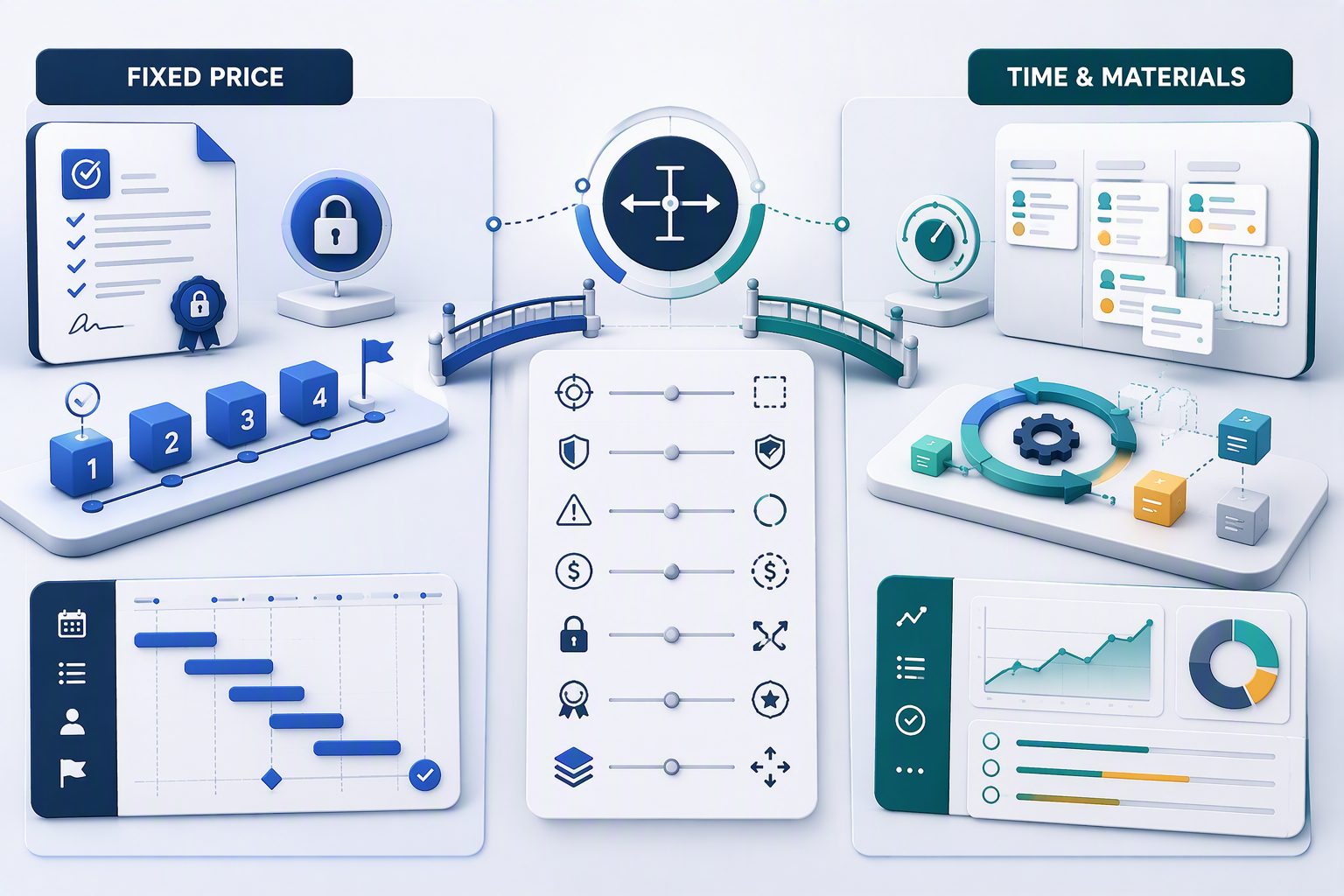
The table below is a practical snapshot of how fixed price software development and T&M software contracts differ across common commercial factors. It is not a universal ranking. The right model depends on scope certainty, change tolerance, governance maturity, and technical uncertainty.
| Factor | Fixed Price Software Development | Time and Material Software Contract |
|---|---|---|
| Scope certainty | Requires clear, stable, documented scope | Works when scope is evolving or partially defined |
| Budget predictability | Higher upfront predictability | Budget depends on actual hours and work performed |
| Flexibility | Lower flexibility after contract signing | Higher flexibility to change priorities |
| Change management | Formal change requests are common | Changes can be reprioritized through backlog or sprints |
| Risk allocation | Vendor carries more delivery-cost risk for defined scope | Buyer carries more budget risk, but gains flexibility |
| Speed to start | Slower if requirements need detailed specification first | Faster if team can start with discovery or iterative delivery |
| Quality control | Depends on acceptance criteria and QA scope in contract | Depends on sprint governance, QA process, and review cadence |
| Best fit | Small or clearly defined projects | Complex, evolving, or long-term product development |
What Is Fixed Price Software Development?
A fixed price contract is an agreement in which the buyer and vendor agree on a predefined price for a defined scope of work. In fixed price software development, the commercial terms usually include documented deliverables, a timeline, acceptance criteria, and a formal process for managing changes. That structure can make budgeting easier because the financial commitment is known before work begins.
This model shifts more delivery-cost risk to the vendor, especially if the effort was underestimated or the scope was more complex than expected. For the buyer, the main risk is incomplete requirements. If the scope document misses edge cases, integrations, user roles, or nonfunctional requirements, the final result may require change requests, extra approvals, or tradeoffs in quality or timeline.
A fixed-price contract is therefore most effective when both sides know exactly what is being built and how success will be accepted. Fixed price does not remove risk. It works best when the work can be planned with enough detail that assumptions are limited and deliverables are measurable.
What Is a Time and Material Software Contract?
A T&M software contract bills the buyer for actual hours or days worked rather than for a single predefined outcome. That makes it a flexible model for product development where priorities may shift as the team learns more. It is especially useful when the work includes discovery, technical investigation, integration complexity, or evolving feature requirements.
The model usually includes tracked time, a flexible backlog, sprint planning, transparent reporting, and regular approval checkpoints. Because the client stays involved in prioritization, the delivery team can adjust what gets built without renegotiating the entire contract each time a requirement changes. That makes the model practical for software development pricing models that need room for iteration.
A time-and-material contract does not mean unlimited spending. It should still include budget caps, reporting cadence, approval rules, and delivery checkpoints so the buyer can control spend while preserving flexibility.
Scope Certainty and Change Management
Scope certainty is usually the main reason to choose one model over the other. Fixed price works when the scope is stable, but unclear requirements can create change orders, delays, or quality tradeoffs. T&M works better when the product may change after user feedback, stakeholder review, technical discovery, or integration testing.
A discovery phase can reduce that uncertainty before the full build begins. It helps define scope, technical assumptions, dependencies, risks, user flows, and acceptance criteria, which makes it easier to decide whether fixed price software development or a T&M software contract is the better commercial fit.
When the scope is still being refined, custom software development services can help teams document requirements, validate feasibility, and identify which parts of the project are stable enough for fixed pricing and which parts need more flexibility.
Risk Allocation, Budget Predictability, and Governance
The commercial difference between fixed price vs time and material is largely about who carries which risks and how tightly the project is governed. Fixed price can improve budget predictability, but only if the scope is truly stable and the proposal includes enough detail. T&M provides more room to adapt, but it requires stronger visibility into progress, hours, and budget burn.
The table below shows how the two models compare across key risk areas and what controls reduce exposure in each case.
| Risk Area | Fixed Price | Time and Material | Risk Control |
|---|---|---|---|
| Scope changes | Usually handled through change requests | Handled through backlog reprioritization | Define change process and approval owners |
| Budget overrun | Lower for fixed scope, higher if scope changes | Higher without caps or governance | Use budget checkpoints and capped phases |
| Quality risk | Risk if vendor cuts corners to protect margin | Risk if team lacks QA discipline | Define QA process and acceptance criteria |
| Speed risk | Slow if specification takes too long | Faster to start, but needs active management | Use discovery, sprint reviews, and roadmap planning |
| Transparency risk | Lower visibility if reporting is weak | Requires time tracking and reporting | Require progress updates and deliverable reviews |
A strong contract is not just about price. It also needs governance. Buyers should know how progress will be reviewed, who can approve changes, what level of reporting they will receive, and how budget checkpoints will prevent surprises.
Which Pricing Model Fits Which Project Type?
The best choice often becomes clearer when you map the contract model to the type of project being built. Some engagements have stable requirements and predictable deliverables, while others involve technical unknowns or shifting priorities that make a rigid scope harder to manage.
| Project Scenario | Better Fit | Why |
|---|---|---|
| Small fixed-scope website or landing page | Fixed price | Scope and acceptance criteria can usually be defined upfront. |
| Simple integration with complete documentation | Fixed price or capped T&M | The scope may be predictable, but unknown API behavior may justify a cap. |
| MVP with evolving requirements | T&M or capped T&M | Requirements usually change after user, market, or technical feedback. |
| SaaS platform with roadmap uncertainty | T&M | Flexible prioritization supports long-term product development. |
| AI, data, or RAG product | T&M or phased milestone model | Technical uncertainty and evaluation cycles make rigid scope risky. |
| Legacy system modernization | T&M or hybrid | Unknown dependencies often emerge during implementation. |
| Design-to-development build with final Figma files | Fixed price | Scope can be estimated if designs, states, and responsiveness rules are complete. |
| Ongoing maintenance and enhancements | T&M | Work usually comes in changing priorities and small batches. |
| Regulated healthcare or fintech product | Hybrid milestone or capped T&M | Compliance, QA, and integration risks need structure and flexibility. |
Hybrid Contract Options: Milestones, Discovery, and Capped T&M
The choice between fixed price vs time and material is not always binary. Many projects include some work that is predictable and some work that is still uncertain. In those cases, a hybrid structure can make commercial sense because it separates known work from unknown work instead of forcing both into the same pricing model.
A fixed-price discovery phase is one of the most practical starting points. It gives the team time to define scope, user flows, technical assumptions, dependencies, and acceptance criteria before committing to the full build. A fixed-price design or specification phase can serve the same purpose when the product concept is clear but the implementation detail is not yet ready for pricing.
Milestone-based delivery is another useful option. It breaks the work into checkpoints with agreed acceptance criteria, which helps both parties review progress and confirm whether the project should move to the next phase. This approach reduces risk because it creates decision points instead of one large commitment.
For ongoing development, capped T&M is often a strong middle ground. It preserves flexibility while limiting budget exposure. A monthly budget cap or fixed sprint budget can work the same way, giving the buyer predictability without freezing priorities. T&M with approval gates adds another layer of control by requiring sign-off before a phase, feature, or budget threshold is crossed.
Some organizations also choose a dedicated team with roadmap-based budgeting when the product is expected to grow over time. This overlaps closely with a staff augmentation model, where the contract follows similar T&M logic but the team integrates directly into your existing workflow. In that case, stable components can be priced more predictably while uncertain features remain under T&M. This is often a practical way to structure software development pricing models for products that are both strategic and evolving.
A well-designed hybrid model can reduce risk by matching the contract structure to the level of certainty in each part of the project. Fixed discovery reduces ambiguity before the build starts, milestone delivery creates checkpoints, and capped T&M keeps flexibility from turning into uncontrolled spend.
Proposal Red Flags to Watch For
A software development proposal should make the commercial terms easy to understand. If the document is vague, it may hide scope gaps, unclear responsibilities, or weak governance. That can create problems regardless of whether the contract is fixed price or T&M.
Watch for these red flags before signing:
- Fixed price without detailed scope
- No assumptions or exclusions
- No change request process
- No acceptance criteria
- No QA/testing scope
- No communication cadence
- No reporting or time-tracking process for T&M
- No budget cap or approval checkpoints for T&M
- No ownership of source code or IP terms
- Vague timeline with no milestones
- No discovery recommendation when scope is unclear
- No plan for dependencies, integrations, or third-party risks
If several of these issues appear together, the proposal may need to be revised before it is ready for signature. A clearer document protects both sides and reduces avoidable conflict later.
Scopic Demonstration: Why Scope Clarity Changes the Contract Decision
StreamerQue is a useful example of the kind of product where contract choice should follow scope clarity rather than preference alone. Scopic developed a full-stack platform connecting streamers and fans, with features such as streamer onboarding, booking, availability management, secure payment processing through Stripe Connect, real-time messaging through WebSockets, a mobile-responsive experience, admin tools, and AWS infrastructure.
This type of product includes multiple workflows, user roles, integrations, and real-time features. If the requirements, designs, payment flows, and acceptance criteria are already fully defined, some components may be estimated as fixed-scope milestones. If the product is still evolving, a T&M or capped-T&M model may be safer because it allows the team to refine priorities as technical and user requirements become clearer.
That is also why web application development services often start with discovery or architecture review when the delivery plan is not fully settled. The commercial model should reflect the amount of uncertainty in the product, not just the team’s preference for one billing structure.
How to Choose Between Fixed Price and Time and Material
Before selecting a contract, the buyer should look at how much of the work is already known and how much could still change. The more complete the requirements package, the easier it is to define a fixed price. The more uncertainty there is around product direction, integrations, or technical feasibility, the more valuable flexibility becomes.
Ask these questions before choosing:
- Can we define the scope and acceptance criteria clearly?
- Are designs, user flows, and technical requirements complete?
- How likely are requirements to change after development starts?
- Do we need fixed budget predictability or delivery flexibility?
- Who will approve changes and priorities?
- How will quality, progress, and budget be reviewed?
- Would discovery reduce risk before signing the full build contract?
Practical Recommendation
There is no universal winner in the fixed price vs time and material debate. Fixed price can be the safer model when the scope is defined and change is unlikely. T&M can be safer when the product is evolving and the team needs flexibility. Hybrid options often provide the best balance for complex products because they separate what is known from what is uncertain.
Scopic can help teams evaluate project scope, technical uncertainty, roadmap priorities, and budget controls before choosing between fixed price, T&M, capped T&M, milestone-based delivery, or a dedicated team model.
Need help choosing the right software contract model?
Scopic can help assess your project scope, technical uncertainty, delivery priorities, and budget requirements to recommend the engagement model that fits your software project. If you want to discuss your software project with our professionals, make sure to contact us.
Conclusion
Choosing between fixed price and time and material is really a decision about scope certainty, change tolerance, risk allocation, and governance. Fixed price can work well when the deliverables are clearly defined, while T&M is often a better fit when the product needs discovery, iteration, or ongoing roadmap flexibility.
For many software projects, the strongest option is not purely fixed price or purely T&M. A fixed-price discovery phase, milestone-based delivery, or capped T&M structure can give teams enough flexibility to adapt while still protecting budget and decision-making control.
If you are comparing time and material vs fixed price for your next software project, Scopic can help evaluate the right structure based on your requirements, roadmap, technical risks, and business goals.
FAQ
What is the difference between fixed price and time and material?
Fixed price sets one agreed cost for a defined scope, while time and material charges for actual hours or days worked. In time and material vs fixed price planning, the key difference is how much certainty you need versus how much flexibility you want.
Which is better, fixed price or time and material?
Neither is always better. Fixed price can suit clearly defined projects, while T&M often works better when requirements may change or the product is still being explored.
When should I choose fixed price software development?
Choose fixed price software development when the scope, acceptance criteria, and deliverables are stable enough to estimate confidently before work begins.
When should I choose a T&M software contract?
Choose a T&M software contract when discovery is still ongoing, priorities may shift, or the project needs room for iterative decisions.
Is fixed price cheaper than time and material?
Not always. Fixed price can look simpler upfront, but vendors may include a risk buffer, and changes can add cost later. T&M can be cost-effective when the scope is managed well.
How can I control budget in a time and material contract?
Use budget caps, approval checkpoints, reporting cadence, time tracking, and regular prioritization reviews. Capped T&M is especially useful when you want flexibility without losing budget control.
What is capped T&M?
Capped T&M is a hybrid model where work is billed on time and material up to an agreed budget limit or phase cap.
Can Agile projects use fixed price contracts?
Yes, if the scope is well defined or broken into smaller fixed-scope phases. If the work is expected to change significantly, T&M or a hybrid model is usually easier to manage.
What should I check before signing a software development proposal?
Look for detailed scope, assumptions, exclusions, acceptance criteria, QA scope, change management, reporting, budget controls, and ownership terms. Proposal red flags often reveal whether the contract is ready for execution.
About Fixed Price vs Time and Material: Which Software Contract Fits Your Project?
This guide was written by Scopic Team
Scopic provides quality and informative content, powered by our deep-rooted expertise in software development. Our team of content writers and experts have great knowledge in the latest software technologies, allowing them to break down even the most complex topics in the field. They also know how to tackle topics from a wide range of industries, capture their essence, and deliver valuable content across all digital platforms.