
Table of Contents
Listen to article
The SEO Overwhelm Is Real — And You Are Not Alone
Most companies that invest in SEO share the same experience. They do the research, collect the data, and stare at spreadsheets full of keywords. They know visibility matters. They know that staying relevant in search is how they stay relevant, period. But somewhere between the data and the actual work that needs to get done, something gets lost.
The direction. The confidence. The answer to the most important question: where do we actually start?
SEO is one of the most powerful paths to sustainable growth — and also one of the most overwhelming. The problem is rarely a lack of data. It is almost always a lack of clarity. And without clarity, teams stall. Content gets created without a plan. Opportunities get missed. The fear of falling behind becomes the reality of falling behind.
The goal of a strong SEO content strategy is not to track more keywords. It is to know — clearly and confidently — what to do next. And then the next thing after that.
What Is Keyword Clustering — And Why Does It Change Everything?
Keyword clustering is the practice of grouping related search terms together based on shared search intent. Instead of chasing individual keywords one at a time, you work with clusters — groups of terms that Google treats as part of the same topic. One well-structured piece of content can then rank for the entire cluster, not just a single phrase.
For the businesses and teams that get this right, the results are significant. Rankings compound. Content builds on content. Traffic grows not just from individual articles but from the cumulative authority of a site that Google recognizes as genuinely expert on a topic.
That is what SEO keyword clustering unlocks: the shift from chasing rankings to building authority. From scattered efforts to a coordinated content strategy that keeps working long after you publish.
The challenge is that doing this well — manually — is enormously time-consuming. Sorting through hundreds or thousands of keywords, identifying which ones belong together, mapping them to content, tracking how rankings shift over time — it is the kind of work that requires either a large team or a tool built specifically for it.
This is exactly why AI keyword clustering tools exist. And why the best ones have become central to how serious SEO teams operate.
How to Do Keyword Research That Actually Leads Somewhere
Good keyword research is not about collecting the most terms. It is about understanding what the people you want to reach are actually searching for — and then building a content architecture around that.
Here is the process that works:

Start with what matters to your audience
Before opening any tool, get clear on the topics that are genuinely relevant to your business and the people you serve. What problems are they trying to solve? What questions are they asking? What would they type into Google at the moment they most need what you offer?
These topics become your seed keywords — the starting points from which your clusters grow.

Expand into the full keyword universe
From each seed keyword, pull every related term, variation, question, and long-tail phrase you can find. At this stage, volume matters less than completeness. You want to understand the full landscape of how people search around your core topics.
For local SEO, this means including geo-modified terms — city names, neighborhood identifiers, regional phrases — that reflect how people search when location matters. For keyword research in affiliate marketing, it means including commercial intent terms (“best”, “vs”, “review”) alongside informational ones, because both types feed the same content ecosystem.

Group by intent, not just by topic
Here is where most keyword strategies lose their way: grouping keywords only by surface similarity. Two keywords can be about the same topic but have completely different intent — and if you target both on the same page, neither ranks as well as it should.
Intent-based clustering separates keywords by what the searcher is actually trying to do: learn something, compare options, or make a decision. Each intent type maps to a different kind of content. Getting this right is the difference between content that ranks and converts, and content that ranks but does nothing.
AI keyword clustering tools handle this automatically — analyzing not just the words themselves but how Google actually responds to each search — grouping terms the way search engines understand them, not just the way they look on a spreadsheet.

Map clusters to content, then prioritize
Once your keywords are clustered, each cluster becomes either a new content opportunity or an optimization target for something you have already published. High-value clusters with strong intent and achievable competition become your starting priorities. Gaps in your current coverage become your content roadmap.
This is seo content planning done right: not a list of keywords, but a structured map of what to create, in what order, and why.
Building Topical Authority: The Long Game That Pays Off
Topical authority is Google’s way of evaluating whether your site genuinely knows a subject — or whether it is just producing content about it. Sites with strong topical authority rank faster, hold rankings longer, and see ranking improvements spread across related content as the site grows.
The way you build topical authority is through clusters. A pillar page covers a broad topic comprehensively. Cluster pages explore specific subtopics in depth and link back to the pillar. The interconnected architecture signals to Google that your site does not just touch on a topic — it owns it.
For small businesses, this is how you compete with sites that have far larger budgets. You do not need to cover everything. You need to cover your corner of the world more comprehensively than anyone else.
For SEO agencies delivering results across multiple clients, topical authority is the compounding asset that makes your work increasingly valuable over time. The clusters you build in the first ninety days become the foundation that every subsequent piece of content reinforces.
The teams that see the most durable organic growth are not necessarily the ones publishing the most content — they are the ones publishing the most strategically connected content. Clusters are the connective tissue.
Introducing ClusterView: When the Maze Finally Has a Map
Picture your entire keyword strategy — not as a spreadsheet, but as a living visualization. Clusters forming in real time. Rankings animating week by week. Content gaps surfacing clearly, so your team always knows what to work on next.
That is ClusterView.
Built by Scopic, ClusterView was designed for the exact moment every growing business and SEO team eventually reaches: the moment when the data is all there, but the direction is not. When the ambition is real but the path forward feels like a maze.
ClusterView changes that — by turning complex keyword data into a clear, interactive visualization that makes it immediately obvious where to focus, what is working, and what to create next.
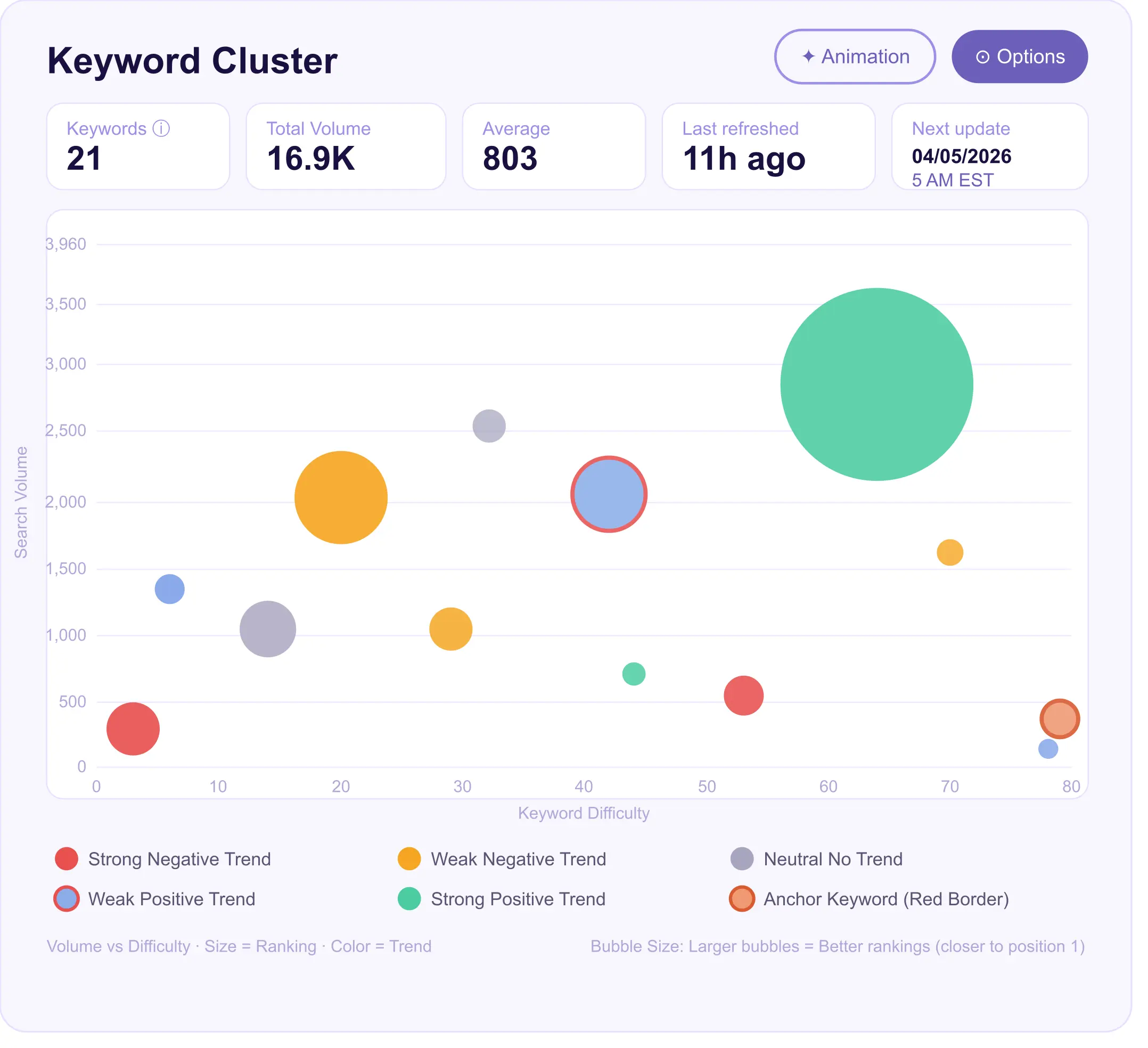
See your SEO strategy, not just your data
Most SEO tools give you data. ClusterView gives you clarity. The interactive keyword visualization maps your entire keyword landscape into clusters — showing you not just which terms you are targeting, but how they relate to each other, where your gaps are, and where your greatest opportunities lie.
As your rankings shift week by week, ClusterView animates that growth in real time. You are not waiting for a monthly report to know whether your strategy is working. You can see it.
Always know the next move
One of the most underappreciated costs of SEO overwhelm is the time lost deciding what to do next. Keyword research is done, but what do we actually write? Which cluster do we tackle first? What does the team need to produce this week?
ClusterView bridges the gap between research and content creation by suggesting what to write about next based on your current rankings, your existing content, and your cluster gaps. Your team goes from staring at a spreadsheet to having a clear, prioritized content queue.
This is especially valuable for SEO teams and agencies managing high volumes of content: the strategic planning that used to take days of analysis happens in ClusterView automatically, so your team can spend their time creating rather than deliberating.
A keyword cluster generator built for real workflows
ClusterView is not just a keyword grouping tool — it is a full SEO content planning platform. Import keyword lists from your existing research tools, run AI-powered cluster analysis that groups by search intent and SERP similarity, identify gaps, map content architecture, and track performance — all in one place.
Plans start from $15/month, with a free trial so you can see the difference before committing.
Who ClusterView Is For
ClusterView was built for anyone who takes SEO seriously and wants their effort to actually compound into results.
SEO agencies and professionals
Agencies managing client portfolios need a repeatable process that scales. ClusterView gives SEO professionals a structured workflow — from keyword research to content roadmap — that can be applied across every client without rebuilding from scratch each time. The visual output also makes strategic conversations with clients far easier: instead of explaining a spreadsheet, you show them a living map of their SEO strategy.
For agencies looking for the best SEO tools for agencies, ClusterView offers the kind of depth that enterprise platforms charge hundreds of dollars a month for — at a price point that makes sense across an entire client roster.
In-house marketing teams
For in-house teams at growing companies, ClusterView answers the question that keeps SEO leads up at night: are we building in the right direction? The cluster visualization and content gap analysis make it clear — at any given moment — what the highest-impact content opportunities are and whether existing content is doing its job.
Small businesses doing their own SEO
SEO tools for small businesses have historically meant either oversimplified tools that miss the strategic depth, or enterprise platforms priced for teams twenty times the size. ClusterView fits where most small businesses actually are: serious about growth, limited on time, and needing clarity more than they need more data.
With ClusterView, a small business owner or a lean marketing team can build a genuinely strategic SEO content plan — without needing a dedicated SEO strategist on staff.
Affiliate marketers and content publishers
Keyword research for affiliate marketing is all about intent alignment: finding the commercial and informational clusters that drive the right traffic to the right content. ClusterView’s AI clustering surfaces intent signals automatically, making it straightforward to build the kind of content ecosystem that converts — not just ranks.
Local SEO specialists
Keyword research for local SEO requires handling geographic complexity at scale: service-area clusters, city-specific variations, location intent signals. ClusterView handles large keyword sets cleanly, making it practical to build well-structured content architecture across multiple locations without losing the strategic thread.
What Good SEO Content Planning Actually Looks Like
The best SEO content strategies are not built around individual pieces of content. They are built around systems — repeatable processes that produce compounding results over time.
With a cluster-based approach and the right AI SEO software supporting it, that system looks like this:
- Map the keyword universe into clusters, prioritized by traffic potential and intent clarity.
- Identify gaps — where the highest-value clusters have no existing content, or where existing content is underperforming.
- Build pillar and cluster content that covers the full intent landscape of each priority topic.
- Track rankings at the cluster level — not just individual keywords — to see how topical authority is building over time.
- Repeat: use performance data to identify the next round of opportunities, and keep building.
This is how SEO stops feeling like an overwhelming maze and starts feeling like a clear path forward. Every piece of content has a purpose. Every cluster has a place in the architecture. And week by week, you can watch the results animate in real time.
SEO strategy examples that work are rarely about doing something clever. They are about doing something systematic — consistently, with clarity about what matters and why.
The Fear of Falling Behind — and What Happens When You Stop Feeling It
There is a specific anxiety that comes with SEO. You know it matters. You see competitors publishing content, gaining visibility, building the kind of organic presence that compounds over time. And somewhere in the back of your mind, the fear of falling behind is always there.
That fear is useful as a motivator. But it becomes a problem when it leads to scattered effort — publishing content without a clear strategy, chasing keywords without understanding how they fit together, making decisions based on instinct rather than clarity.
What changes when that fear becomes confidence is not just the feeling — it is the quality of the decisions. When you can see your SEO strategy clearly, when you know what is working and what to do next, you stop reacting and start building. You stop publishing content and start building an asset.
That shift — from overwhelm to confident, directed growth — is what ClusterView is built to create. Not just better data. A clearer path.
See Where Your SEO Strategy Actually Stands
If you have been collecting keyword data without the clarity to act on it — or if your team is spending more time deciding what to create than actually creating — ClusterView is worth a serious look.
The keyword visualization alone tends to change how teams think about their content strategy. Seeing clusters animate as rankings shift, watching gaps become visible, having the next content priority surface automatically — it is a different experience from working in a spreadsheet.
Plans start from $15/month. Start your free trial at ClusterView and find out what it looks like when your SEO strategy finally has a map.

About The SEO Content Strategy That Turns Chaos Into Confident Growth Guide
This guide was authored by The Scopic Team.
Scopic provides quality and informative content, powered by our deep-rooted expertise in software development. Our team of content writers and experts have great knowledge in the latest software technologies, allowing them to break down even the most complex topics in the field. They also know how to tackle topics from a wide range of industries, capture their essence, and deliver valuable content across all digital platforms.