Table of Contents
Application modernization is the process of updating legacy software so it can run on modern infrastructure, integrate with current systems, and meet today’s performance and security demands. This means outdated applications aren’t being scrapped entirely, but rather modernized to extend their value.
And with the application modernization services market projected to grow at a 19.86% CAGR between 2026 and 2031, it’s clear that businesses are increasingly prioritizing the modernization of their existing applications to keep pace with evolving technology and business needs.
If your system no longer fits how your business actually operates today, you need a structured application modernization strategy that accounts for technical debt, business risk, integration dependencies, and your team’s actual capacity to execute change.
This article walks you through what that strategy involves in practice.
Key Takeaways
- Modernization is a portfolio decision, not a single project. Different applications in your stack often need different modernization approaches, from a simple cloud rehost to a full rebuild.
- The “6 Rs” framework gives you a common decision model for deciding how aggressively to modernize each system: rehost, replatform, refactor, rearchitect, rebuild, or replace.
- Prioritization should weigh business value against technical risk, not just which system is oldest or most annoying to maintain.
- The right application strategy and modernization advisory partner brings both legacy-system fluency and modern cloud-native expertise, a combination that’s harder to find than either skill alone.
What Is an Application Modernization Strategy?
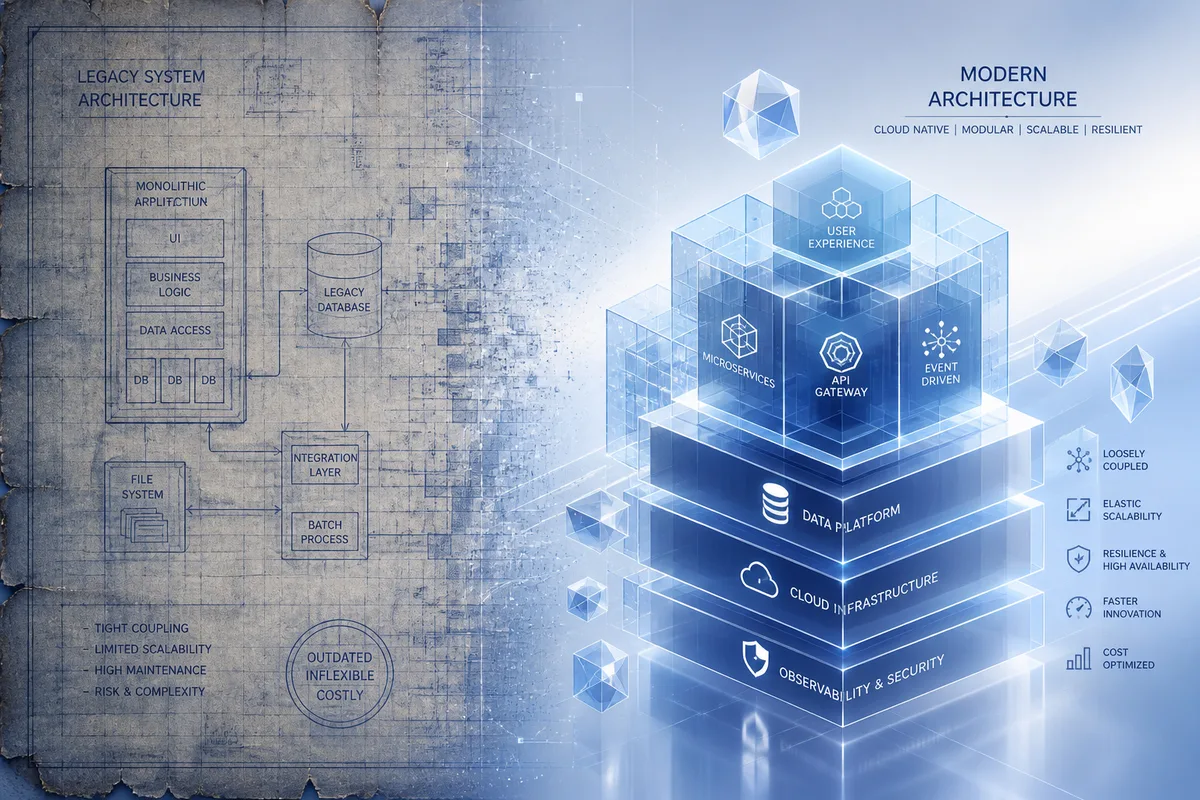
An application modernization strategy is a structured plan for updating legacy software systems to align with current business requirements, technical standards, and growth plans. It defines which applications need to change, which modernization approach fits each one, what order the work happens in, and how risk gets managed along the way.
A real strategy goes beyond a single technical decision like “migrate to AWS” or “rewrite in a new framework.” It’s a decision framework applied across a portfolio: a legacy inventory system, a decade-old customer portal, and an internal reporting tool rarely warrant the same treatment, for example.
Signs Your Legacy Systems Need a Modernization Strategy
Legacy application modernization typically become urgent when the cost of maintaining the status quo starts outweighing the cost and risk of change.
Watch for these indicators:
- Maintenance costs climb while delivery speed drops. Engineering time increasingly goes toward patching bugs, managing workarounds, and babysitting fragile deployments rather than shipping new features.
- Integration requests keep getting declined or delayed. A legacy system can’t expose data through modern APIs. This stalls partnerships, mobile apps, and automation initiatives that depend on clean, reliable integrations.
- Security and compliance exposure increases. Vendors stop issuing security patches, frameworks reach end-of-life, and outdated systems become more vulnerable to cyber threats.
- Talent becomes the bottleneck. Fewer engineers know (or want to learn) the original tech stack, concentrating critical knowledge in one or two people.
- The system can’t scale with demand. Performance degrades under load because the original architecture assumed a fraction of today’s traffic or data volume.
- AI and analytics initiatives stall. Leadership wants predictive analytics or AI-powered features, but the legacy data layer isn’t structured to support them.
None of these signs individually demands a rebuild. Together, they tell you it’s time to formally assess the system rather than keep patching it reactively.

Core Application Modernization Strategies: The 6 Rs
Most application modernization strategies fall into one of six categories, often referred to as the “6 Rs.” Each represents a different level of technical change, cost, and business disruption.
| Approach | What It Involves | Relative Effort | Best Fit |
| Rehost | Move the application to new infrastructure (often cloud) with minimal code changes, also called “lift and shift” | Low | Systems with urgent infrastructure risk but stable functionality |
| Replatform | Make targeted changes to take advantage of cloud-native features (managed databases, auto-scaling) without rewriting core logic | Low-Medium | Applications that need better performance or reliability without a full rebuild |
| Refactor | Restructure existing code to improve maintainability and performance while preserving external behavior | Medium | Codebases with significant technical debt but sound business logic |
| Rearchitect | Redesign the application’s structure, such as breaking a monolith into services, to support new scalability or integration requirements | Medium-High | Systems where the current architecture actively blocks growth |
| Rebuild | Redesign and rewrite the application from scratch while keeping its original scope and purpose | High | Systems too brittle, undocumented, or outdated to safely refactor |
| Replace | Retire the custom application in favor of a commercial off-the-shelf or SaaS alternative | Variable | Commodity functionality that no longer needs to be custom-built |
Choosing between these approaches is rarely obvious from the outside. This is where a structured technical assessment, not a quick guess, pays for itself.
For organizations that land on rebuild or rearchitect, the work typically resembles a new product build more than a migration project, which is why it often falls under custom software development services rather than a pure migration engagement.
Building a Cloud Application Modernization Strategy: 5 Key Steps
A cloud application modernization strategy covers more than relocating workloads. Realizing its full value requires a deliberate, staged process, which we outline below.
Step 1: Assess Your Current Application and Infrastructure
Before changing anything, get a clear picture of what you actually have. List out the application’s main components, how they depend on each other, where the data lives, and how the whole thing is hosted today.
Then identify where it’s struggling: slow release cycles, scaling limits, rising hosting costs, security gaps, or integrations held together with workarounds.
For each major part of the application, this assessment should answer three plain questions: What does it do? How well is it still doing that job? And what would it take to modernize it?
The answers determine which of the steps below apply to your application, and in what order you should tackle them.
Step 2: Choose Your Modernization Path Using the 6 R’s
Different applications warrant different treatment, and cloud teams typically sort their options into the “6 R’s” covered above: rehost, replatform, repurchase, refactor, retire, and retain.
The right choice depends on what the assessment in Step 1 told you about each part of the application. For instance, a stable internal tool with light traffic might only need rehosting, while a customer-facing application straining under growth may be a stronger candidate for refactoring.
This is also where you decide whether any part of the application is worth rebuilding as smaller, independently run services, an approach known as microservices. Breaking a monolithic application into microservices lets each component be developed, deployed, and scaled on its own schedule, which matters most for the parts of your system that change frequently or face unpredictable demand.
Step 3: Package the Application Into Containers
A container is a way of bundling an application together with everything it needs to run, so it behaves the same way on a developer’s laptop, in testing, and in production.
Tools like Docker create these containers, while a tool like Kubernetes manages them once you have many running at once, starting them up, shutting them down, and keeping them balanced across available resources.
Once an application is containerized, each piece can scale up or down on its own instead of being locked to a fixed amount of server capacity.
Step 4: Replace Self-Managed Infrastructure With Managed Cloud Services
Hand off the pieces of infrastructure that your team currently maintains by hand, like databases, message queues, and caching systems, to a managed version run by your cloud provider, such as Amazon RDS or Azure SQL Database.
The provider takes care of the routine, time-consuming work: applying security patches, running backups, and keeping things running if a server fails. This is often where businesses see the clearest, earliest payoff from modernization, in both lower costs and fewer outages.
Step 5: Automate Releases and Build In Monitoring From Day One
Set up an automated pipeline so your team can ship updates quickly and reliably, which is usually the whole point of modernizing in the first place.
A modern, cloud-ready application without this kind of automation tends to stall out. The team ends up managing more moving pieces with no faster way to actually release changes to any of them.
At the same time, put monitoring and alerting tools in place from the start, rather than adding them after something breaks in production. Once an application is split across several services running on cloud infrastructure, figuring out what went wrong without these tools in place is far harder than it was with the original setup.
A modernization effort that stops after moving an application to the cloud, leaving it “running in the cloud now” and little else, tends to run into the same scaling and maintenance problems all over again, just in a new environment. Working through all five steps, starting with an honest look at what you currently have, is what separates real modernization from a simple move.
Tips for a Successful Legacy Application Modernization
A disciplined process keeps legacy application modernization strategies from becoming open-ended rewrites. The following practices reflect how successful modernization engagements are typically run:
-
Assess before you touch anything. Catalog every application in scope, documenting its business function, technical stack, dependencies, data flows, and known pain points. Skipping this step is the most common reason modernization projects uncover costly surprises mid-build.
-
Prioritize by value and risk, not convenience. Score each application against business value (how critical it is, how much it’s blocking growth) and technical risk (how fragile, undocumented, or unsupported it is). High-value, high-risk systems typically warrant the earliest attention, even though they’re often the hardest to touch first.
-
Match the approach to the application, not the portfolio. Apply the 6 Rs framework system by system rather than committing every application to the same strategy. A system worth rebuilding and one worth simply rehosting rarely sit in the same portfolio by accident.
-
Sequence for early, visible wins. Build a phased roadmap so the first releases validate the approach and build organizational confidence before the largest or riskiest systems are touched.
-
Favor incremental cutovers over big-bang replacements. Patterns like the strangler fig approach, where new services progressively take over functionality from the legacy system, limit the blast radius if something goes wrong, unlike a single cutover that risks total failure.
-
Build in security from day one. Modernized systems should consider security practices from the start rather than being an afterthought, as recommended in our software development best practices guide.
-
Carry engineering discipline into the new system. Automated testing, version control discipline, and DevOps automation significantly reduce the risk of the modernized system inheriting the same maintenance problems as the one it replaced.
How to Choose Application Strategy and Modernization Advisory Partners
The right application strategy and modernization advisory partner should combine legacy-system fluency with genuine cloud-native engineering depth, not just one or the other.
Look for the following when evaluating a partner:
-
Portfolio assessment methodology. Top legacy software modernization companies have a repeatable process for auditing your application portfolio and scoring systems against both business value and technical risk, rather than jumping straight to recommending a rebuild.
-
Demonstrated experience with your legacy stack. Whether that’s a decades-old ColdFusion application, a Visual Basic desktop tool, or an unsupported version of a framework, the partner should have specific experience untangling similar systems, not just modern-stack experience.
-
Modern cloud and architecture expertise. The team should be equally comfortable designing event-driven systems, containerized deployments, and API-first architectures, since that’s typically where the modernized system ends up.
-
A track record of phased, low-risk delivery. Strong partners favor incremental migration patterns (like the strangler fig pattern, where new functionality gradually replaces legacy modules) over risky, big-bang cutovers.
-
Security and compliance competence, particularly for regulated industries where legacy systems often carry outdated authentication, encryption, or audit-logging practices.
Scopic’s approach to software development consulting applies here directly: the right advisory relationship starts with clarifying objectives and constraints before any code gets touched, not after.
Why the Timing Matters
The United States already represents a mature, innovation-driven segment of this market, accounting for 36% of global application modernization services revenue in 2025, according to Fortune Business Insights.
That maturity signals something important: organizations that treat modernization as a one-time cleanup project are increasingly outpaced by competitors who treat it as an ongoing capability.
Legacy systems don’t stay “modernized” forever. A sound application modernization strategy aims to leave your application portfolio in a state where the next round of changes, whether that’s a new integration, a compliance requirement, or an AI feature, doesn’t require starting from scratch.
Final Thoughts
If your organization is weighing where to start, the decision usually comes down to a clear-eyed assessment of your current systems and an honest read on which ones are actually holding the business back. That’s exactly the kind of evaluation our team works through with clients before recommending an approach.
Ready to map out a modernization plan for your own systems? Explore Scopic’s legacy software modernization services to see how our team approaches portfolio assessment, migration planning, and phased execution for organizations moving off outdated systems.
Frequently Asked Questions
When to modernize vs migrate applications as-is cloud strategy?
Migrate an application as-is when it still meets business needs but runs on infrastructure that’s expensive, unsupported, or hard to maintain. Modernize it when the application’s underlying architecture, not just its hosting environment, limits scalability, security, or integration.
What is a cloud strategy, and how does it relate to application modernization?
A cloud strategy determines which workloads move to public cloud, private cloud, or a hybrid combination, and in what order. For modernization, it answers which components can move immediately, which need refactoring first, and which should stay put due to compliance, latency, or cost constraints.
How does a hybrid cloud strategy support application modernization efforts?
A hybrid cloud strategy lets you move and refactor workloads incrementally instead of all at once, shifting lower-risk components to the public cloud early while keeping sensitive or regulated workloads on-premises until they’re ready. This phased approach reduces the risk of downtime or data exposure and gives your team room to test new architectures before committing the entire system.
How to pick an application modernization strategy?
Picking the right strategy starts with assessing an application’s business criticality, technical debt, and expected future growth, which map to the common “6 Rs”: rehost, replatform, refactor, repurchase, retire, or retain. An experienced modernization partner can help match the right path to each application rather than applying one strategy portfolio-wide.

About Application Modernization Strategy: How to Go From Legacy to Modern Systems
This guide was written by Baily Ramsey.
Scopic provides quality and informative content, powered by our deep-rooted expertise in software development. Our team of content writers and experts have great knowledge in the latest software technologies, allowing them to break down even the most complex topics in the field. They also know how to tackle topics from a wide range of industries, capture their essence, and deliver valuable content across all digital platforms.