Table of Contents
“This article contains content that has been artificially generated or manipulated using AI tools.”
Most companies have already run an AI pilot. Far fewer have turned that pilot into something that changes how the business actually operates. That gap between AI adoption and AI transformation is where most enterprise AI budgets quietly stall.
The pattern is familiar. You reached a generative AI proof of concept that impressed the board, and then nothing happened. Disconnected pilots, inconsistent data, stalled production deployments, and governance added as an afterthought all keep organizations from capturing repeatable value.
AI transformation consulting exists to close that gap and bring all elements into one coordinated engagement.
This article walks through that full journey, from assessing whether your organization is ready to the framework consultants use to take a pilot to enterprise scale.
What AI Transformation Consulting Actually Involves
AI transformation consulting is an advisory and implementation service that helps organizations redesign how they operate around artificial intelligence, rather than simply deploying isolated AI tools. It combines business strategy, technology architecture, and organizational change management.
AI Consulting vs AI Transformation Consulting
AI consulting solves a defined technical or strategic problem, such as selecting a model architecture or scoping a single use case.
AI transformation consulting is broader, coordinating change across business priorities, technology, processes, people, data, and governance at the same time. Which one you choose depends on whether your challenge is contained or systemic.
| Dimension | AI Consulting | AI Transformation Consulting |
|---|---|---|
| Scope | Single project or use case | Enterprise-wide or multi-department |
| Duration | Weeks to a few months | Months to multiple years |
| Focus | Technical solution | Strategy, technology, and change together |
| Typical trigger | “We need this specific tool built” | “We need AI to change how we operate” |
| Success measure | Delivered feature or model | Scaled, adopted, governed capability |
If your organization needs coordinated change across multiple functions, data sources, and stakeholder groups, transformation consulting is the more suitable path.
AI Transformation vs Isolated AI Development
AI development is the right choice when you already know what you want to build and how it fits into your operations. If a finance team needs an anomaly-detection model integrated into an existing fraud workflow, that is an AI product development project with a clear specification.
AI transformation consulting becomes more relevant when the open questions sit above the code: which use cases deserve investment, whether the organization is actually ready, who owns the outcome, how workflows need to change, what governance is required, and how success will be measured.
AI development builds the capability. AI transformation determines where that capability belongs in the business, how the organization adapts around it, and how a successful pilot scales beyond its original team. Many engagements start with AI consulting to answer those upstream questions before any development work begins.
Why This Is a Boardroom Priority Now
AI transformation has become a board-level issue because adoption has outpaced scaled value, and that gap carries real financial and competitive risk. According to McKinsey’s 2026 State of AI survey, 88 percent of organizations now use AI in at least one business function, and 40 percent of enterprises with over $1 billion in revenue are actively scaling AI agents in at least one function. Yet Gartner research finds that only 22 percent of organizations have successfully scaled AI across multiple business units.
That gap between experimentation and enterprise-wide scale is exactly the problem transformation consulting is built to close. It also explains why the market is expanding so quickly. Industry market research values the global AI consulting services market at $11.9 billion in 2026, projecting 25.6 percent annual growth through 2034. This is why the question most boards ask today is why a pilot from last year has never turned into an operating model.
The AI Transformation Consulting Framework: From Readiness to Scale
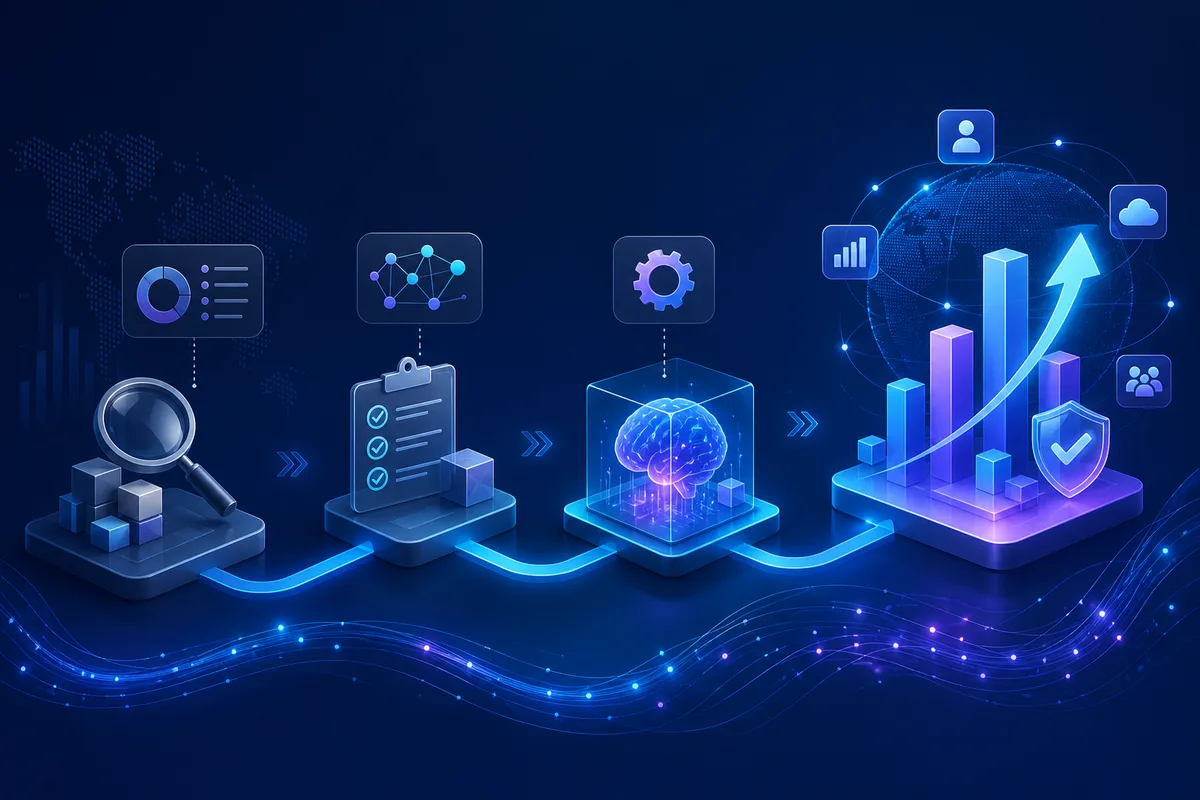
A structured AI transformation engagement follows a repeatable sequence. Each AI transformation stage reduces uncertainty before the organization commits more budget and more operational exposure to the next one. Governance and measurement run through every phase, which is what separates a managed transformation from a string of unrelated AI projects.
Phase 1: Assess AI Readiness and Maturity
An AI readiness assessment determines what the organization can realistically support today, before any use case is selected. Skipping this step is one of the most common causes of stalled transformations, because gaps that go undetected at the start surface later as integration failures or abandoned pilots.
Not sure where your organization stands?
Find out how ready your business is for AI in just a few minutes. Take the free AI readiness assessment →
A rigorous assessment covers five areas:
- Business readiness depends on leadership answering a few uncomfortable questions before the project starts: What business objective does this serve? Who is accountable if it fails? And will a sponsor still back the project six months in, once the initial excitement fades?
- Process readiness means looking past the org chart to the actual workflow. Things like manual handoffs and repetitive approvals are exactly where AI has something to offer. Processes that are too ambiguous or inconsistent make poor first candidates.
- Data readiness is about whether the organization’s data can be trusted and reached. A company can sit on years of historical records and still fail this test if the data is scattered across disconnected systems or inconsistently labeled.
- Technical readiness asks whether existing infrastructure can support what’s being proposed, including APIs, integrations, cloud adoption, and any legacy systems that resist connecting to anything built in the last five years.
- Organizational readiness is the human side of the equation. Do the people who will use the AI system have the skills and baseline literacy to do so, or does the organization need to invest in that capacity first?
Phase 2: Prioritize High-Value AI Use Cases
Technical feasibility alone does not make an AI project worth pursuing. A use case can be entirely buildable and still fail to justify the investment if it doesn’t move a business metric that matters.
Consultants typically build a use-case portfolio and score each opportunity against four criteria.
- Business value asks a simple question: does this use case move a metric leadership actually cares about, whether that’s revenue, cost, speed, or customer satisfaction?
- Technical feasibility checks whether the underlying data and systems can realistically support the use case today, not in some future state after a dozen upgrades.
- Risk forces a hard look at what happens when the model gets it wrong, who’s exposed, and whether the regulatory and accuracy bar can even be met.
- Adoption complexity is often the most underestimated criterion. It measures how much the use case will disrupt the way people already work, and how much retraining and change management that disruption demands.
This scoring turns a long wish list into a short, defensible set of priorities.
Phase 3: Build the AI Transformation Roadmap
A transformation roadmap translates those priorities into a working plan: what each use case should achieve, who owns it, and what data and architecture work it depends on. From there, the roadmap lays out implementation waves with realistic milestones and KPIs attached.
The roadmap matters because it makes dependencies explicit. A typical sequence looks like data consolidation, then an integration layer, then a first production use case, followed by governance standards, and only then additional rollout across other teams.
Without that sequencing, organizations tend to attempt the use case before the infrastructure underneath it can support it. This is also where AI strategy consulting work often feeds directly into the transformation roadmap.
Phase 4: Validate Through Prototypes, PoCs, and Pilots
Validation exists to test assumptions before the organization commits to full deployment. Each stage exists to answer a distinct question:
- Prototype: Can this concept work at all?
- Proof of concept (PoC): Does this specific technical approach solve the problem we’ve defined?
- Pilot: Does it hold up inside a real workflow, with real users who didn’t help build it?
- Production: Can this run reliably at scale, day after day, without constant hand-holding?
These stages echo the broader AI development lifecycle, applied within a governed roadmap. Pilot success should never be judged on model accuracy alone.
Relevant metrics fall into a few categories:
| Category | What to Measure |
|---|---|
| Performance | Latency, reliability, error reduction |
| Cost and efficiency | Operating cost, employee time saved, frequency of human intervention |
| Usage | Adoption rate, task completion |
| Outcomes | Measurable business impact |
After validation, every initiative should pass through one of four explicit decisions: Scale, Improve, Pause, or Stop.
“Many AI pilots fail to reach production because they are built to show what AI can do, not to prove it can operate reliably in a real business environment. A proof of concept can perform well on a curated dataset, but production brings inconsistent data, legacy integrations, latency, costs, and security. In my view, the gap is often an engineering and operational challenge, not a model performance problem. Teams should define production requirements early and validate under realistic conditions, measuring reliability, cost per task, and human intervention, not just accuracy.”
— [Viet-Anh Nguyen, Machine Learning Lead]
Phase 5: Implement, Integrate, and Drive Adoption
Implementation has a technical side and an organizational side, and both need to happen together. On the technical side, teams are making decisions about architecture, model selection, APIs, data pipelines, security, and monitoring. For conversational use cases, that includes choosing among suitable chatbot development frameworks. On the organizational side, they’re redesigning workflows, training staff, and rethinking who owns which processes.
Deploying an AI system is implementation. Changing how the organization actually operates because of that system is transformation, and the aim is to make AI part of real workflows that employees rely on.
Our guide to AI integration consulting covers the technical side of this phase in more depth, but change management belongs here too, as a core part of implementation rather than an HR afterthought bolted on after launch.
Phase 6: Scale AI Across the Organization
Organizations generally choose between two AI operating models at this stage. In a centralized model, a core team governs standards and infrastructure for the whole company. In a decentralized model, individual business units build on a shared foundation but retain more autonomy over their own AI initiatives.
Either way, every initiative moving toward scale should pass through the same decision gates used during validation. A well-run transformation also increases internal capability over time, so the organization depends less on outside consultants as its own teams mature.
Data, Infrastructure, and Governance Foundations
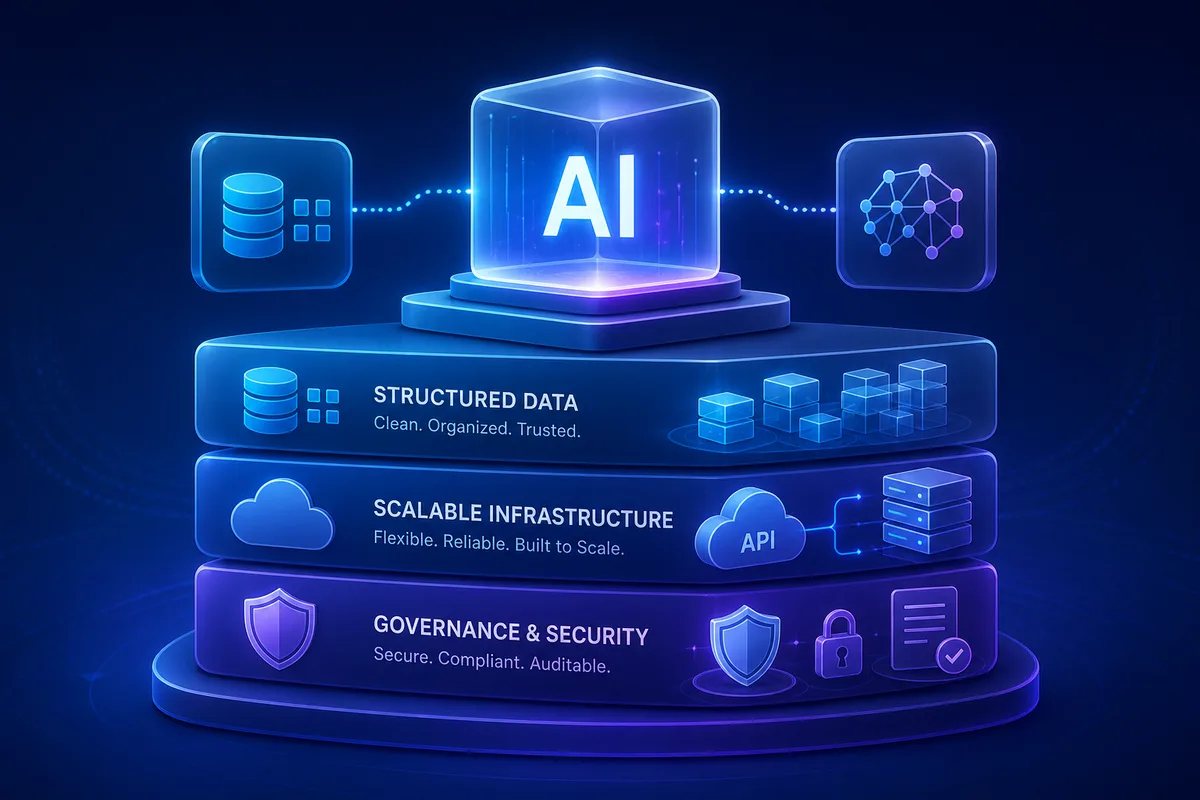
Structured, accessible data is the baseline requirement before any model work begins. Organizations attempting to layer AI on top of siloed, inconsistent, or poorly labeled data routinely see projects stall regardless of how sophisticated the chosen model is.
Compute, API, and storage decisions also differ by organizational scale. A smaller company typically relies on cloud-based infrastructure and managed services to avoid upfront hardware costs, while a larger enterprise may need private infrastructure, hybrid cloud architecture, or custom-built platforms to meet compliance and performance requirements.
Enterprise-grade AI readiness assessment frameworks now evaluate organizational capability across six primary domains before any code is written or any foundation model is selected, reflecting how central this groundwork has become to transformation planning.
Governance has to be built in from the start, ideally within the AI SDLC itself so checks run at every release. That means establishing auditability for every AI-driven decision, running regular bias checks on models that affect customers or employees, and mapping regulatory requirements specific to your industry before deployment.
How to Measure AI Transformation Success
Measuring AI transformation success means connecting technical performance to adoption and business outcomes. A credible measurement framework tracks performance at five levels.
- Business outcomes: revenue impact, cost reduction, productivity gains, customer satisfaction, retention, and risk reduction.
- Operational outcomes: cycle time, throughput, processing speed, automation rate, error reduction, and employee time saved.
- AI system performance: accuracy, reliability, latency, error or hallucination rate, uptime, and cost per task.
- Adoption metrics: active usage, workflow penetration, training completion, override frequency, user satisfaction, and the rate of human intervention.
- Transformation progress: the percentage of pilots that reach production, the number of reusable AI capabilities built, time from approval to deployment, and how many workflows have actually been redesigned around AI.
Establish baseline metrics before implementation begins. Without them, there is no way to credibly demonstrate improvement later.
Not every initiative needs to be judged solely on immediate financial ROI. Some early-stage projects exist to build organizational capability or validate an approach, and their value shows up in later initiatives.
Why AI Transformation Programs Fail
Most transformation failures trace back to the following patterns:
| Failure Pattern | Why It Happens | Better Approach |
|---|---|---|
| Technology-first planning | Teams select a model or vendor before defining the business problem | Start with use-case prioritization tied to measurable business value |
| Disconnected pilots | Projects run in isolated teams with no shared infrastructure | Build a roadmap with explicit dependencies across initiatives |
| Weak data foundations | Data is siloed, inconsistent, or unlabeled | Run a data-readiness assessment before model work begins |
| No executive owner | Initiative lacks a sponsor accountable for outcomes | Assign a named business owner before launch |
| Governance added too late | Compliance and bias checks are retrofitted after deployment | Build governance requirements into the roadmap from Phase 1 |
| Pilots that cannot scale | Pilot architecture isn’t designed for production load or integration | Design pilots against production requirements from the outset |
| Low employee adoption | Workflow and training needs are ignored until after launch | Treat change management as part of implementation, not an afterthought |
| Unclear ROI | No baseline metrics were established before deployment | Define KPIs and baselines during the roadmap phase |
A structured methodology exists precisely to catch these failure modes before they become expensive.
Build In-House, Outsource, or Use a Hybrid Model
The right delivery model depends on your specific needs and requirements. Here is the breakdown:
| Model | Best For | Trade-off |
|---|---|---|
| In-house team | Organizations with mature data and engineering functions already in place | Slowest to start, highest long-term control |
| Staff augmentation | Teams with internal AI knowledge but limited bandwidth | Faster ramp-up, requires strong internal coordination |
| Full outsourcing | Organizations without internal AI expertise or needing speed | Fastest start, requires a clear knowledge-transfer plan |
Costs scale with scope rather than following a single flat rate. Within that, the development line item shifts with model complexity, data volume, and integration needs, which is why AI development cost estimates are best built bottom-up.
An assessment-only engagement is a relatively contained investment measured in weeks. On the other hand, a full transformation program spanning readiness through scaling is a materially larger, multi-phase investment measured in months to years. Lastly, a phased contract structure tied to the six-phase framework, where each phase is scoped and priced before the next begins, gives you far more budget control than a single fixed-scope deal signed before readiness work has even started.
It’s also worth noting that build decisions are shifting. According to industry analysis, 32 percent of large enterprises now build customized internal tools with agentic development tools rather than buying commercial software outright. This trend is reshaping how organizations think about the build-versus-buy decision for custom AI solutions inside a transformation program.
What Should an AI Transformation Consultant Deliver?
A transformation engagement should produce concrete deliverables that drive specific decisions.
These deliverables typically fall into three groups:
Diagnostic deliverables establish where the organization stands today:
- AI readiness assessment and maturity baseline
- Data-readiness plan
Strategic deliverables define what to do and in what order:
- Prioritized use-case portfolio with supporting business cases
- Transformation roadmap
- Target architecture
- Governance framework
Operational deliverables turn strategy into execution:
- Pilot or PoC specification
- Implementation plan
- KPI framework
- Change-management plan
- Training plan
- Scaling roadmap
Not every engagement requires all of these, and the scope should match the organization’s actual starting point.
The link between deliverable and decision is what makes them valuable. Each deliverable exists to answer a specific question. The readiness assessment tells you where to start by surfacing the gaps that matter most. The use-case portfolio tells you where to invest first. The pilot tells you whether your assumptions actually hold before you commit to full deployment. And the KPI framework tells you whether an initiative has earned the right to scale.
Ask any prospective consultant to explain which decision each deliverable is meant to support.
How to Choose an AI Transformation Consulting Partner
Start by reviewing documented case studies with quantified outcomes in your industry. A consultant who can point to measurable results in a comparable environment is a far better signal than general AI expertise.
Ask directly how the consultancy handles data security, model auditability, and knowledge transfer to your internal team. A partner who cannot clearly explain how they document decisions, test for bias, or hand off systems to your staff is not set up for a long engagement. Confirm their approach to generative AI and autonomous agents as part of a forward-looking roadmap, since an engagement built only around today’s tools will need to be revisited within a year or two given how quickly the underlying technology moves.
Finally, request references tied to the specific phase of transformation you actually need help with. A consultant with strong readiness-assessment references may not be the right fit for a scaling engagement, and vice versa. Matching the reference to the phase gives you a much more honest picture of fit than a generic client list.
To see what documented results look like in practice, here are three AI projects Scopic has delivered across healthcare, machine learning benchmarking, and insurance.
AccuSlice: AI-Powered 3D Bone Segmentation for Surgical Planning
Converting foot and ankle CT scans into 3D models has traditionally required clinicians to segment each bone by hand. For AccuSlice, Scopic built an AI platform that processes DICOM images, automatically segments individual bones, and generates labeled STL files for visualization and surgical planning. Our team also developed the data preparation and training pipeline behind the deep learning models, then validated them across CT scans with varying spacing and orientation. Development is now underway to extend the platform to additional body parts.
MLPerf: Benchmarking Machine Learning Performance Across Hardware
ML Commons needed a way to compare machine learning workloads across laptops, desktops, and workstations. Scopic participated in the project development of MLPerf, a benchmarking tool that evaluates image recognition, natural language processing, and recommendation tasks across multiple hardware and software configurations. In the second phase, we built the desktop and iPad interfaces with input from ML Commons and hardware vendors including AMD, NVIDIA, Intel, Microsoft, and Qualcomm, and added automated testing.
SalesTank: AI-Driven CRM for Insurance Lead Acquisition
Insurance agents often juggle several platforms to find and convert leads. SalesTank is a custom CRM that Scopic built to consolidate that workflow, using machine learning and AI to deliver real-time insights, advanced analytics, AI-driven coaching, personalized recommendations, and automated lead acquisition. Integrated lead dialer technology supports efficiency and compliance, helping insurance teams improve engagement and conversion while reducing compliance risk.
Turn AI Strategy Into Measurable Transformation
AI transformation succeeds when assessment, roadmap, pilot, and scale are treated as one continuous process. The organizations closing the gap between AI adoption and scaled value are the ones running this as a managed engagement with clear phases, owners, and decision gates.
Scopic’s AI consulting services are built around exactly this framework, from readiness assessment through implementation and scaling. If you’re ready to move your organization from isolated AI pilots to a transformation program with measurable business outcomes, book a free consultation with our team.
Frequently Asked Questions
What does an AI transformation consultant actually do day to day?
An AI transformation consultant runs readiness assessments, builds and refines transformation roadmaps, manages pilots and proofs of concept, and coordinates between data teams, engineering teams, and business stakeholders. Day-to-day work also includes reporting on KPIs tied to business outcomes and adjusting the roadmap as results come in.
How much does AI transformation consulting cost?
Cost depends heavily on scope. An assessment-only engagement is a relatively contained investment measured in weeks, while a full transformation program is a substantially larger multi-phase investment. Structuring the contract in phases tied to the transformation framework keeps spending aligned with validated results rather than committing to a single large fixed-scope deal upfront.
How long does a full AI transformation engagement take?
A readiness assessment and roadmap typically take a few weeks. Pilots and proofs of concept generally run a few months. Enterprise-wide scaling across multiple business units often takes a year or more, depending on data complexity, the number of systems involved, and how much organizational change is required.
How is AI transformation consulting different from AI strategy consulting?
AI strategy consulting focuses primarily on planning and vision: defining goals, identifying opportunities, and setting a direction. AI transformation consulting covers that same strategic groundwork but extends through the full execution cycle, including implementation, adoption, measurement, and scaling.
Do we still need a consultancy if we already have an in-house data team?
Often, yes. Internal data teams frequently lack the bandwidth or the objectivity needed for enterprise-wide rollouts, especially when a transformation spans multiple business units with competing priorities. A consultancy can augment an in-house team’s capacity and provide an outside perspective on readiness gaps, rather than replacing it.
Which industries benefit most from AI transformation consulting?
Healthcare, finance, manufacturing, and retail tend to see the fastest returns because of their data richness and repetitive, well-documented processes. That said, nearly any data-rich sector can benefit, since the underlying framework of readiness, prioritization, validation, and scale applies regardless of industry.
How is AI transformation consulting different from AI implementation consulting?
AI implementation consulting typically focuses on the technical deployment of a specific, already-defined AI system: building the architecture, integrating it with existing software, and getting it live. AI transformation consulting includes that implementation work but also covers the upstream readiness and prioritization decisions and the downstream adoption and scaling work needed to turn that one deployment into a repeatable organizational capability.
About AI Transformation Consulting: From Readiness Assessment to Implementation
This guide was written by Scopic Team
Scopic provides quality and informative content, powered by our deep-rooted expertise in software development. Our team of content writers and experts have great knowledge in the latest software technologies, allowing them to break down even the most complex topics in the field. They also know how to tackle topics from a wide range of industries, capture their essence, and deliver valuable content across all digital platforms.