Table of Contents
Listen to article
Chatbot development frameworks have powered some of the most successful customer engagement strategies for years, and for good reason. Chatbots are one of the most effective marketing automation tools available today, with 67% of global consumers having interacted with one in the past year alone.
The bigger question isn’t whether you need a chatbot but how to build the right one. Chatbot development has become far more accessible in recent years, with faster turnaround times and a growing pool of skilled developers. The real challenge now is choosing the right framework for your business and finding the expertise to execute it well.
To make that decision easier, we’ve rounded up the best chatbot development frameworks on the market today. Ready to find the right fit for your company? Read on.
What Is a Chatbot Framework?
A chatbot framework is a developer-oriented toolkit that enables the creation of automated customer interaction systems by providing the underlying logic, integrations, and structure needed to interpret user input and generate appropriate responses.
Unlike platforms—which are commonly used by non-developers and have limited capabilities—chatbot frameworks are designed for developers and coders, providing the tools needed to build chatbots from the ground up.
These frameworks integrate seamlessly into existing tech stacks by connecting with APIs, databases, and third-party services, enabling custom workflows and real-time data exchange.
Chatbots 101: Understand the Basics Before You Make Your Pick
Before you pick the best framework for your business, let’s break down the essentials so you can make an informed decision.
What are the 4 Types of Chatbots?
There are four general types of chatbots:
- Menu-based chatbots: Menu-based or button-based chatbots present users with a predefined set of options, allowing them to navigate through a scripted menu to find the most relevant response. These chatbots have limited functionality but are great for tasks like answering questions and scheduling appointments.
- Simple, a.k.a. rule-based chatbots: These chatbots analyze customer queries based on the keywords entered and then provide automated responses based on the information previously uploaded in the chatbot database.
- AI-powered chatbots: AI-powered chatbots use machine learning (ML) and natural language processing (NLP) technologies to generate the best responses for customer queries automatically. These chatbots learn as they interact with more customers and require some advanced training in the early stages.
- Voice chatbots: Voice chatbots are AI-powered conversational tools that are capable of processing human speech, interpreting intent, and responding in real-time. By leveraging text-to-speech technology, they enhance accessibility and improve the customer experience.
Benefits of Using a Chatbot Framework
Using a chatbot framework offers greater customization, scalability, and seamless integration with existing systems, enabling developers to build more flexible and intelligent chatbot solutions.
Once developed, chatbots provide a variety of benefits for your business:
- 24/7 customer support availability
- Immediate response time
- High response rates (35-40%)
- Reduced customer support costs
- Huge time-saver
- Automated storage of customer data
- Integrated with the CRM of your choice
The 7 Steps to Building a Chatbot Strategy
Nothing about chatbot development is random. Every stage of your chatbot strategy is carefully planned and aligned with your goals, often with the guidance of a custom AI development company that understands both technology and business needs
- Define your chatbot’s purpose: Whether your company wants to reduce response times, increase personalization, or boost sales, the purpose of your chatbot should be clearly defined, as it will shape the rest of your strategy.
- Choose a chatbot type: As mentioned, different chatbot types have unique functionalities and serve different purposes. Before making a decision, carefully consider the features required for your project, your business size, and the unique needs of your target audience.
- Select the right chatbot framework: Depending on factors like your project goals and the complexity of your data, your partner will choose an AI chatbot framework that best fits your needs.
- Design user conversations: The next step is to create natural language interactions between users and the chatbot, which may include crafting dialogues, building flows, and shaping the chatbot’s personality to improve the user experience.
- Train the chatbot (AI/NLP if applicable): This step involves feeding the chatbot with relevant data, refining its understanding of user intent, and continuously improving its natural language processing capabilities to ensure accurate and context-aware responses.
- Integrate backend services (CRMs, APIs): Developers will then connect the chatbot to tools like CRM systems and APIs so it can access data, perform tasks, and provide real-time responses based on user input.
- Test, deploy, optimize: Your chatbot will then be tested for key factors like user intent and data security before deployment. After the initial launch, developers will continue to optimize the bot based on user feedback and interactions.
8+ Best Chatbot Development Solutions: Picking Your Winner
You can create chatbot solutions using a variety of chatbot frameworks. To create a proper chatbot, you will have to hire a certified developer who is familiar with the coding languages used to develop the chatbot framework.
Depending on the chosen framework, you can deploy your chatbots directly into your third-party apps, messaging platforms, or even electronic devices.
Now, let’s look at the best chatbot development frameworks and see what makes them unique.
#1: Dialogflow — Cloud Platform

Dialogflow is a Google-owned natural language platform used to develop a variety of chatbot solutions. It’s a strong fit for anyone who wants scalability, cross-platform reach, and both voice and text support out of the box.
You can integrate Dialogflow-built chatbots into any major social or messaging platform, and it works seamlessly across devices thanks to Google’s API, making it easy to connect through professional AI integration services when you need deeper backend connections.
As of 2026, Dialogflow CX also supports Playbooks — a Gemini-powered feature that lets you define a bot’s goals and instructions in natural language rather than building out a rigid flow, so the bot can handle conversations more dynamically instead of only following a fixed decision tree.
Use Cases: Chatbot development, voice interface integration, customer support automation, multi-platform deployment.
Ideal For: AI-powered chatbots that need dynamic, Gemini-backed conversation flows.
Pricing: Usage-based, charged per request and audio duration, with different rates for text, voice, and advanced features across ES and CX editions. Full pricing details are on Google Cloud’s site.
| PROS | CONS |
|---|---|
| Supports both voice & chat | Lackluster support |
| Versatile API (Supports Alexa, Google Assistant, Slack, Twitter, etc.) | Steep learning curve |
| Easily Scalable | |
| 20+ languages supported |
#2: Microsoft 365 Agents SDK (formerly Microsoft Bot Framework) — Cloud Platform

The Microsoft 365 Agents SDK is Microsoft’s current framework for building agents and bots that work across Teams, Microsoft 365, and other channels via Azure AI Bot Service. It has SDK support for C#, JavaScript, and Python, and is built to pair with the Microsoft Agent Framework for orchestration when you need multi-agent logic rather than a single bot. If you want a lower-code option instead, Copilot Studio covers similar ground with a visual builder aimed at less technical teams.
Use Cases: Enterprise system integration, customer service automation, virtual assistants for Microsoft Teams and other Microsoft 365 surfaces.
Ideal For: Enterprise-grade agents built on the Microsoft stack, especially teams already using Teams or Azure.
Pricing: Standard channels are free; premium channels charge per 1,000 messages, plus hosting and Azure service costs. Learn more here.
| PROS | CONS |
|---|---|
| Actively maintained | Newer SDK — smaller pool of tutorials and community examples than the old Bot Framework had |
| C#, JavaScript, and Python support | Best value is realized inside the Microsoft/Azure ecosystem |
| Designed to pair with Microsoft Agent Framework for multi-agent orchestration | |
| Copilot Studio option for lower-code builds |
#3: Amazon Lex — Cloud Platform

Lex is Amazon’s chatbot framework, built on AWS. It offers one of the simplest interfaces and is praised for ease of use, with strong conversational capabilities that need little training time to process user input and generate responses.
You can deploy Lex-enabled chatbots into any mobile app, messenger, or IoT device, making it a strong value pick for beginners. It also ships with a capable free tier and no development restrictions, plus one-click cross-platform deployment.
Use Cases: Voice-enabled applications, enterprise productivity chatbots, customer support automation.
Ideal For: Voice and text chatbots that need seamless integration with AWS cloud services.
Pricing: Free for the first year for up to 10,000 text and 5,000 speech requests per month; usage-based pricing after that (roughly $0.004 per speech request and $0.00075 per text request). Learn more here.
| PROS | CONS |
|---|---|
| One-click cross-platform deployment | Limited chatbot hosting options |
| Unmatched conversational AI capabilities | Chatbot goes down if AWS goes down |
| Easy to scale | Occasional bugs |
| SDK for iOS and Android | |
| Supports all major messengers |
#4: Wit.ai — Developer Framework

Wit.ai was built to support Internet of Things (IoT) devices — smart homes, smartwatches, smart fridges, smart cars. It’s fairly complex under the hood, but the API documentation is detailed and beginner-friendly, its NLP engine is strong, and it’s completely free, including for commercial use.
Use Cases: Voice assistants, devices, cars, and messengers handling many simultaneous users.
Ideal For: Developers building chatbots into electronic devices.
Pricing: Free, including for commercial use.
| PROS | CONS |
|---|---|
| Detailed API documentation + strong community support | NLP engine training takes a lot of time |
| Best-suited for IoT | Can be hard to trace missing parameters |
| Strongest NLP capabilities | |
| 130+ languages supported |
|
| Quick deployment on Facebook Messenger |
#5: Botpress — Developer Framework
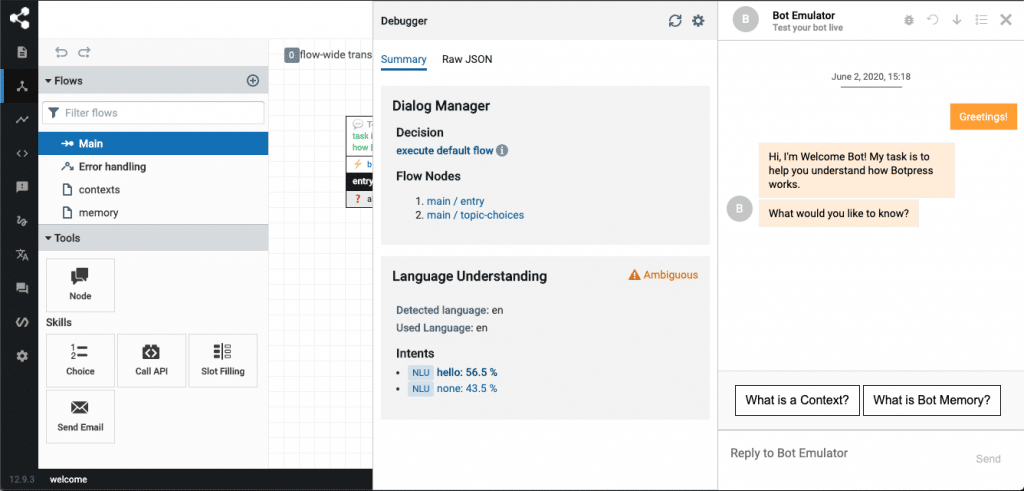
Botpress used to be described as “WordPress for bots” — open-source, free, with a thriving plugin ecosystem. That description is outdated. Botpress has repositioned itself as an LLM-native agent platform: its Autonomous Node lets an agent reason through multi-step tasks rather than follow a fixed flow, and it’s model-agnostic, with support for OpenAI, Claude, and Gemini rather than locking you into one provider.
Besides this, just as WordPress democratized web development services for the masses, Botpress is set to do the same for chatbot creation. While it’s one of the more rigorous frameworks, its detailed documentation and strong community support make it approachable for new builders.
Use Cases: Chatbot development, customer support automation, internal helpdesk bots, conversational AI for websites and apps.
Ideal For: Teams that want an LLM-native agent builder without being locked into a single model provider.
Pricing: Free pay-as-you-go tier; paid plans start at $89/month. See Botpress’s pricing page for current rates.
| PROS | CONS |
|---|---|
| LLM-native agent platform (Autonomous Node) | Steep learning curve for advanced use |
| Model-agnostic: OpenAI, Claude, Gemini | Can get complex as you add integrations |
| Native JavaScript support | |
| No-code environment for bot management |
#6: Rasa — Developer Framework

Rasa‘s traditional strength is its NLU: trainable models that let a bot look for the right answer in its own database without heavy manual scripting. That’s still core to the platform — but Rasa’s current engine, CALM (Conversational AI with Language Models), layers an LLM on top of that NLU foundation. The result is a hybrid: predictable, rule-governed behavior for the paths you want locked down, and generative flexibility for everything else, without giving up the auditability that made Rasa popular with regulated industries in the first place.
Use Cases: Real-time voice assistants, IT helpdesk bots, Help Desk Software, contact center automation, lead generation and sales assistants.
Ideal For: Support bots that need both deep understanding of customer queries and predictable, auditable behavior.
Pricing: Free for developers and teams starting an AI assistant project; Growth and Enterprise subscription tiers available. See Rasa’s pricing page for current rates.
| PROS | CONS |
|---|---|
| CALM: hybrid NLU + LLM engine | Not the simplest option for beginners |
| Personalized, auditable bot responses | NLU/LLM concepts required to get the most out of it |
| Deploy on your own servers (stronger data control) | |
| Multiple development environments |
#7: Pandorabots — No-Code / Developer Hybrid

Pandorabots is the most distinctive framework on this list. It offers the standard features you’d expect from a chatbot development framework but takes a different approach: it uses a purpose-built AI markup language (AIML) to build virtual agents that behave like real humans, and pairs well with 3D modeling for a genuinely lifelike result.
Use Cases: AI-driven virtual agents, customer support automation, educational bots, 3D avatar-based assistants.
Ideal For: Interactive chatbot models and avatar-based business solutions.
Pricing: Free plan with limited capabilities; paid tiers start at $19/month. You can view the plans here.
| PROS | CONS |
|---|---|
| Integrates with all major messaging platforms | Not suited for IoT |
| Third-party app integration | Pricier than several alternatives here |
| API access | AIML only works with Pandorabots |
#8: IBM Watson — Cloud Platform

IBM Watson is one of the most established AI development frameworks, used by large enterprises for complex projects, with high standards for security and data storage. Its ML engine interprets user queries and generates custom responses automatically, and chatbots built on Watson can deploy into virtually any third-party app, messaging platform, or device.
Use Cases: Customer support automation, enterprise virtual assistants, conversational AI for apps, voice-enabled services.
Ideal For: AI-powered chatbots that need advanced natural language understanding and enterprise-level scalability.
Pricing: Free Lite plan with limited usage; paid plans start at $140/month. You can check out the plans here.
| PROS | CONS |
|---|---|
| Rigorous, enterprise-grade platform | Tough learning curve |
| Advanced ML engine | Fewer tutorials available online |
| Private-cloud-only data storage option | Expensive relative to alternatives |
| Automated sentiment interpretation |
2026 Evaluation Criteria: What to Check Regardless of Which Framework You Pick
Whichever framework you land on, current industry guidance points to the same handful of capabilities as the baseline for evaluating any chatbot or agent tool in 2026:
- RAG as a baseline: The ability to ground responses in your own documents or data, not just the model’s training data
- Guardrails and hallucination control: Mechanisms to keep the bot from confidently making things up, especially on anything customer-facing
- Agent orchestration: Support for chaining steps, calling tools, and — increasingly — coordinating multiple agents on a single task
- Proactive, not just reactive, conversation: The ability to initiate a relevant message rather than only responding to what a user types
- Observability: logging, tracing, and monitoring of what the bot actually did, so you can debug and improve it after launch, not just at demo time
Choosing the Right Framework for Your Use Case
With so many chatbot frameworks available, the right pick depends on your goals, technical resources, and deployment environment. Here’s a side-by-side summary:

The Real Cost of a Chatbot: Beyond the Framework’s Price Tag
A framework’s sticker price is only part of the budget. Industry estimates for a mid-sized custom chatbot or agent deployment typically break down into three buckets beyond the framework license itself:
- Developer salaries: roughly $80K–$150K per year per developer, depending on seniority and whether the work is in-house or outsourced.
- Hosting and infrastructure: roughly $6K–$60K per year, depending on traffic volume and whether you’re running on a managed cloud platform or self-hosting.
- Compliance and security: roughly $70K–$120K per year for regulated industries (healthcare, finance) that need audits, data handling review, and ongoing compliance work.
Altogether, a realistic year-one budget for a mid-sized custom deployment often lands somewhere in the $150K–$300K range — well above what any single framework’s pricing page suggests on its own. These are general planning figures, not a quote: your actual cost depends heavily on scope, industry, and whether you build in-house or work with a development partner. If you want a number specific to your project, that’s exactly the kind of scoping conversation an AI consulting team can walk through with you.
AI Agent Frameworks: The Future of Scalable Bots
If there’s one thing we’re sure of, it’s that AI agents are the direction chatbot development is heading.
As more companies move from single-turn chatbots to multi-step agents, orchestration frameworks like LangChain (paired with LangGraph for stateful workflows), CrewAI, and Microsoft Agent Framework have become the tools teams reach for to manage memory, chain tool calls, and coordinate multiple agents working on the same task.
Open-source large language models such as Mistral and Llama are also playing a growing role here — letting developers build private, self-hosted agents without depending on a single proprietary API. That gives teams more control, more transparency, and more room to customize, which matters more every year as competition in this space increases.
Even the traditional chatbot frameworks covered above are adapting to this shift. Rasa’s CALM, Botpress’s Autonomous Node, and Dialogflow’s Playbooks are all evidence that the line between “chatbot framework” and “agent framework” is already blurring — and we expect that trend to continue as multi-agent orchestration, tool use, and memory-enhanced conversation become standard rather than cutting-edge. For businesses that want to move on this now, Scopic’s custom AI agent development services can help turn these capabilities into a real, scalable solution.
Recap: Three Questions to Narrow Your Choice
With so many frameworks out there, three questions can quickly narrow your options:
- Your people — Do you have in-house developers, and what languages do they know? A powerful framework outside your team’s skill set often costs more in ramp-up time than a simpler tool they already use.
- Your timeline — Need to launch fast? No-code or cloud platforms get you there quicker than a self-hosted framework, though usually with less flexibility.
- Your data requirements — Regulated industry or compliance needs? That alone can rule out several options before you compare features.
Answer these three, and you’ll likely be down to one or two realistic choices instead of eight.
At Scopic, we help businesses choose the right chatbot framework for their specific needs — not just the most popular one. Contact us for a free quote on our AI chatbot development services.
FAQs about Chatbot Development Frameworks
What is the best chatbot framework for AI use?
The best AI chatbot framework depends on your goals, but Dialogflow, Rasa, and IBM Watson remain top choices thanks to their natural language understanding, scalability, and integration capabilities, especially when implemented with the support of AI integration consulting.
What is the difference between a chatbot and a chatbot framework?
A chatbot is the end-user application that interacts with people, while a chatbot framework is the set of tools and infrastructure used to build, deploy, and manage that chatbot.
Can chatbot frameworks integrate with GPT and other LLMs?
Yes. Most modern chatbot frameworks can integrate with GPT, Claude, Gemini, and other LLMs to enhance conversational ability, enabling more natural, context-aware interactions through API-based integrations.
Which chatbot frameworks are open-source?
Popular open-source chatbot frameworks include Rasa, Botpress, and ChatterBot.
Are chatbot frameworks like these still relevant now that LLMs exist?
Yes, the frameworks haven’t been made obsolete, they’ve been rebuilt. Every established framework on this list now has an LLM layer of some kind (Rasa’s CALM, Botpress’s Autonomous Node, Dialogflow’s Playbooks), which means the underlying decision still matters just as much as it did before LLMs arrived. What’s changed is that you’re no longer choosing between “NLU” and “LLM”; you’re choosing how much of each a given framework blends, and how well it lets you control that mix.

About Chatbot Development Frameworks Guide
This guide was authored by Maksim Lezginov and updated by Baily Ramsey.
Scopic provides quality and informative content, powered by our deep-rooted expertise in software development. Our team of content writers and experts have great knowledge in the latest software technologies, allowing them to break down even the most complex topics in the field. They also know how to tackle topics from a wide range of industries, capture their essence, and deliver valuable content across all digital platforms.