Table of Contents
API integration cost depends on more than connecting two systems. A realistic budget needs to account for API documentation quality, authentication, data mapping, sync logic, error handling, testing, security, and ongoing monitoring.
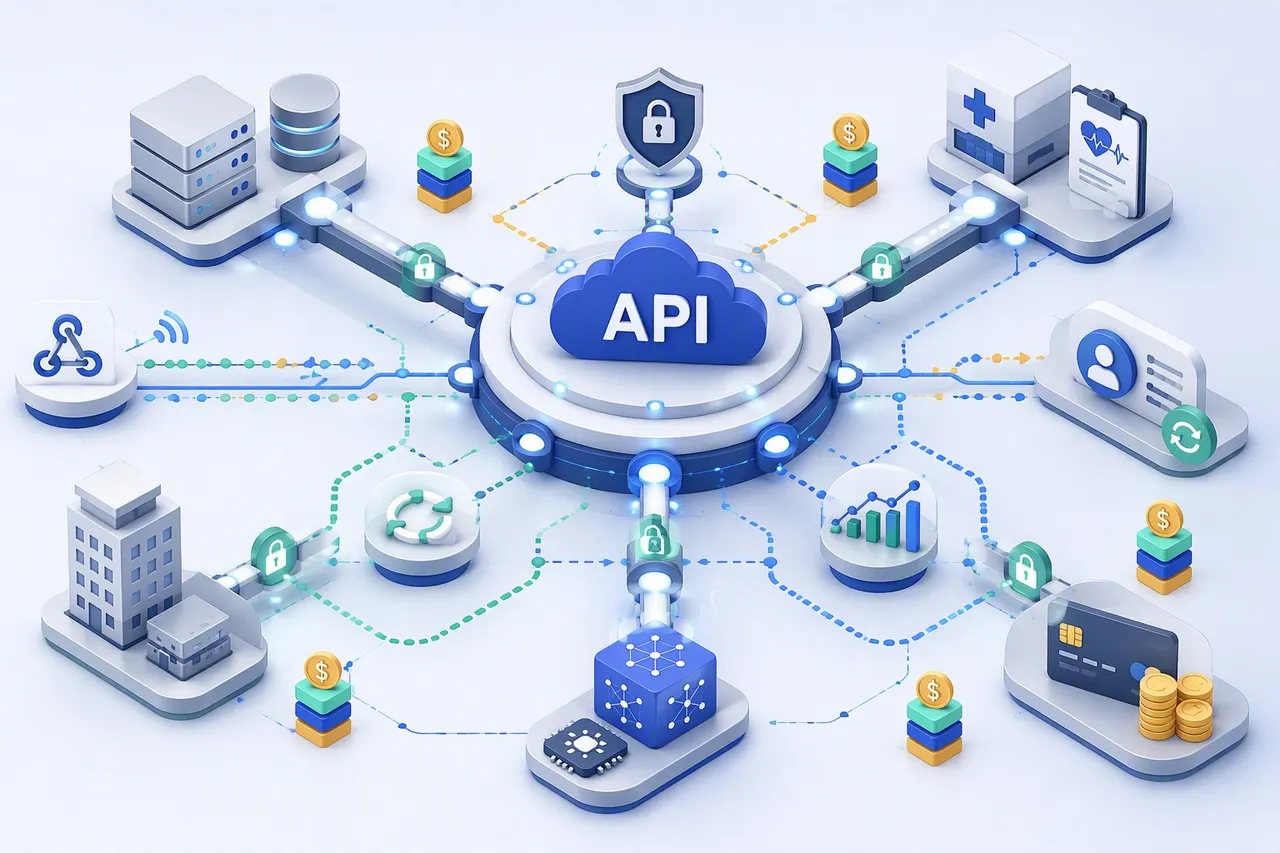
AWS describes an API as a contract of service between applications, but the cost of implementing that contract depends on how cleanly the systems communicate. A simple one-way integration with a well-documented API may be relatively straightforward, while a regulated, bidirectional, or real-time integration can require significantly more engineering.
This guide breaks down API integration cost by complexity level, use case, security requirements, data mapping, webhooks, rate limits, hidden costs, and long-term maintenance. It also explains how API integration differs from API development cost and when custom API integration pricing increases.
Key Takeaways
- API integration cost depends more on workflow complexity, data mapping, authentication, testing, and maintenance than the number of endpoints alone.
- Poor documentation, limited sandbox access, unclear data models, and weak error handling can significantly increase third-party API integration cost.
- Payment, healthcare, AI, CRM, marketplace, and enterprise integrations have different cost profiles because each one has different security, compliance, sync, and testing requirements.
- Bidirectional sync, webhooks, rate-limit handling, conflict resolution, and retry logic increase custom API integration pricing.
- A structured scoping checklist helps teams estimate effort early and reduce budget risk before development starts.
API Integration Cost by Complexity Level
To estimate API integration cost, it helps to group projects by scope rather than by a generic difficulty label. Some integrations are limited to a one-way data flow and a few fields, while others require real-time sync, compliance controls, and custom business logic. These planning ranges are directional estimates, not fixed quotes.
| Integration Type | Typical Scope | Estimated Cost Range | Main Cost Drivers |
|---|---|---|---|
| Basic API integration | One-way sync, one system, simple authentication, limited fields | $2,000–$10,000 | Documentation quality, authentication, simple data mapping. |
| Standard API integration | Two-way sync, CRM/payment/ecommerce integration, standard data mapping | $10,000–$30,000 | Data transformation, rate limits, testing, webhook handling. |
| Advanced API integration | Real-time sync, custom workflows, multiple endpoints, complex business rules | $30,000–$75,000+ | Webhooks, queues, retries, conflict resolution, custom logic. |
| Enterprise or regulated API integration | Healthcare, fintech, EHR, legacy systems, multi-system integrations | $75,000–$250,000+ | Compliance, audit logs, encryption, legacy systems, security testing. |
| Custom API development | New API built from scratch for internal or external use | $20,000–$150,000+ | API design, database logic, authentication, documentation, testing, maintenance. |
These ranges are directional planning estimates. Actual API integration cost depends on API maturity, documentation quality, authentication, data complexity, compliance, traffic volume, testing requirements, and long-term support needs.
API Integration Cost vs API Development Cost
API integration and API development solve different problems. Integration connects existing systems or third-party services so data can move between them. That usually means working with an established API, mapping fields, handling authentication, and managing sync logic and errors.
Custom API development starts earlier in the process. Instead of connecting to an existing interface, the team designs a new API from scratch, including the data model, endpoints, access rules, documentation, and testing strategy. That is why API development cost is often higher: the interface itself has to be planned, built, secured, and maintained.
| Category | API Integration | API Development |
|---|---|---|
| Goal | Connect existing systems or third-party services | Build a new API from scratch |
| Main work | Authentication, data mapping, sync logic, error handling, testing | API design, database logic, endpoints, documentation, access rules |
| Typical cost profile | Usually lower if the API is mature and well documented | Usually higher because the interface must be designed and built |
| Main risks | Poor documentation, rate limits, data mismatch, vendor changes | Scope creep, security design, scalability, documentation, maintenance |
| Best fit | Connecting CRM, payment, EHR, marketplace, AI, or SaaS tools | Creating proprietary APIs for internal systems, partners, or external developers |
What Drives Third-Party API Integration Cost?
The first factor is API maturity and documentation quality. A stable API with complete reference docs, examples, and clear field definitions usually takes less time to integrate. In contrast, an API with unclear behavior, missing examples, or outdated documentation often increases implementation time because developers must test assumptions and verify edge cases manually. This is one reason custom application development planning should begin with API discovery rather than code estimates.
Sandbox availability also matters. A realistic test environment helps teams validate authentication, payloads, and error handling before production launch. When no sandbox exists, developers may have to rely on mocks or limited live testing, which increases risk and can slow delivery.
Authentication method is another major driver. Simple API keys are usually easier to implement than OAuth flows, token refresh logic, or signed request schemes. More advanced authorization setups can require extra engineering around session handling, token expiry, and access control.
Endpoint and data model complexity affect effort as well. The more fields, nested objects, and business rules involved, the more time it takes to map source data to destination systems accurately. Complex transformations often require validation layers, formatting rules, and custom middleware.
Rate limits and pagination can add hidden work. Teams may need to batch requests, throttle traffic, or build backoff logic to stay within vendor limits. Large datasets can also require pagination handling so records are processed reliably without missing updates.
Webhook support can reduce polling overhead, but it introduces its own implementation demands. Developers need to verify event delivery, handle duplicates, and process messages in the right order when the vendor does not guarantee sequencing.
Error handling and retry logic are essential for stable integrations. Failures can happen because of network issues, invalid payloads, timeouts, or temporary vendor downtime. The more resilient the integration needs to be, the more logic the team must build for retries, logging, and alerts.
Finally, vendor reliability and version changes can affect cost over time. APIs evolve, fields are deprecated, and authentication policies change. Teams should plan for maintenance work so the integration does not break when the vendor updates its platform.
A well-documented API with stable endpoints, clear authentication, and a reliable sandbox usually costs less to integrate than a poorly documented API that requires trial-and-error testing.
Authentication, Security, and Compliance Requirements
Security requirements can significantly affect API integration cost because they add design, testing, and review work. According to the OWASP API Security Top 10 2023, Broken Object Level Authorization is the top API security risk, which is why access control, token validation, and object-level permission checks should be treated as core integration requirements.
Developers usually need to implement role-based access controls, secure token handling, webhook signature verification, and encryption in transit. If sensitive data is involved, logging and access review practices may also need to be tightened so security teams can trace activity without exposing protected information.
Payment integrations may require PCI-related controls depending on how payment data is handled, stored, or redirected through the system. Some payment integrations have limited compliance scope because a processor or hosted checkout page handles sensitive data, while others require much more oversight if the application touches cardholder data directly.
Healthcare and EHR integrations may require HIPAA-related security and audit controls. The data standard can also vary by system, so teams should verify whether they are working with HL7, FHIR, proprietary vendor formats, or a mix of these. That is why EHR software development projects often require more planning than a simple system-to-system sync.
Data Transformation, Mapping, and Validation
Data mapping often takes more effort than the connection itself. APIs rarely store information in the exact same structure, so teams have to transform fields, normalize formats, and validate records before sending them to another system. Even a small mismatch in required fields or date formats can cause failed transactions or incomplete records.
For example, a CRM may store a customer as one contact record, while an ERP or billing system may split the same customer into account, billing profile, tax profile, and subscription records. Mapping these structures correctly can take more effort than the API connection itself.
Validation is also important because integrations rarely move data in a perfect state. Duplicate records, incomplete fields, invalid formats, and conflicting business rules can all create downstream errors. The more systems involved, the more careful the mapping and validation logic needs to be.
Webhooks, Rate Limits, and Bidirectional Sync
Real-time, bidirectional synchronization increases third-party API integration cost because developers must handle webhook events, retries, duplicate events, pagination, and conflict resolution. Stripe recommends processing webhook events asynchronously and returning a successful response quickly before running complex logic, which is a useful example of why webhook architecture needs careful planning.
Developers may also need queues, idempotency checks, monitoring, alerting, and replay tools to keep data consistent when one system is temporarily unavailable. If the integration is expected to work at scale, the team may also need to think about load patterns, delayed jobs, and recovery procedures so data does not drift across systems.
API Integration Cost Examples by Use Case
Different use cases create different cost profiles because the workflow, security requirements, and testing burden are not the same. A simple sync between a SaaS integration and a CRM is usually easier than a regulated healthcare workflow or a marketplace that moves data across multiple parties. That is why estimating by use case is more useful than relying on a generic integration label.
| API Type | Common Use Case | Typical Complexity | Estimated Cost Range | Main Cost Factors |
|---|---|---|---|---|
| Payment API | Checkout, subscriptions, refunds, marketplace payouts | Standard to advanced | $5,000–$40,000+ | Webhooks, tokenization, PCI scope, subscriptions, split payments. |
| CRM API | Lead sync, contact updates, sales pipeline automation | Basic to standard | $3,000–$25,000+ | Field mapping, deduplication, sync direction, rate limits. |
| EHR API | Patient records, scheduling, clinical data exchange | Advanced to enterprise | $30,000–$150,000+ | HIPAA, audit logs, HL7/FHIR, legacy system constraints, testing. |
| Marketplace API | Vendor onboarding, payouts, booking, messaging, inventory | Advanced | $25,000–$100,000+ | Multi-party workflows, payment flows, permissions, notifications. |
| AI API integration | Text generation, recommendations, summarization, support automation | Standard to advanced | $10,000–$75,000+ | Prompt flow, token usage, model fallback, evaluation, monitoring. |
| Enterprise/legacy API | ERP, logistics, finance, internal systems | Advanced to enterprise | $40,000–$250,000+ | Legacy systems, middleware, custom security, data transformation. |
These examples show why API integration cost should be scoped by workflow, not by API category alone. A simple payment integration may be less expensive than a custom marketplace payout flow, while an EHR integration can become costly when legacy systems, compliance, and complex data mapping are involved.
If your product includes specialized AI functionality, custom AI integration services can help define the architecture, model flow, and operational requirements before implementation begins. Likewise, a marketplace development project often needs more than a single API connection because it must coordinate onboarding, payments, messaging, and transaction states across multiple users.
Scopic Case Study: StreamerQue API Integration Example
StreamerQue is a relevant example of how API integrations shape real product functionality. Scopic developed the platform with Stripe Connect for secure payment processing and WebSockets for real-time messaging, allowing streamers and fans to manage bookings, payments, availability, and communication in one connected system.
This type of project shows why API integration cost depends on more than simply connecting to a payment provider. Marketplace-style products often need onboarding flows, payout logic, booking states, real-time notifications, error handling, and user-facing communication features. Each layer adds implementation, testing, and maintenance effort.
Hidden and Ongoing API Integration Costs
The visible build effort is only part of the budget. Third-party APIs can introduce subscription fees, vendor usage charges, or transaction-based pricing that continues after launch. On the infrastructure side, high-volume APIs can also create usage-based costs. AWS API Gateway, for example, uses request-based pricing for REST, HTTP, and WebSocket APIs, which means traffic volume can affect monthly operating cost.
Teams should also budget for monitoring and logging, alerting, failed job handling, retries, replay tools, and version updates. Security reviews may be needed when vendors change authentication methods or when new data flows are introduced. Long-term developer support is another real cost because integrations often require maintenance when upstream APIs change behavior or deprecate fields.
How to Reduce API Integration Cost Without Creating Risk
The best way to control API integration cost is to reduce uncertainty before development begins. Start by choosing well-documented APIs with stable endpoints and, when possible, confirm that a sandbox environment is available for testing. The more complete the reference materials and test tools, the less time the team usually spends on trial-and-error debugging.
Define the data fields and ownership rules early so the integration team knows exactly what must move between systems. Whenever possible, begin with one-way sync before adding bidirectional logic, and avoid real-time requirements unless the product truly depends on them. Real-time sync is useful in some cases, but it usually raises implementation and support effort.
Authentication and compliance decisions should also be addressed during scoping rather than after development starts. That includes deciding how tokens will be handled, whether any regulated data is involved, and what security checks are required before launch. Testing should include edge cases, duplicate events, missing records, and temporary vendor failures so issues are caught before go-live.
After launch, monitor failures and ownership boundaries closely. Document who maintains the integration, who responds to alerts, and how the team will handle vendor changes or broken jobs. Clear maintenance planning can reduce risk without increasing unnecessary scope.
API Integration Scoping Checklist
Before estimating API integration cost, confirm:
- Which systems need to be connected?
- Is the API public, partner-only, private, or custom?
- Is documentation complete and up to date?
- Is there a sandbox or test environment?
- What authentication method is required?
- Is the sync one-way, two-way, batch, or real-time?
- Which fields and records need to move between systems?
- Are webhooks available?
- What rate limits, pagination rules, and payload limits apply?
- What error handling, retry, and alerting logic is needed?
- Are there compliance requirements such as HIPAA, PCI, SOC 2, or internal security rules?
- Who owns maintenance after launch?
API Integration Cost: Practical Recommendation
The safest way to estimate API integration cost is to scope the workflow first, then price the engineering work around authentication, data mapping, sync direction, testing, security, and long-term maintenance. Do not estimate based only on the number of endpoints or the vendor’s API availability.
For simple use cases, a one-way integration with a mature API may be enough. For regulated systems, marketplaces, AI workflows, or real-time product features, budget for additional architecture, QA, monitoring, and support.
Need help estimating API integration cost?
Scopic can help evaluate your API complexity, data flow, security requirements, integration architecture, and long-term maintenance needs before development starts. Discuss your API integration project by contacting our professionals.
Conclusion
API integration cost depends on system complexity, data movement, authentication, security, testing, traffic volume, and long-term maintenance. A simple one-way integration with a mature API may cost a few thousand dollars, while regulated, real-time, marketplace, AI, or enterprise integrations can require a much larger engineering investment.
The most reliable way to plan the budget is to define the workflow, map the data, verify security and compliance requirements, test the API early, and account for post-launch monitoring and support. For products that depend on payments, messaging, AI, healthcare data, logistics, CRM, or internal business systems, integration architecture can directly affect reliability and user experience.
If you are estimating API integration cost for a software product, Scopic can help assess API complexity, data flow, security requirements, integration architecture, and long-term maintenance before development starts. Discuss your API integration project with our team.
FAQ
How much does API integration cost?
API integration cost can range from a few thousand dollars for a simple one-way connection to well over six figures for regulated, real-time, or multi-system projects. The final budget depends on documentation quality, authentication, data mapping, testing, security, and maintenance requirements.
What affects third-party API integration cost?
Third-party API integration cost is affected by API maturity, sandbox access, authentication method, endpoint complexity, rate limits, webhook support, error handling, vendor reliability, and the amount of data that must move between systems.
Is API integration cheaper than custom API development?
In many cases, yes. Integrating an existing API is often less expensive than building a new API from scratch because the core interface already exists. That said, a difficult integration with poor documentation, strict compliance needs, or complex workflows can move closer to the cost of custom development.
How much does payment API integration cost?
Payment API integration cost depends on the payment flow. A simple checkout integration may fall in the lower planning range, while subscriptions, refunds, marketplace payouts, or split payments usually require more engineering and testing. Costs should be treated as estimates, not guarantees.
Why is EHR API integration more expensive than standard API integration?
EHR API integration is often more expensive because healthcare workflows usually involve stronger security controls, audit requirements, and more complex data exchange. Teams also need to confirm the vendor’s data format, system constraints, and testing requirements before estimating the work.
What are hidden API integration costs?
Hidden API integration costs can include vendor usage fees, infrastructure charges, logging, monitoring, alerting, retries, replay tools, failed job handling, version updates, security reviews, and long-term developer support.
How can companies reduce API integration cost?
Companies can reduce API integration cost by choosing well-documented APIs, confirming sandbox access, defining fields early, starting with one-way sync, avoiding unnecessary real-time requirements, testing edge cases, and planning maintenance ownership before launch.
When should a company build a custom API instead of integrating an existing one?
A company should consider custom API development when it needs proprietary workflows, unique access rules, specialized data structures, or a new interface for internal systems or external developers. If the goal is only to connect existing tools, API integration is usually the better starting point.
This guide was written by Scopic Team
Scopic provides quality and informative content, powered by our deep-rooted expertise in software development. Our team of content writers and experts have great knowledge in the latest software technologies, allowing them to break down even the most complex topics in the field. They also know how to tackle topics from a wide range of industries, capture their essence, and deliver valuable content across all digital platforms.