Table of Contents
Listen to article
Most companies have already adopted AI. Far fewer have anything to show for it.
That gap is not a technology problem. The tools are available to everyone at the same price and the same starting line.
The dividing line isn’t which tools a company owns; it’s how effectively it puts them to work. That’s AI maturity, and it’s what separates real returns from a pilot that never left the lab.
In this article, we’ll cover what an AI maturity model actually measures, the four stages most companies climb through on the way to real returns, the major published frameworks, and how to pinpoint exactly where your own business stands today.
What Is an AI Maturity Model?
An AI maturity model is a framework for measuring how far an organization has progressed in using AI effectively. Instead of asking “are we using AI,” it asks a more useful question: “how well are we using it, and what has to be true for us to use it better.”
AI maturity builds in stages, each stage depends on the one before it, and skipping ahead rarely works. This is also why so many companies bring in outside AI consulting services at exactly this point, not to run the AI itself, but to get an outside, structured read on which stage they are actually in before committing to the next one.
AI Maturity vs. AI Readiness: What’s the Difference
The two terms are used interchangeably, but they answer different questions:
- AI readiness asks whether your organization is prepared to begin using AI, looking at things like data quality, infrastructure, and leadership buy-in.
- AI maturity asks how far you have actually progressed once you started. A company can be highly ready and still immature if it has clean data and executive support but has never moved past isolated pilots.

Where AI Maturity Models Come From
Maturity modeling did not start with AI. It borrows a structure that has existed in software engineering for decades, most notably the Capability Maturity Model, developed at Carnegie Mellon’s Software Engineering Institute to help organizations assess and improve their software development processes.
That same logic, that capability builds in predictable, cumulative stages rather than all at once, is what MIT, Gartner, Accenture, and SEI have each adapted for artificial intelligence maturity model development. It is a borrowed idea, but it is a well-tested one.
The Stages of AI Maturity: From Experimentation to Transformation
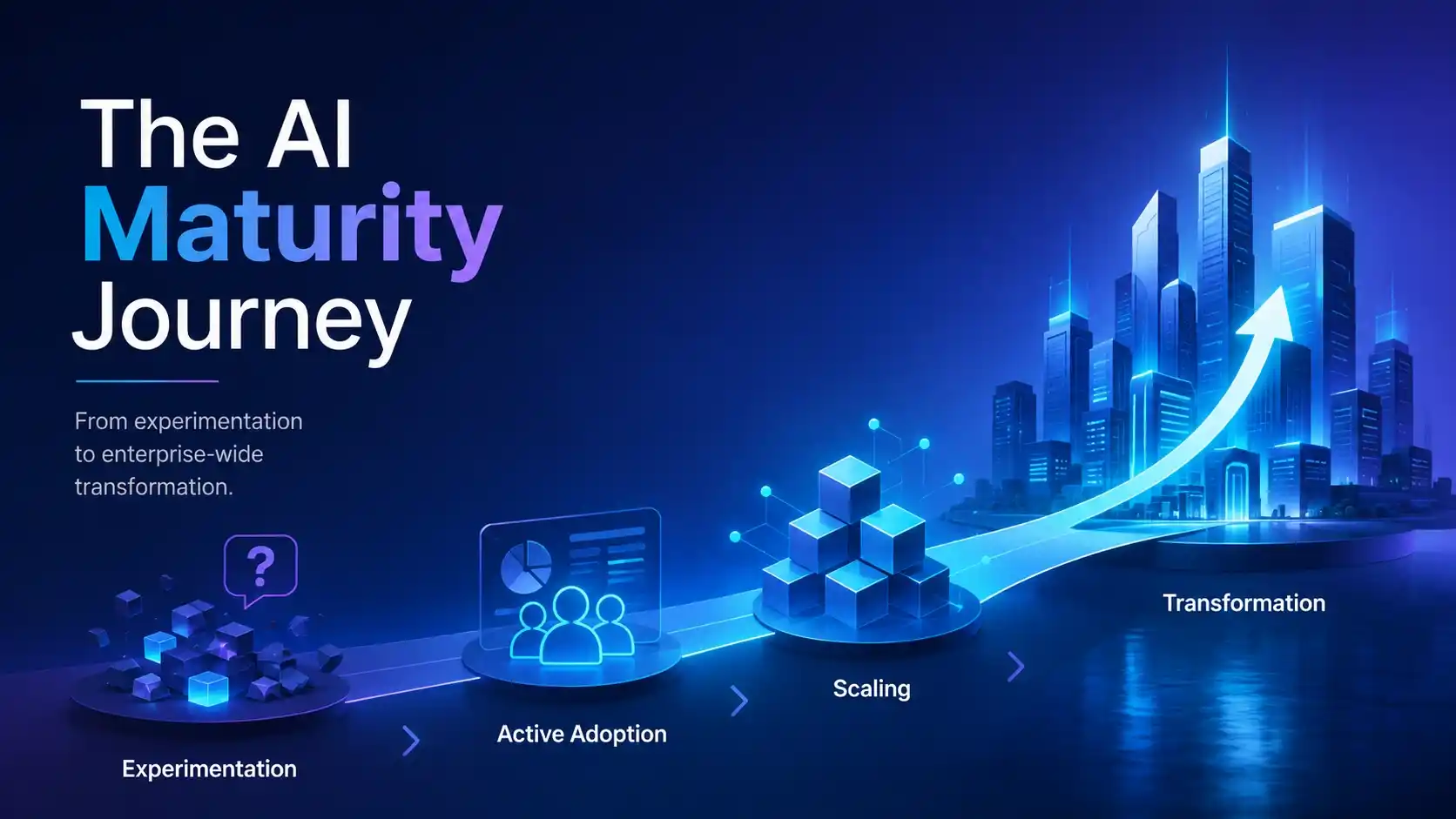
Published frameworks differ on exact stage count and naming. Underneath the differences, though, most describe a similar progression. For simplicity, we’ll use this four-stage version as our framework:
Stage 1: Experimentation
This is where almost every organization starts. Individual employees or scattered teams try AI tools on their own initiative, but they lack:
- Formal strategy, funding, or coordination
- Consistent measurement
- Shared ownership
The common trap at this stage is staying here indefinitely. Companies run pilot after pilot, feel busy, and never commit real budget or a named owner to move past experimentation. This “pilot fatigue” is one of the most common reasons AI investment fails to show up in the numbers. A pilot that never gets realized is not really a step toward maturity but a demo that repeats itself every quarter.
Stage 2: Active Adoption
At this stage, AI initiatives get a dedicated budget and someone accountable for them. Tools are used consistently within specific departments rather than by scattered individuals, and organizations begin making early attempts to measure return on investment. This is usually the first stage where AI shows up as its own line item in a budget conversation, rather than getting absorbed into a general software or innovation spend.
The risk here is that success stays siloed. A sales team gets real value from an AI-assisted workflow, but that win never spreads to adjacent departments, because there is no mechanism for sharing what worked or why. Without a shared process for capturing and repeating what works, each department effectively restarts the experimentation stage on its own.
Stage 3: Scaling
Scaling is where AI initiatives start crossing department lines. Data infrastructure and governance, which were probably informal or nonexistent at previous stages, get formalized enough to support broader use. Leadership begins treating AI as a strategic priority with its own roadmap, rather than a side project owned by whichever team happened to get there first.
Companies at this stage are also the ones most likely to invest in dedicated AI development services to build and integrate the internal tooling that off-the-shelf products cannot cover, since a scaled AI program usually outgrows whatever generic subscription got it started.
Stage 4: Transformation
In the final stage, AI is not bolted onto existing processes; it is embedded in how the company operates and competes. Governance is strong, optimization is continuous, and AI literacy runs through the organization at every level, not just among a handful of specialists.
However, the AI transformation stage is still rare. Most organizations, including well-resourced ones, are still working through Stages 1 and 2. If your company is not there yet, you are not behind some invisible curve; you are in the same place most of the market is.
Companies looking to accelerate that progression, particularly the shift from siloed pilots to a coordinated roadmap, often work with AI consulting companies to formalize the governance and prioritization that later stages require.
Comparing the Major AI Maturity Models
Several organizations have published their own named AI maturity models, and if you have read more than one, you have probably noticed they do not agree on how many stages exist. Some use four, others stretch to seven or eight.
That is not a sign that any single model is wrong. Each was built for a different audience and a different purpose. What matters is picking the framework that matches who is actually going to use the results, not necessarily the one with the most citations. The table below compares five of the most-cited frameworks before we walk through each one.

MIT CISR’s Enterprise AI Maturity Model
MIT CISR’s four-stage model,published in 2024, is grounded in data from 721 companies along with 9 in-depth case studies covering both traditional and generative AI.
What makes it distinct among the frameworks here is that it is validated against financial performance rather than just descriptive of technical sophistication: MIT CISR found that organizations in the first two stages (Experiment and Prepare and Build Pilots and Capabilities) had financial performance below their industry average, while those in the final two stages (Industrialize and Become AI Future Ready) performed above it.
Only 7% of the surveyed companies had reached that top, future-ready stage, and roughly a third sat in the Build Pilots and Capabilities stage, which tracks closely with what we describe as Stage 2 above.
Suitable for: If your audience is a CFO or board that wants maturity tied to something they already track (revenue, margin, or growth relative to peers), this is the model built for that conversation.
Gartner’s AI Maturity Model
Gartner’s version maps a five-level progression, from Awareness, where conversations happen but nothing is funded yet, through Active and Operational, where pilots move into at least one live workflow, up to Systemic and finally Transformational, where AI is reshaping the business model itself rather than optimizing a single process.
Unlike MIT’s freely published research briefing, Gartner’s model lives inside a paid research toolkit aimed primarily at CIOs and enterprise IT leadership building out AI investment roadmaps.
Suitable for: It is a solid framework if your organization already works within Gartner’s broader research ecosystem and wants its AI maturity conversation to plug directly into existing IT planning cycles.
The SEI/Accenture AI Adoption Maturity Model
Released in June 2026 by Carnegie Mellon’s Software Engineering Institute and Accenture, this is the newest framework on the list and one built specifically to address a gap the other models leave open.
According to the SEI, the two organizations reviewed more than 100 existing AI maturity efforts, interviewed roughly two dozen executives, and surveyed close to 600 practitioners before building what they call an empirically validated AI adoption maturity model.
It evaluates organizations across eight dimensions, including:
- Organizational strategy
- Workflow re-engineering
- Workforce and culture
- Risk and governance
- Data
- Engineering
- Operations
- Ecosystem
The framework has a deliberate emphasis on the engineering discipline needed to scale AI safely, not just the strategy slide that usually gets the attention.
Suitable for: This is the framework to reach for if your organization is past the pilot stage and needs to prove AI can scale safely, particularly if engineering, risk, or platform teams are the ones being asked to sign off, not just leadership.
The framing behind the launch was blunt: despite rising investment, the SEI reported that the large majority of organizations are seeing no measurable returns from their AI spending so far. Because this framework is so new, figures tied to it are worth pulling directly from the SEI’s own release rather than secondary coverage, which has already started to diverge in the details.
OWASP’s AI Maturity Assessment (AIMA)
OWASP’s framework is free, open-source, and, unsurprisingly given OWASP’s roots, weighted heavily toward security and governance. It spans five core domains, Strategy, Design, Implementation, Operations, and Governance, with each domain scored across its own maturity levels.
Suitable for: This is the framework to reach for if your team’s biggest AI maturity question is being asked by compliance or security, not by the CFO. It fits naturally alongside broader AI capability maturity model work that security and platform teams already run for other systems.
Note: No single model here is the “correct” one. A ten-person startup evaluating its first AI pilot and a regulated bank scaling AI across a dozen business units are not solving the same problem, and they should not be judged against the same framework.
Why AI Maturity Matters for Business Performance
The clearest evidence for why maturity matters comes from MIT CISR’s own research: financial performance improves at each successive stage of the model, with the clearest split falling between the bottom two stages and the top two. Enterprises in the top half of the model outperformed their industry peers; enterprises in the bottom half trailed them
The broader investment-versus-returns gap shows up well beyond this one framework. Even as AI spending climbs, returns are proving slow to materialize and hard to measure across industries, which lines up with what the four-stage model would predict: most organizations are still working through the earlier, less coordinated stages rather than the later ones where returns compound.
Knowing exactly where your organization sits is the first, and arguably the only honest, step to closing that gap, which is often where AI strategy consulting comes in, turning that knowledge into a sequenced roadmap instead of another isolated initiative.
How to Assess Your Company’s AI Maturity Level
Most leadership teams significantly over- or underestimate their own stage when they judge it informally in a meeting.
A structured, dimension-based AI maturity assessment gives a far more reliable answer, mostly because it forces you to score the parts of the business that do not come up naturally in conversation, like data governance or vendor risk.

The Dimensions Worth Evaluating
A useful assessment looks at more than just how many AI tools are in use. At minimum, it should score:
- Strategy alignment: Do AI initiatives connect to specific business goals, or are they disconnected experiments?
- Data infrastructure: Is data clean, accessible, and governed well enough to support AI at scale?
- Talent and skills: Does the team have the AI literacy needed to build on and maintain what gets deployed?
- Governance: Are there real policies covering risk, ethics, and oversight, or informal habits that would not survive an audit?
- Technology stack: Is the underlying architecture built to scale AI use cases, or was it assembled ad hoc?
Note: This is just a rough starting point, not a full checklist. Weighing each dimension properly and mapping it to an actual stage takes more structure than a bullet list can offer.
Take Scopic’s Free AI Maturity Assessment
Reading about the stages is useful context, but it will not tell you exactly where your organization stands today. Guessing informally, or debating it in a leadership meeting, tends to produce answers that are more optimistic than the data supports.
The faster and more objective route is a structured assessment built for exactly this question. Scopic’s free AI Assessment takes about five minutes, requires no sign-up, and returns a maturity score, a benchmark against your peers, and a personalized roadmap for what to prioritize next.
FAQ
What are the 4 stages of AI maturity?
Most simplified frameworks describe a progression from Experimentation, ad hoc pilots with no formal ownership, to Active Adoption, dedicated budget and departmental use, to Scaling, cross-department initiatives with formal governance, and finally Transformation, where AI is embedded in how the company operates.
Other published models use different stage counts, ranging from four up to eight, but they describe a similar underlying climb.
What is an AI maturity assessment?
An AI maturity assessment is a structured evaluation of an organization’s AI capabilities across dimensions like strategy, data, talent, and governance. It is used to identify a company’s current stage and its most useful next steps, and it is meaningfully more accurate than an informal, self-judged estimate.
How is AI maturity different from AI readiness?
Readiness measures whether an organization is prepared to begin using AI. Maturity measures how far it has actually progressed since it started. A company can be ready without being mature, and, less commonly, mature in one area while still catching up on readiness in another.
Which AI maturity model should my business use?
No single model is universally “best.” Smaller organizations often do fine with a simple four-stage framework, while enterprises with heavier compliance requirements may get more value from a detailed model like OWASP’s AIMA or the SEI/Accenture AI adoption maturity model.
How do I know what AI maturity level my company is at?
Self-reported answers tend to skew optimistic, especially when a stage gets decided in a single meeting rather than measured against evidence. Scopic’s free AI Assessment replaces that guesswork with a scored, five-minute evaluation you can act on right away.

About Creating the AI Maturity Model Guide
This guide was authored by Vesselina Lezginov and reviewed by Assia Belmokhtar, an SEO Project Manager at Scopic.
Scopic provides quality and informative content, powered by our deep-rooted expertise in software development. Our team of content writers and experts have great knowledge in the latest software technologies, allowing them to break down even the most complex topics in the field. They also know how to tackle topics from a wide range of industries, capture their essence, and deliver valuable content across all digital platforms.